
Evolution of Colored Contact Lens Manufacturing: A Buyer’s Guide to Production Techniques
Early colored contact lenses emerged in the 1980s to meet cosmetic demands, starting with rudimentary surface printing methods that prioritized simplicity over safety. These initial techniques laid the groundwork but exposed critical flaws, driving rapid innovation toward safer, more durable processes like the sandwich method, which remains the gold standard today.
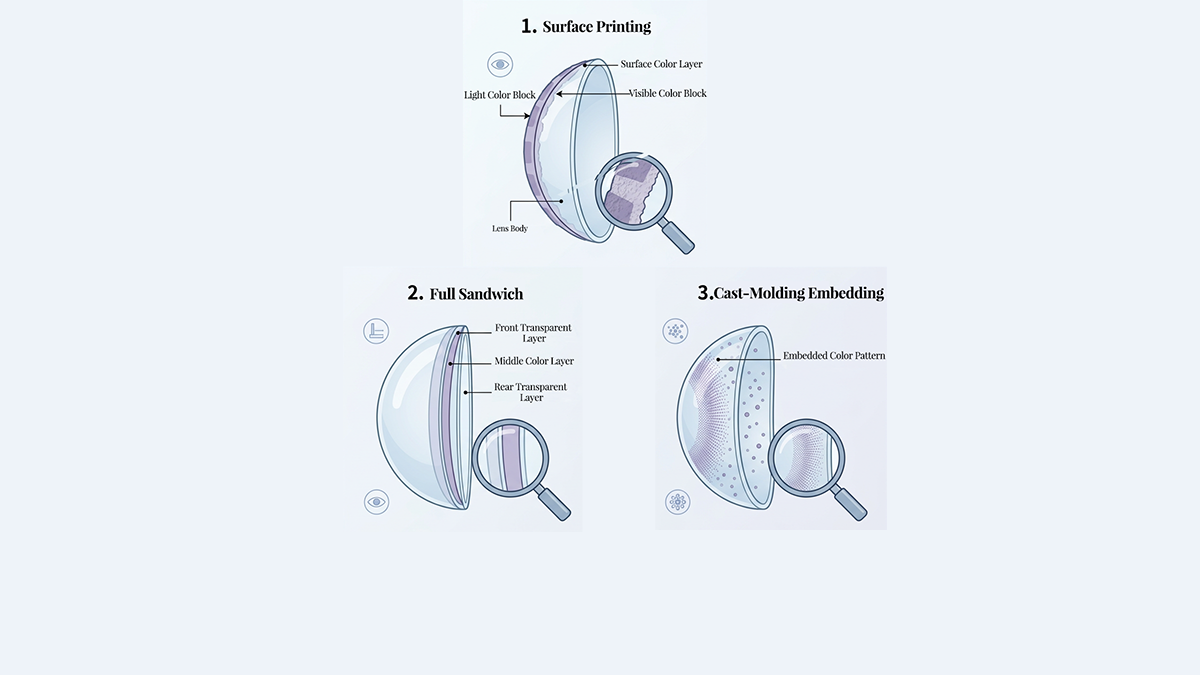
Origins: Surface Printing (1980s)
The first commercial colored contacts used silk-screen or pad printing on soft hydrogel lenses.
In silk-screening, a mesh stencil transferred opaque pigment ink directly onto the lens front surface (10-14mm iris pattern), followed by air-drying or thin protective coating.
Pad printing improved this by using a silicone pad to pick ink from an etched metal cliché and transfer it precisely to the curved surface—faster and more accurate for automation.
Key Drawbacks: Pigment layers (2-5μm thick) wore off during wear/cleaning, risking eye irritation or leaching into tears; uneven adhesion led to high rejection rates.
Transitional: Semi-Embedded Printing (1990s)
Semi-embedded bridged the gap by pad-printing patterns onto concave molds before injecting monomer liquid (e.g., HEMA).
The front mold received the color layer, then the convex mold pressed in liquid hydrogel, partially burying the pigment ~10-20% into the final lens during UV/thermal curing.
Improvements: Better pigment protection than pure surface methods, thinner lenses with decent oxygen permeability.
Limitations: Still partial exposure risk; not fully isolated like later techniques.
Gold Standard: Full Sandwich Process (1990s-Present)
The full sandwich (or “three-layer”) method revolutionized safety by encapsulating color between two transparent hydrogel layers—now the most emphasized technique for buyers.
Detailed Workflow
Base Color Layer: Print a 2-4μm hydrophilic carrier film (monomers + dispersants) onto the female mold’s concave surface.
Pattern Printing: Pad-print opaque pigment ink (biocompatible, non-leaching) onto specific iris zones of the carrier.
Monomer Pour: Inject lens precursor (HEMA/silicone hydrogel) to cover the entire pattern.
Mold Closure: Align male mold, dwell 30-500s for interpenetration, then cure via UV/heat—forming front/rear transparent barriers (20-50μm each).
Demold & Hydrate: Extract lens, hydrate to finalize ~38-60% water content.
Core Advantages
Zero Pigment-Eye Contact: Full encapsulation prevents fading, migration, or corneal irritation—FDA/CE Class III certified, <0.5% adverse events.
Durability & Consistency: Batch-stable colors, suitable for daily/monthly disposables; oxygen transmission >100Dk in silicone variants.
Natural Aesthetics: Refractive index matching creates lifelike iris halos and edge blends.
Scalability: Automated molding yields low defect rates; costs now competitive at 1.5x pad printing.
Buyer Tip: Verify “sandwich” claims via cross-section SEM images or supplier certifications—essential for premium private-label runs.
Modern Evolution: Cast-Molding Embedding (2000s+)
mold-embedded technology: integrates pigments directly into the molding process:
Pre-mix micro-pigments (<5μm) into monomer or coat molds, then high-pressure cast (50-200bar) for seamless fusion during polymerization—no distinct layers.
Safety Edge: Arguably equals or exceeds sandwich via uniform material integration, superior oxygen flow in ultra-thin (<0.08mm) dailies.
Cast-Molding Embedding Vs. Sandwich: No delamination risk, 30% higher throughput; slightly costlier pigments.
Current Market Adoption (2026)
| Process | Safety Level | Market Share (Asia) | Best For | Leading Brands |
| Surface/Pad | Low | <5% (low-end only) | Budget novelties | None |
| Semi-Embedded | Medium | ~10% | Transitional stock | Regional OEMs |
| Full Sandwich | High | 55-70% | Premium dailies/monthlies | J&J, Alcon, Bausch, Constar, Realcon, Iris |
Cast-Molding Embedding | High+ | 25-35% (rising) | Ultra-thin dailies | Acuvue Define |
Sandwich dominates reliable supply chains, but embedding gains for next-gen disposables. For procurement, prioritize sandwich-certified suppliers to balance cost, compliance, and consumer trust—especially as regulations tighten globally. This progression from exposed pigments to fully embedded designs underscores a safety-first industry; savvy buyers focus on verified processes over marketing claims.
What Should You Evaluate Next?
Need to Evaluate This for Your Market?
Tell us about your market, sales channel or purchasing plan, and our team can discuss the next step with you.