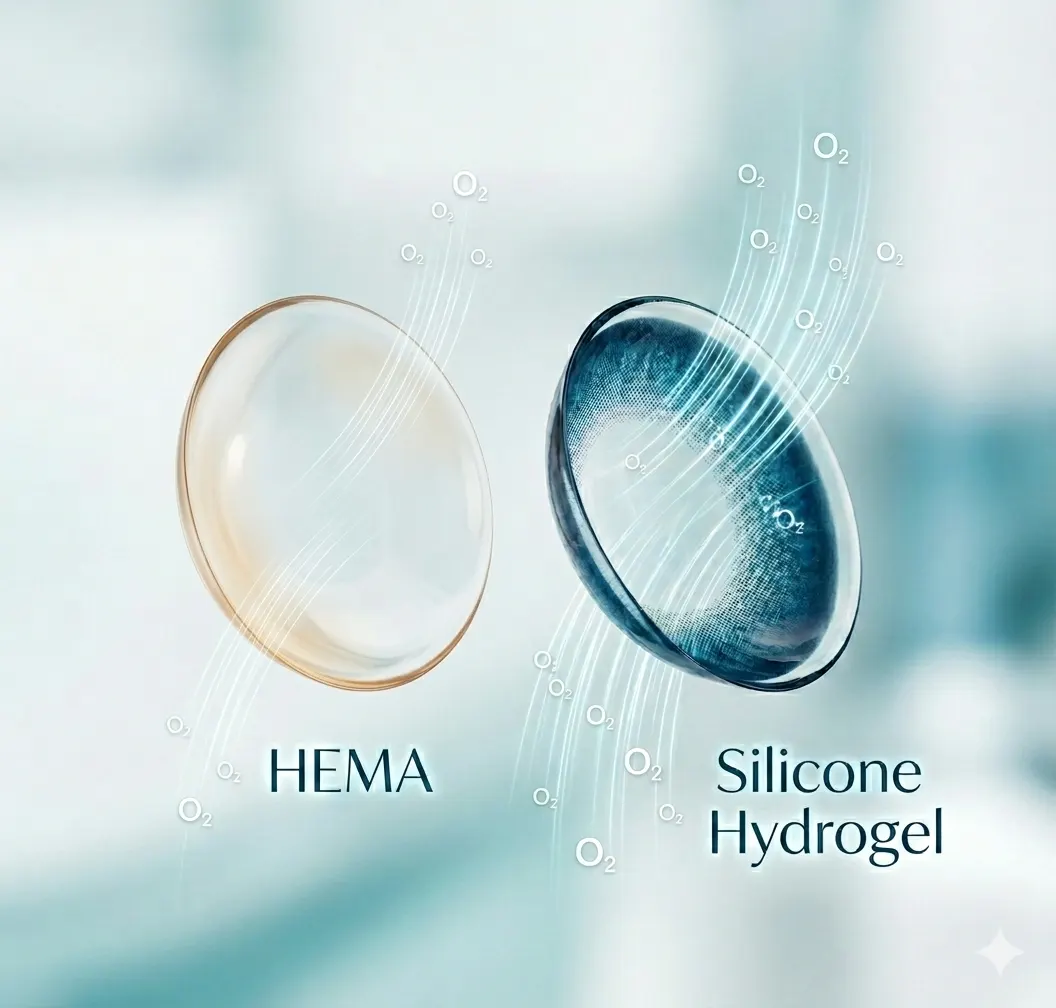
Your eye is the only organ in your body that breathes air directly from the atmosphere, not from your blood. When you place a contact lens on the eye, you aren't just adding color; you are placing a barrier. To build a loyal brand, you must understand how oxygen negotiates that barrier.
1. The Anatomy of a Breath: What is Dk/t?
Before we talk about materials, we must understand the "Invisible Math." Oxygen permeability isn't a single number; it's a relationship.
The Formula: Dk/t
-
Dk (The Material): How fast oxygen moves through the specific material.
-
t (The Thickness): The distance the oxygen has to travel to reach the cornea.
Oxygen permeability (Dk/t) measures how much oxygen reaches the eye. For daily wear, the international safety benchmark is 24 Barrer/cm. If the Dk/t is too low, it leads to Corneal Hypoxia, causing redness, dryness, and long-term eye health risks.
2. The 4 Hidden Factors: What Actually Stops the Oxygen?
Why do two lenses made of the same material feel completely different? Because several variables act as "checkpoints" for oxygen.
A. Material Molecular Structure (The "Roadway")
The material determines how the oxygen travels.
-
In HEMA, oxygen travels through the water molecules in the lens.
-
In Silicone Hydrogel, oxygen travels through the silicone molecules—which act like a high-speed highway compared to water's local road.
B. The "Thickness" Barrier (The Denominator)
Oxygen is lazy; it wants the shortest path.
-
Central Thickness: The thicker the lens, the lower the Dk/t.
-
The Trade-off: Factories often make lenses thinner to increase Dk/t, but if they go too thin, the lens becomes fragile and dehydrates the eye faster.
C. The "Pigment Sandwich" (The Color Lens Specialty)
This is unique to our industry. A color lens is a 3-layer sandwich: Front layer - Pigment layer - Back layer.
-
The pigment (ink) acts as a physical wall.
-
The Insight: A high-quality lens uses "Micro-encapsulation" where the pigment particles are spaced out enough to let oxygen "seep" through, rather than acting like a solid sheet of plastic.
D. The Water Content Paradox
Distributors often think High Water = High Oxygen. This is only true for HEMA.
-
In HEMA: More water usually means more oxygen transport.
-
In Silicone Hydrogel: Too much water can actually decrease oxygen permeability because silicone (not water) is the primary oxygen carrier.
3. The Great Material Debate: HEMA vs. Silicone Hydrogel
Now that we understand the variables, we can see why the market is split between these two "engines."
HEMA: The Soft & Reliable Classic
-
How it works: It maximizes comfort through softness and high water content.
-
The Strategy: We use ultra-thin HEMA (optimizing the "t") to ensure the Dk/t remains in the "Safety Zone" (24-30).
-
Best For: Most fashion-forward brands. It is the most cost-effective way to offer vibrant colors and "instant comfort" for standard 8-hour wear.
Silicone Hydrogel (SiHy): The High-Performance Specialist
-
How it works: It ignores the "thickness" limitation by using a material with a massive Dk value.
-
The Strategy: Even if the lens is slightly thicker for durability, the Dk/t remains extremely high (100+).
-
Best For: Premium "Pro" lines, sensitive eyes, and users in dry environments who need 12h+ wear time.
4. Breaking the "Parameter Anxiety"
Distributors often ask, "Is the Dk/t high enough?" But the real question is: "Is the Dk/t optimized for the user's lifestyle?"
While the media focuses on "High Oxygen," the global safety standard for daily-wear lenses is a Dk/t of approximately 24. As long as a lens meets this threshold, it is safe for standard daily use.
For a brand owner, the goal isn't just to chase the highest number; it’s to provide "The Safe Sweet Spot"—where oxygen flow, initial comfort, and price meet.
5. HEMA: The Time-Tested Standard for Comfort
Most color contact lenses on the market today are made of HEMA (Hydrogel), and for a very good reason.
Why HEMA remains the "Mass Market King":
Superior Softness: HEMA has a lower "modulus" (stiffness) than most Silicone Hydrogels. For the average user, the "first-touch comfort" of a HEMA lens is often higher.
Water-Loving Nature: HEMA is naturally hydrophilic, making it feel "soft and wet" the moment it touches the eye.
Color Vibrancy: HEMA is an excellent carrier for pigments, allowing for the complex, beautiful patterns that drive color lens sales.
The Oxygen Strategy for HEMA:
We optimize our HEMA lenses by focusing on the "t" (thickness) in the Dk/t formula. By utilizing ultra-thin designs and advanced pigment encapsulation, we ensure our HEMA collections comfortably exceed the safety threshold for 8-hour daily wear.
6. Silicone Hydrogel: The "Pro-Line" for Sensitive Eyes
If HEMA is the reliable daily driver, Silicone Hydrogel (SiHy) is the high-performance specialist. In our portfolio, SiHy is reserved for your premium product tier.
Who is SiHy for?
The "Power User": Those who wear lenses for 12+ hours a day.
The "Sensitive Eye": Users prone to dryness or those living in arid, air-conditioned environments.
The "Premium Buyer": Customers willing to pay a surcharge for the latest material science.
By offering a few SiHy SKUs alongside a robust HEMA line, your brand demonstrates technical authority without sacrificing the volume driven by HEMA’s affordability.
7. Decoding the "Sandwich Tech" Across Materials
Regardless of the material, the pigment layer is where the brand’s quality is proven.
In HEMA: We focus on a "Micro-Sandwich" approach—keeping the pigment layer as thin as possible to prevent the lens from becoming too thick, which preserves oxygen flow.
In SiHy: We use the material's high intrinsic Dk (oxygen highway) to ensure that even with high-coverage patterns, the eye receives maximum breathability.
8. Strategic Advice for Distributors: Building Your Portfolio
A smart brand doesn't choose one material; it leverages both. Here is how to structure your 2026 inventory:
| Product Tier | Material | Primary Selling Point | Wearer Profile |
| Essential Line | HEMA | "Instant Comfort & Trending Colors" | Mass market, students, fashion-focused. |
| Standard Line | Premium HEMA | "Optimized Thinness & All-Day Wear" | Office workers, daily commuters. |
| Pro/Elite Line | SiHy | "Max Breathability for Sensitive Eyes" | High-income, sensitive eyes, 12h+ wearers. |
9. Summary: Positioning is Everything
As a brand owner, you aren't just selling a medical device; you are selling a lifestyle experience.
HEMA is your foundation. It provides the comfort, the price point, and the variety that scales your business.
SiHy is your peak. It provides the health-conscious "halo" that elevates your brand’s professional reputation.
The Golden Rule: HEMA brings them in for the comfort and style; Silicone Hydrogel keeps the most demanding customers loyal. A great brand masters both.
Want a technical breakdown of our HEMA and SiHy lens specs? Contact our production team for a 2026 Material Safety Data Sheet.