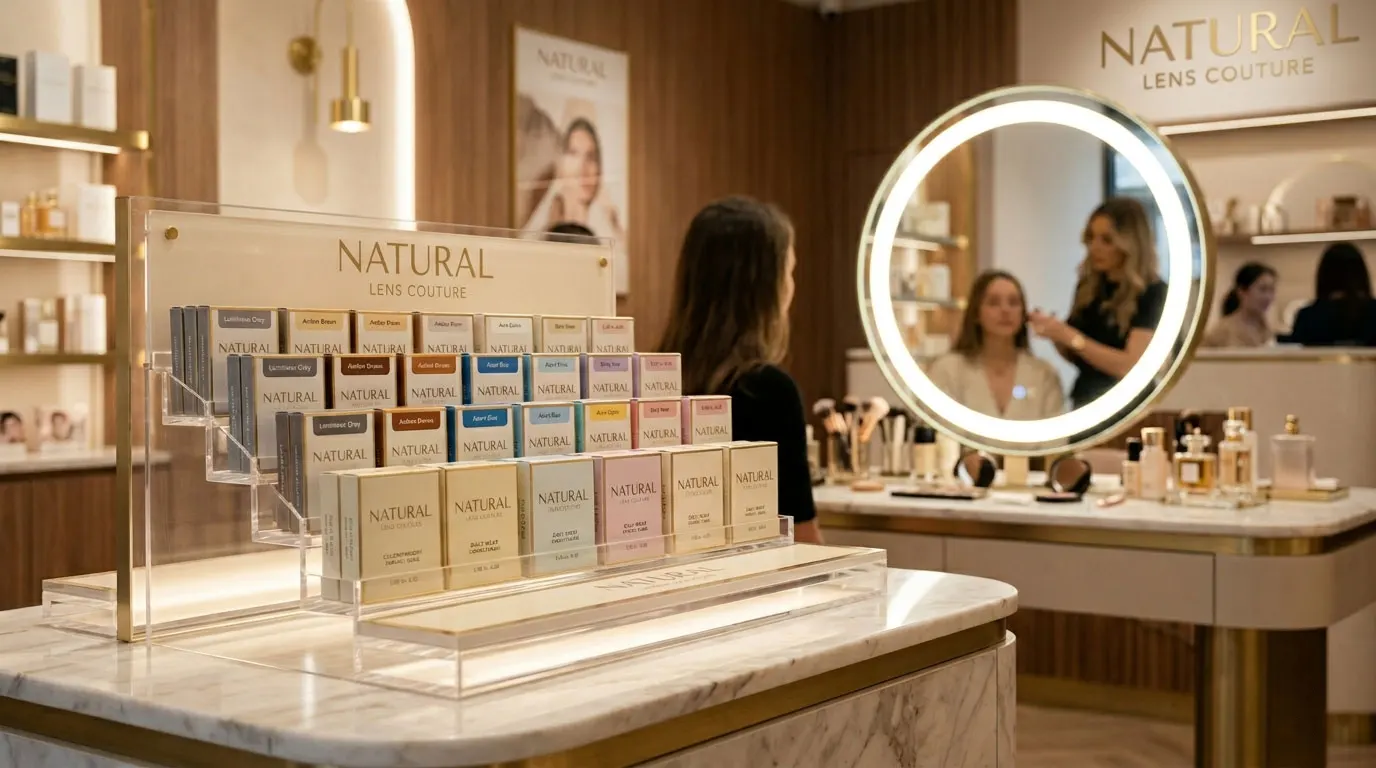
Most retailers display colored contacts like medicine.
They organize boxes by base curve, diameter, and color name on a sterile glass shelf. That sounds logical, but it misses the real issue. The real reason stores struggle with conversion is that shoppers do not buy parameters. They buy a new identity.
Once you treat colored contacts like makeup instead of medical supplies, everything about your retail sales changes.
If you want to know how to display colored contacts in-store, the answer is simple: stop treating them like optical tools. Effective visual merchandising for contact lenses requires grouping products by "makeup effect," providing excellent mirror lighting, and matching lenses to skin tones. This guide will show you how to redesign your optical shop merchandising to boost sales and turn browsers into buyers.
1. Why Traditional Contact Lens Displays Kill Your Sales
Walk into a typical optical shop, and you will see dozens of similar boxes lined up in rows.
Retailers often stock long lists of near-identical SKUs. They group them solely by color labels—Brown, Gray, Blue. But this creates massive cognitive overload for the shopper.
When buyers cannot tell the difference between 20 different brown lenses, they experience decision fatigue. They fear choosing a style that will look unnatural on their skin tone.
When options proliferate without context, customers do not choose. They walk away.
If your shelves feel clinical and technical, you are failing to activate the aspirational impulse that drives beauty purchases.
2. Sell the "Eye Effect," Not the Specifications
Most non-prescription fashion lens buyers do not shop by DIA (diameter) or BC (base curve).
Those parameters matter for comfort, but they are not the primary reason a customer opens their wallet. Customers evaluate lenses by the visual “eye effect” they produce.
People do not buy a 14.2mm lens. They buy the "Soft Korean Idol" look.
Instead of selling specifications, your store needs to sell lifestyle outcomes:
-
Soft Korean Look: Muted contrast, subtle enlargement, soft limbal blur.
-
Big Eyes: Visible enlargement and defined dark rings.
-
Mixed-Race Inspired: Multi-tonal shades with soft color gradients.
-
No-Makeup Makeup: Lenses that enhance naturally for the office.
3. Visual Merchandising Tips to Boost Colored Contacts Sales
To transform your colored contacts retail business, implement these three structural changes in your store layout.
1. Scenario-Based Product Zoning
Stop organizing your shelves by brand or color. Create clear in-store zones that reflect lifestyle outcomes.
Set up a "Natural Daily" zone for office workers, and a "Party & Glam" zone for weekend buyers. Use outcome-driven signage.
That matters because it maps directly to the customer’s mental model. Instead of parsing 20 confusing blue variants, a customer chooses between “soft” and “dramatic” within a single zone. This emotionally resonant framework speeds up decisions.
2. Mirrors and Lighting Over Shelves
Colored lenses are a "mirror conversion product."
The moment of trial—standing at a mirror and seeing the new eye effect—drives conversion more than any shelf aesthetic.
A mirror and a ring light will sell more lenses than a wall of 100 SKUs.
Prioritize makeup mirrors with diffused, bright lighting (color-corrected to 5000–6500K). Add comfortable seating and phone holders. When customers take selfies in your store, social validation accelerates their commitment to buy.
3. Use Realistic Eye-Model Photography
Packaging shots of flat circular lenses create abstraction. Lifestyle photos create identification.
Eye-model photography that shows real before-and-after results is your most persuasive sales tool. However, avoid over-edited studio images.
Show how the same lens looks on dark brown eyes versus light eyes. Transparency about how a tint actually shows up reduces buyer regret and eliminates post-purchase returns.
4. How to Increase Basket Size with Cross-Merchandising
Customers do not merely buy lenses. They buy a complete makeup identity.
Cross-merchandising is the easiest way to increase your average order value (AOV). Position false lashes and eyeliners adjacent to the "Big Eyes" lens zone. Propose a coordinated lip tint to finish the look.
You should also guide choices based on skin tones.
-
Warm skin tones: Favor honey, amber, and warm brown tints.
-
Cool skin tones: Ashy browns, grays, and muted blues perform better.
When you offer pre-packaged "Look Kits" (e.g., lens + eyeliner + blush), you reduce purchase hesitation and establish your store as a beauty expert.
5. Adapting to Regional Beauty Trends
Beauty standards vary by region. If you are a distributor, you must guide your retailers to adapt their contact lens store design locally.
-
Southeast Asia: Emphasize “Soft Korean” and “Natural Daily” zones. Subtle enlargement is highly popular. (Read more about [Southeast Asia Contact Lens Regulations here - Insert Internal Link])
-
Middle East: Expand “Party & Glam” zones. High-contrast limbal rings and bold colors dominate this market.
-
North America/Europe: Highlight “No-Makeup Makeup” and mixed-tone lenses. Ensure your store models represent a diverse range of skin tones.
6. The Bottom Line for Retailers and Distributors
The real issue is not how many SKUs you have. It is how easy you make it for the buyer to choose.
If you are a pharmacy, beauty chain, or distributor looking to upgrade your retail experience, Mislens can help you eliminate the guesswork.
Stop guessing what sells.
Contact us today to get our "12-SKU Hero Assortment Starter Kit". It comes complete with in-store planograms, high-resolution model photography for your region, and retail sales scripts.
The best part? You can start testing your market today with our incredibly low MOQ of just 100 pairs (as low as 5 pairs per SKU).
👉 [Request Your Retail Starter Kit Today ]
Frequently Asked Questions (FAQ)
1. How should I display colored contacts in a small optical shop?
Focus on a curated "Hero SKU" display rather than showing every available lens. Use small, scenario-based zones (e.g., "Daily Wear" vs. "Glamour"), and ensure there is a well-lit mirror station nearby for customers to visualize the effect.
2. What is the most common mistake in colored contacts retail?
Organizing lenses by technical parameters (like base curve or diameter) or simply by color name. Shoppers buy beauty outcomes, so merchandising should focus on the final "eye effect."
3. How can I reduce customer returns for colored lenses?
Provide realistic before-and-after photography showing how the lenses look on different natural eye colors and skin tones. Setting accurate expectations before the purchase drastically reduces return rates.
4. What is the minimum order quantity (MOQ) to start a contact lens retail display?
With traditional factories, MOQs can be thousands of pieces. However, Mislens offers a retail-friendly MOQ of just 100 pairs, allowing small beauty stores and pharmacies to test market demand with minimal financial risk.