Replacing a supplier can look like a straightforward procurement decision.
A distributor sees longer lead times, unstable SKU availability, recurring documentation problems, or communication that has become increasingly reactive. A new supplier appears with better terms, responsive communication, acceptable samples, and a cleaner operating model.
The obvious conclusion is to move.
That is also where risk increases.
An existing supplier may be frustrating, but it is already connected to the rest of the business. Current inventory, product listings, prescription structures, reseller expectations, repeat-order routines, and customer familiarity have all developed around that supply relationship.
A new supplier may look stronger on paper and still be unproven under normal operating pressure.
The mistake is treating supplier approval as supplier replacement.
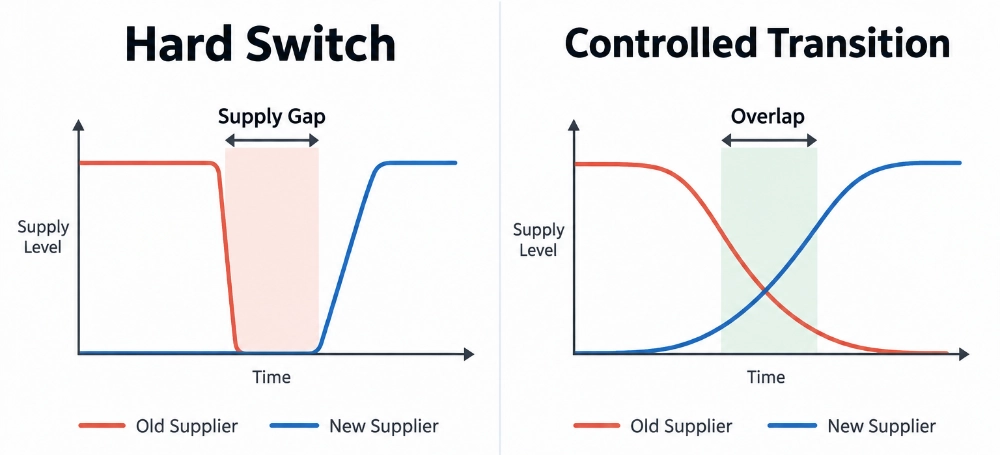
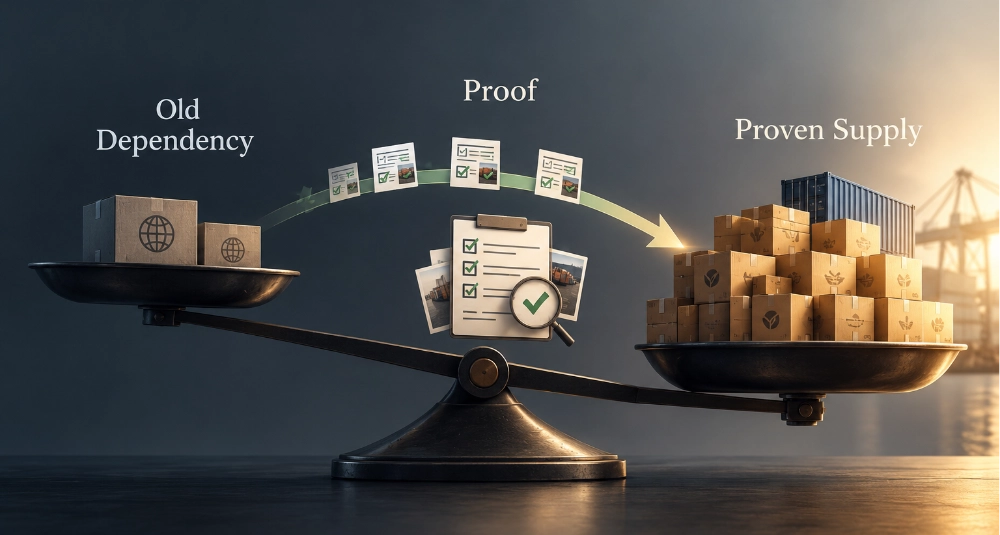
Do not replace the old supplier before the new supplier has earned the dependency.
A safer switch creates a temporary period in which the distributor can test the new supply system while the existing one is still able to protect the business.
A New Supplier Has to Prove the Business, Not the Sample
Samples answer a narrow but useful question:
Can this supplier provide a product worth evaluating?
They do not show how that supplier behaves once the product becomes part of normal replenishment.
The same is true of quotations, catalogs, certificates, and early communication. They help buyers screen an alternative source, but the operating relationship has not yet been tested.
| Early Evaluation Shows | Real Orders Need to Prove |
|---|---|
| Sample quality | Repeat commercial consistency |
| Quoted lead time | Actual usable lead time |
| Catalog availability | Repeat SKU availability |
| Documentation supplied | Documentation remains relevant to the products ordered |
| Responsive communication | Useful communication when something changes |
The distinction becomes especially important when the business carries more than simple cosmetic SKUs.
For example, a distributor handling powered clear lenses or broad prescription ranges may depend on continued availability across multiple powers. A supplier that can provide the product once but repeatedly misses commercially important powers has not really replaced the previous supply capability.
A visually sensitive colored lens creates another kind of exposure. The product may technically remain within specification while still changing enough to create friction with existing listings, reseller expectations, or product photography.
This is why a new source should be evaluated under real operating conditions before the distributor removes the old fallback.
Our guide on how to evaluate contact lens replenishment reliability before choosing a long-term supplier covers that upstream question in more detail: can the supplier support repeat purchasing with enough continuity and predictability to justify a longer relationship?
If the answer is yes, the next task is controlling the transition itself.
Keep the Customer-Facing Business Stable While the Supply Side Changes
Changing supplier already introduces a major variable.
If the distributor simultaneously redesigns the entire assortment, changes key specifications, restructures prescription coverage, replaces packaging logic, and rewrites product listings, any later problem becomes difficult to diagnose.
Suppose sales weaken after the transition.
Was the supplier responsible?
Did the new product configuration change customer response?
Did a core power disappear?
Did a retailer receive packaging that no longer matched familiar shelf stock?
Did the ecommerce listing stop representing the product accurately?
When too many variables move at once, the business loses the ability to read the result.
A cleaner transition leaves enough of the customer-facing system familiar while the supply relationship is being tested.
This does not mean every product detail must remain frozen. It means unrelated changes should not be piled onto the same period without a reason.
Supplier verification also still applies. Using a company as an alternative source does not justify skipping document review, product verification, or the type of supplier audit covered in The 2026 Guide to Compliance, Supplier Audits, and ROI.
The purpose is simple: if something goes wrong during the transition, the distributor should be able to identify what changed.
Build an Overlap Before You Build Dependency
Consider a fictional European contact lens distributor carrying around 35 active SKUs.
The company supplies several repeat wholesale accounts, maintains multiple prescription options, and usually places replenishment orders every month.
Its current supplier has not completely failed. Orders still arrive and communication still exists.
But during the previous six months, two commercially important SKUs were replenished late. Lead time became harder to predict, and the distributor increasingly had to chase information that previously arrived without prompting.
Management decides to evaluate another supplier.
The alternative source provides suitable samples, a clear quotation, and the requested product documents. Initial communication is strong.
At this point, moving the entire next monthly order may feel efficient.
It would also create the greatest dependency at the moment when the distributor knows the least.
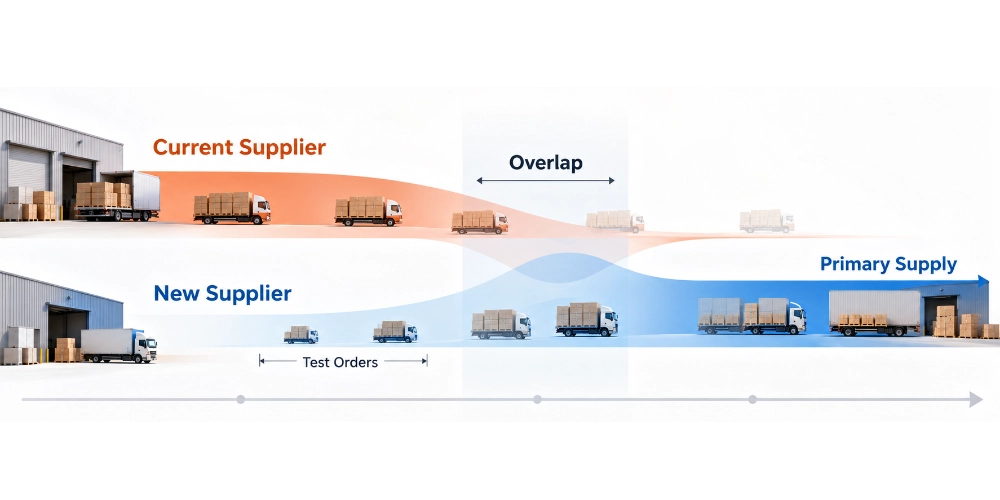
Instead, the company keeps its existing supplier capable of supporting core business while moving seven representative SKUs into real orders with the new source.
Those seven are deliberately mixed:
- one high-repeat core SKU;
- one prescription-heavy SKU;
- one visually sensitive colored lens;
- two moderate-demand products;
- one SKU that regularly needs replenishment;
- one lower-risk product that can be substituted more easily.
The exact number is not the point. The mix is.
A test containing only easy, low-value products may prove very little about the supplier's ability to support the actual business.
The first order establishes basic execution.
Did the correct products arrive?
Were quantities and packing accurate?
Did the supplied products match the information used during evaluation?
The second cycle is usually more revealing.
Can the same SKUs be ordered again?
Does the documentation still align with the actual products?
Does replenishment arrive within a usable operating window?
If something becomes unavailable, does the distributor learn early enough to respond?
Do colored products remain commercially consistent enough for existing customer expectations and listings?
The old supplier remains useful during this period, even if the long-term plan is to reduce dependence on it. If the new system fails, the distributor still has a route back.
The distributor is buying information before buying dependency.
That overlap is not wasted purchasing complexity. It is what prevents a sourcing experiment from immediately becoming a customer problem.
Move the Right SKUs First
Once both supply routes exist, migration becomes a SKU decision.
There is no universal percentage that distributors should move in the first order.
A moderate-demand SKU that matters commercially but can still be substituted may be a sensible early candidate. It gives the new supplier a real job without exposing the entire business to one failure.
Some complexity should also be included early.
For a professional optical distributor, that may mean testing a product with broader prescription coverage rather than validating only a simple cosmetic SKU. For a colored lens business, it may mean including at least one design where visual consistency matters to the listing and downstream customer.
The most business-critical SKUs generally deserve backup for longer.
That can include products with:
- strong repeat demand;
- important prescription coverage;
- dependence from major wholesale accounts;
- limited substitutes.
A transition therefore does not need to move the catalog evenly.
It should move commercial exposure in proportion to the evidence already available.
Our guide to building a reliable prescription clear contact lens portfolio for distribution is particularly relevant here because a powered range can remain technically broad while becoming commercially weak if important powers cannot be replenished consistently.
Give Yourself Time to Discover a Problem
Even a well-run supplier transition can fail on the next cycle.
The second shipment may be delayed.
A previously available SKU may become temporarily unavailable.
A document may need clarification.
A product may require additional verification.
The practical question is:
If the next order fails, how long can the business operate before customers are affected?
That is the purpose of a transition buffer.
It gives the distributor enough time to continue selling, clarify the issue, use remaining stock, or temporarily rely on the previous source.
The buffer does not need to become another inventory system.
Its value is the time it creates between discovering a problem internally and exposing that problem to downstream buyers.
There is also a clear limit. Holding excessive inventory across the entire portfolio just to make a supplier switch feel safe creates its own working-capital problem.
The transition needs room for correction, not enough stock to remove every possible uncertainty.
Retire the Old Supplier When the New Supply Becomes Boring
The first successful shipment from a new supplier can feel important.
The fifth routine shipment usually does not.
That difference matters.
A supply relationship becomes dependable when normal orders stop producing surprises.
The expected products arrive.
Core SKUs remain available.
Prescription coverage remains usable.
Documentation stays aligned with the supplied product.
Replenishment timing becomes something the distributor can plan around.
When exceptions occur, they are communicated early enough to manage.
Nobody has to treat every order as a special project.
There is no useful rule saying that this requires three orders, five orders, or a specific number of months. A distributor ordering weekly is not operating on the same evidence cycle as one ordering quarterly, and a broad prescription range carries different complexity from a small cosmetic assortment.
The standard is repeated evidence.
As that evidence builds, the old supplier can gradually stop carrying critical backup. Dependence moves because the business no longer needs the same protection, not because a predetermined switch date has arrived.
A Successful Supplier Switch Is Almost Invisible to the Customer
Procurement teams experience a supplier switch as a major event.
Customers ideally do not.
A successful transition should avoid preventable stock gaps, unexplained product changes, repeated listing corrections, unexpected prescription shortages, and emergency substitutions downstream.
The real success test is not whether the distributor signed a new supplier.
It is whether the supply relationship changed while the customer-facing business remained stable.
A supplier switch is successful when customers barely notice it.
For distributors evaluating an alternative supply source, the useful first conversation is not simply a request for price.
Prepare the operating context:
- the products you currently distribute;
- replacement cycles;
- prescription requirements;
- destination market;
- the supply problem you are trying to solve;
- approximate purchasing volume.
That makes it possible to discuss whether an alternative source is relevant to the actual business rather than comparing quotations in isolation.
Mislens works with B2B distributors, wholesalers, optical stores, beauty retailers, ecommerce sellers, and other professional channel partners, with a focus on Europe, North America, and the Middle East. Its product positioning includes colored lenses as well as powered clear-lens ranges for professional distribution contexts.
Discuss Your Supply Requirements
Tell us what you currently distribute, where you sell, and what problem you are trying to solve with your existing supply arrangement. We can review relevant product and supply options with you.