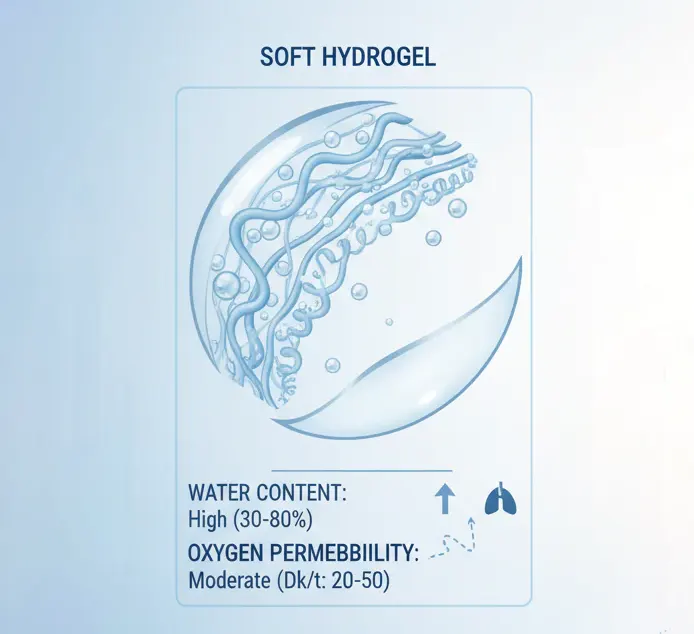
HEMA‑based hydrogel remains one of the most fundamental and widely used materials in the colored contact lens (cosmetic “circle lens” / “color contact”) industry, especially in the mid‑to‑low‑end, daily disposable, and yearly wear product segments. For startup brands and distributors entering the colored contact lenses space, understanding where HEMA sits in the “material–cost–experience” triangle is critical for positioning, margin design, and long‑term survival in a crowded market.
1. What HEMA Is and Its Role in Colored Lenses
HEMA (hydroxyethyl methacrylate) is a hydrophilic monomer that, when polymerized, forms PHEMA (poly‑HEMA), the classic soft hydrogel used in early soft contact lenses. In colored contacts, manufacturers typically use “HEMA‑based blends,” where HEMA is the primary matrix, mixed with NVP (N‑vinylpyrrolidone), cross‑linkers, or a small amount of silicone to tune water content, flexibility, and dye compatibility.
In many emerging markets—especially China and other Asian and developing regions—over 70% of mid-tier daily disposables and yearly color lenses still use HEMA as the base material. The underlying logic is clear: low cost, mature process, and good compatibility with complex dyeing and printing techniques.
2. Material Performance: Water, Oxygen, Softness, and Color
2.1 Water content and wettability
- Typical HEMA‑based hydrogels reach about 38%–55% water content after full hydration, which classifies them as “medium‑water” materials.
- This means:
- Initial comfort and wetness feel acceptable, but these lenses can become noticeably drier in the later hours of wear, especially in air‑conditioned offices, long screen‑time environments, or overnight‑style use.
- Compared with silicone‑hydrogel (often 60%+ water) or high‑water “super‑hydrogel” materials, HEMA is weaker in maintaining moisture, so it fits best with short‑term and frequent‑replacement strategies.
2.2 Oxygen permeability (Dk/t)
- Pure HEMA lenses usually deliver oxygen transmissibility (Dk/t) in the range of roughly 8.4–34, far below mainstream silicone‑hydrogel lenses (often 50–150+).
- For founders and distributors, the practical implication is:
- HEMA is better suited for daily disposables, yearly wear, not for extended or overnight wear.
- Marketing should avoid direct comparison with “high‑oxygen” products, or risk skepticism from medically‑aware users and professional channels.
2.3 Softness and wearing comfort
- HEMA‑based hydrogels tend to be moderately soft, neither too stiff nor too floppy, which suits many first‑time users.
- However, low‑cost HEMA formulations can feel brittle; repeated handling or harsh disinfection routines may cause edge curling or breakage, increasing returns and customer complaints.
2.4 Dye and print compatibility
- HEMA’s hydrophilic surface works well with immersion dyeing and “sandwich” printing technologies:
- It can support complex patterns: multi‑color over‑printing, outer‑ring halo effects, and large‑diameter “pupil‑enlarging” designs.
- The color layer bonds relatively stably with the substrate, reducing visible pigment shedding, but only if dye purity and sandwich‑layer工艺 are well controlled.
- From a product‑development standpoint, this makes HEMA ideal for “aesthetic‑first” SKUs such as big‑diameter daily disposables, K‑pop‑style lenses, and fashion‑driven collections.
- You can also pair HEMA with small amounts of silicone or non‑ionic additives to improve edge smoothness, but it should not be marketed as “silicone‑hydrogel‑level comfort.”
3.Why HEMA Hydrogel Can Be Used for Annual-Use Colored Contact Lenses
Although HEMA (hydroxyethyl methacrylate) is the main component of traditional hydrogel lenses, its inherent durability is limited. To achieve annual-use lifespan for colored lenses, manufacturers rely on a combination of material modification and advanced manufacturing technologies:
3.1 HEMA Copolymerization and Cross-Linking
· Cross-Linking
During polymerization, HEMA is combined with cross-linking agents (e.g., EGDMA, ethylene glycol dimethacrylate).
This forms a three-dimensional network that enhances mechanical strength, resistance to swelling, and chemical stability.
Effect: Prevents excessive expansion or degradation during daily wear and cleaning, extending the lens lifespan.
· Copolymerization
HEMA can be copolymerized with other monomers, for example:
MMA (methyl methacrylate) → Increases hardness and wear resistance
NVP (N-vinylpyrrolidone) → Improves water retention and wearer comfort
Effect: Optimizes oxygen permeability, elasticity, and durability, making HEMA suitable for annual-use lenses.
3.2 Surface Treatment and Coating Technologies
Surface Coating
A thin hydrophilic or anti-protein coating can be applied post-molding.
Effect: Reduces protein deposition, surface wear, and prolongs lens lifespan.
Encapsulated Pigment Layer (for colored lenses)
Color pigments are sandwiched between two transparent hydrogel layers.
Effect: Prevents pigment exposure to tear fluid, minimizing chemical degradation and maintaining color stability over long-term use.
3.3 Water Content Optimization and Controlled Hydration
High water content in HEMA hydrogels can reduce durability.
Annual-use lenses typically:
Maintain medium water content (e.g., 38–42%)
Include moisture-retaining monomers such as PVP or NVP to preserve comfort
Effect: Reduces micro-cracking from repeated swelling and shrinking, improving long-term stability.
3.4 Advanced Manufacturing Processes
Precision Polymerization Control → Ensures uniform HEMA network, avoiding weak points.
Thermal Treatment / Annealing → Enhances mechanical stability of the lens.
Sterile Packaging and Storage Solution → Annual-use lenses are sealed in high-hydration storage solutions, slowing degradation and maintaining hygiene.
4 Profit drivers and risks
- Pros:
- Low cost enables high‑SKU, low‑price, fast‑turnover strategies.
- Ideal for “traffic” SKUs and impulse‑driven, social‑media‑driven campaigns.
- Cons:
- High price sensitivity increases the risk of margin‑killing price wars.
- User‑experience ceiling is limited by oxygen permeability and water retention, making HEMA products vulnerable to replacement by silicone‑hydrogel and next‑gen materials.
5. Market share (global and key regions)
Public reports rarely split out “HEMA” vs “silicone‑hydrogel” explicitly, but combining market structure and industry consensus yields reasonable estimates:
- Globally, traditional hydrogel (including HEMA‑blend) still accounts for roughly 50%–60% of colored lens *volume*, but only about 30%–40% of *value* (sales revenue), as it dominates the low‑price, daily‑disposable, and e‑commerce bulk‑pack segments.
- In China, Southeast Asia, and similar emerging markets, HEMA‑based color lenses may represent over 70% of lenses.
- In mature Western markets, silicone‑hydrogel clear lenses are mainstream, but decorative color lenses (especially large‑diameter “circle” styles) still often rely on HEMA‑blend material to keep cost and color complexity manageable.
6. Pros and cons for founders and distributors
Advantages
- Technologically mature: Formulations, processing, and dyeing workflows are well‑standardized, making it easy to launch multiple SKUs quickly.
- Low and stable cost: Materials and fabrication are inexpensive, enabling strong “value‑for‑money” positioning.
- Excellent color adaptability: Ideal for multi‑layer prints, halo rings, and other visually striking designs.
- Channel‑friendly: Fits well with daily disposables, single‑lens packs, and combo sets, driving fast turnover and repeat purchases.
Limitations
- Limited oxygen permeability: Not ideal for long‑wear or high‑screen‑time users; this can hurt brand credibility among more informed wearers.
- Poor moisture retention: Dryness and discomfort increase with prolonged use, leading to higher complaint rates.
- Low premium ceiling: Hard to sustain high tier “tech‑driven” positioning, making it easy to be replaced by silicone‑hydrogel or newer materials.
- Regulatory and safety risks: If low‑grade dyes or poorly controlled sandwich‑layer technique are used, pigment leakage incidents can severely damage brand reputation.
7. Trends and business opportunities
7.1 Material and technology trends
- Rise of silicone‑hydrogel color lenses:
- Silicone‑hydrogel dominates clear lenses in many developed markets, but its use in color lenses is still growing slowly, because high silicone content can interfere with dye stability and pattern clarity.
- Over the next three years, leading brands will likely introduce “HEMA‑silicone hybrid” color lenses, balancing oxygen permeability and visual fidelity.
- Non‑ionic / high‑oxygen super‑hydrogels:
- Aimed at premium, medical‑aesthetic, or long‑wear users, these materials suit high‑margin “niche premium” lines.
- For startups and distributors, these are better suited for small test runs than full‑scale launches.
7.2 Colored lens market potential
- Total contact lens markets are projected to grow around 6% CAGR through the 2030s, with color lenses among the fastest‑growing sub‑segments—especially in Asia and the Middle East.
- E‑commerce and short‑video live‑shopping have boosted demand for daily disposable color lenses; young consumers readily accept “100‑lens packs at 1 RMB per lens,” creating a durable demand base for HEMA‑based products.
7.3 Business opportunities for founders and distributors
- For founders:
- Focus HEMA color lenses on “daily fashion, short‑term wear, high‑aesthetic value” positioning, deliberately avoiding direct competition with silicone‑hydrogel on “tech specs.”
- Partner with established OEMs to develop “HEMA‑lite silicone” blends that improve lubricity and comfort without sacrificing cost efficiency.
- Introduce “try‑on kits” or “makeup‑style” bundles to increase average order value and repeat purchases.
- For distributors:
- Prioritize HEMA color lenses in developing markets (Southeast Asia, Middle East, Latin America), leveraging price and pattern diversity to secure exclusive regional deals.
- In Western markets, work with cross‑border e‑commerce platforms to push “decorative daily” SKUs, avoiding direct confrontation with premium silicone‑hydrogel brands.
8. Strategic takeaways and recommendations
HEMA‑based hydrogel is not obsolete technology, but a strategic tool for specific market segments and user profiles. For colored contact lenses brand founders and distributors, the key is to use it consciously and strategically:
- **Positioning strategy:**
- Position HEMA color lenses as “daily fashion, short‑term, high‑aesthetic, value‑driven” products, not as “medical‑grade, all‑day” devices.
- Pair HEMA SKUs with silicone‑hydrogel or high‑oxygen lines in a dual‑tier portfolio: HEMA for volume, silicone for margin and brand image.
- **Product and operations guidance:**
- Choose manufacturers with stable HEMA processes, robust dye sourcing, and rigorous sandwich‑layer quality control.
- Build “daily disposable, multi‑pattern, small‑pack” SKUs first, and test market response quickly via social‑media and influencer campaigns.
- Clearly label recommended wearing time and “not for overnight use” in marketing and packaging to mitigate medical and legal risks.
- **Long‑term play:**
- Over the next 3–5 years, gradually shift part of HEMA capacity toward “HEMA‑silicone hybrid” or silicone‑hydrogel color lenses, creating a technology upgrade path.
- At the same time, keep a “value HEMA line” as a traffic driver for price‑sensitive, design‑driven users.
In an era of intense material competition and user‑experience obsession, leveraging HEMA’s strengths in cost, manufacturability, and visual appeal—while being honest about its limitations—is the smart way for founders and distributors to stake a profitable, sustainable position in the color contact lens market.