Natural Colored Contact Lenses: Why Most Look Fake and How to Source the Real Thing
Most distributors think "natural" is a color.
They open a supplier catalog, look at the shades of brown, gray, and hazel, and select the ones that aren't neon green or vampire red. That sounds logical, but it misses the real issue.
The real reason a colored contact lens looks natural has almost nothing to do with the color. It has everything to do with structure.
Consumers do not buy a lens; they buy the confidence that no one knows they are wearing a lens. When a buyer puts on a lens and it looks fake, their brain isn't rejecting the color. It is rejecting the pattern.
Once you understand that natural appearance comes from iris realism, not simply darker colors, everything about how you source and sell colored contacts changes.
What Are Natural Colored Contact Lenses?
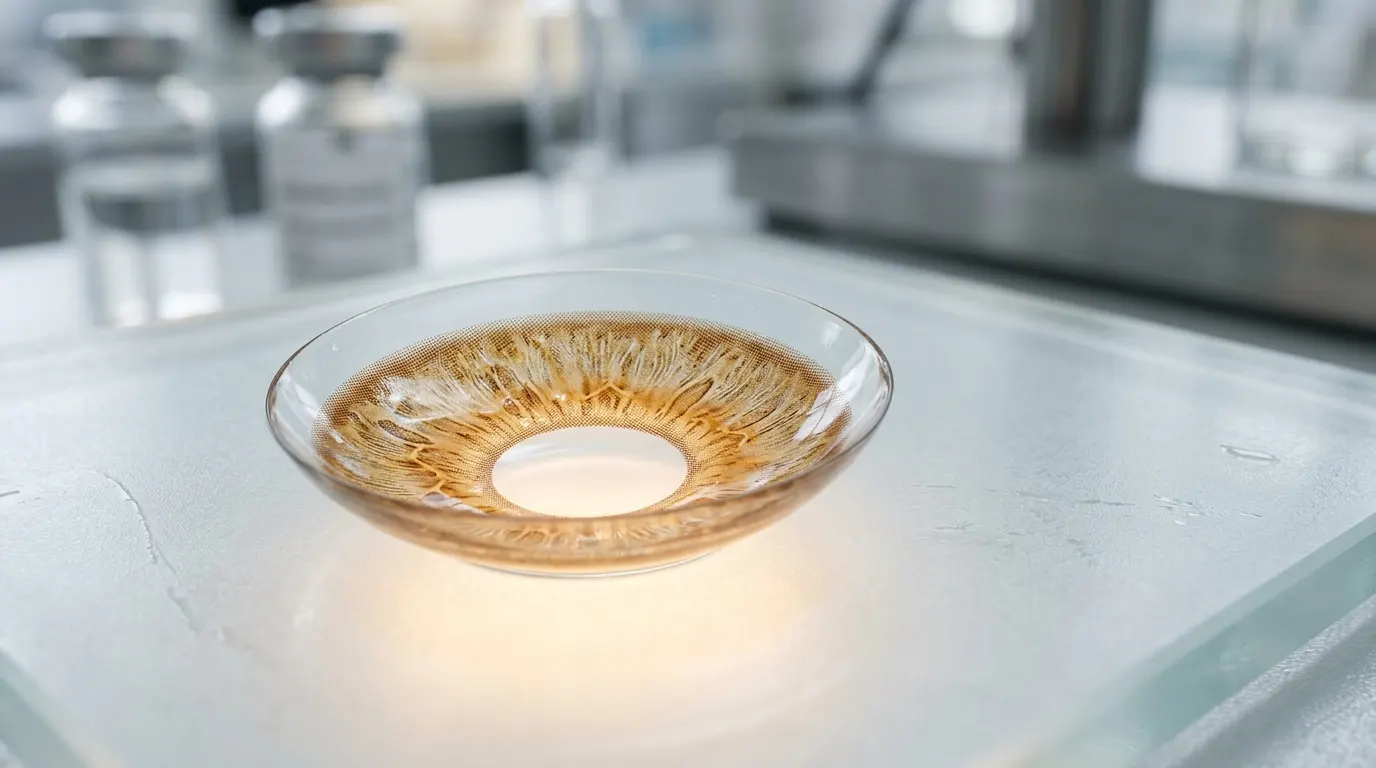
Natural colored contact lenses are cosmetic contact lenses designed to perfectly mimic the organic structure of a human iris. Rather than relying on solid, flat colors, the most realistic contact lenses use multi-layered transparency, soft limbal rings, and irregular radial patterns to blend seamlessly with the wearer's original eye. For wholesale distributors, stocking high-quality natural-looking colored contacts requires evaluating pattern mechanics, not just color names.
The Core Illusion: Why the Human Eye Detects “Fake” Lenses
The human brain is an incredibly advanced pattern-recognition machine.
When we look at someone’s eyes, we don't consciously analyze radial textures, transparency layers, or limbal ring softness. But our brain instantly knows whether an iris looks biological or artificially printed.
The human iris is not a flat colored ring. It is not a perfectly symmetrical pattern, nor is it a solid disc of pigment. A real iris is a deep, complex muscle made of overlapping fibers, varying pigment densities, and soft light refractions.
Therefore, a lens only looks natural when it reproduces these exact biological characteristics.
The closer a lens resembles an organic iris structure, the more natural it appears.
If you print a perfectly uniform brown circle onto a piece of hydrogel, it will always look like a piece of plastic sitting on the eye. To sell products that consumers love, distributors must look past the color and examine the architecture of the lens.
The 5 Structural Pillars of Natural Lens Patterns
If you want to know if a lens will succeed in the modern natural market, look for these five features.
1. Radial Texture Instead of Circular Repetition
Natural irises radiate outward from the pupil. They are made of muscle fibers that stretch and contract.
Because of this, premium natural lenses use fine radial strokes. They feature fiber-like textures and non-mechanical transitions that pull the eye inward toward the pupil.
Avoid gear-like patterns, repetitive rings, or sharp geometric printing.
Perfect symmetry is a machine's idea of beauty, not nature's. Radial diffusion creates biological realism.
2. The Soft Inner Transition Around the Pupil
Natural irises do not abruptly change color. There is no hard line where the pupil ends and the iris begins.
However, many cheap colored contacts use a harsh, jagged cutout for the pupil hole. This creates a terrifying, reptilian look—even if the color is a beautiful brown.
Truly natural lenses use feathered blending. They use dot fading and transparent inner gradients so the artificial color melts smoothly into the wearer’s natural eye color.
In practice, this means the lens integrates into the eye instead of sitting on top of it.
3. A Soft Limbal Ring Instead of Heavy Black Borders
The limbal ring is the dark circle around the outside of the iris. In youth, this ring is slightly darker, which is why lenses with limbal rings make eyes look younger and larger.
But a natural iris has only a subtle, translucent darkening at the edge.
Modern natural lenses prefer soft brown or dark gray borders, blurred outer edges, and low-contrast rings.
Avoid thick black circles and hard outlines. These create an outdated, cartoon-like enlargement effect. Consumers increasingly associate softer borders with premium, high-end aesthetics.
4. Multi-Layer Transparency Creates Depth
A real iris contains optical depth, not flat color. Light bounces off multiple layers of tissue.
When a lens pattern is printed with 100% opacity, it kills the depth. It creates what the industry calls the "dead eye" effect.
High-quality natural-looking colored contacts combine translucent base tones with layered pigments. By using varying opacity and multiple density zones, the wearer's natural eye color is allowed to peek through the lens.
That matters because a semi-transparent lens interacts with lighting dynamically. The eye appears more dimensional, more realistic, and more alive.
5. Controlled Irregularity Improves Realism
Look closely at your own eye in the mirror. It is not identical all the way around. There are freckles, broken fibers, and lighter patches.
Natural-looking lens patterns intentionally include broken fibers, density variation, and irregular diffusion.
Slight imperfection creates biological authenticity. When you evaluate a SKU, look for controlled chaos in the pattern. If it looks like it was stamped by a flawless robot, it will look fake on a human.
The "Dead Giveaways": Why Some Lenses Look Artificial
To source better products, you must know exactly what to avoid. If your current catalog features any of the following, you are likely losing market share to competitors with more sophisticated designs.
Overly Thick Black Rings
Heavy, solid black limbal rings create a harsh boundary. They result in an exaggerated enlargement that screams "colored contacts." This is an outdated aesthetic that modern consumers reject.
Flat, Solid-Color Printing
Lenses printed with a single, highly saturated layer of pigment look like plastic. They lack depth and block all light refraction, leading to an unnatural, painted-on appearance.
Excessively High Contrast
Real irises rarely contain harsh, high-contrast boundaries between light and dark zones. If a gray lens features stark white highlights next to pitch-black shadows, it will look like a graphic design project, not an eye.
Mechanical or Gear-Like Patterns
Spokes that look like bicycle wheels or repeating geometric dots create a repetitive visual rhythm. Biology does not repeat in perfect mathematical sequences.
The problem is rarely what the industry says it is. Lenses don't fail because the color is wrong. They fail because the pattern is mechanical.
The Market Shift: From Enlargement to Naked-Eye Realism
The colored contact lens market has fundamentally changed.
Ten years ago, the dominant trend was the "doll-eye" effect. Consumers wanted massive diameters (14.5mm to 15.0mm) and heavy limbal rings. The goal was to make the eye look as large as possible.
Today, the dominant trend is naked-eye realism.
Driven by the "no-makeup makeup" trend, consumers want soft definition, subtle iris texture, and low saturation. They want lenses that enhance their eyes without obviously looking like colored contacts.
If your wholesale purchasing strategy is still based on the trends of 2015, your inventory is at risk.
How Distributors Should Evaluate “Natural” Lens SKUs
How do you translate these principles into actionable sourcing decisions? Here is a framework for selecting the right natural lens patterns for your brand.
1. Evaluate Structure Before Color
A brilliantly designed gray lens will appear much more natural than a poorly designed brown lens. Color is secondary. Always evaluate the architectural realism of the pattern first.
2. Examine Transition Quality
Look closely at the inner ring (near the pupil) and the outer ring. Look for soft blending, gradient diffusion, and layered opacity. Reject any lens with abrupt color boundaries.
3. Check Texture Under Zoomed Product Images
Do not rely entirely on photoshopped model images provided by the manufacturer. Ask for macro-lens shots of the lens sitting in a blister pack. Natural patterns should resemble organic diffusion and iris fibers.
4. Match Natural Styles With Daily-Wear Consumers
Remember who you are buying for. Natural-style collections perform best for first-time users, office workers, students, and daily fashion markets. Market these lenses as everyday confidence boosters, not dramatic cosmetic changes.
Frequently Asked Questions (FAQ)
1.What is the most natural looking contact lens color?
There is no single most natural color. The most natural look depends on the wearer's skin tone and natural eye color. However, soft hazel, muted olive greens, and transparent grays tend to blend most naturally across diverse demographics.
2.Do smaller diameter lenses look more natural?
Generally, yes. A Graphic Diameter (GD) between 12.8mm and 13.2mm mimics the natural human iris size. Anything over 13.6mm GD introduces an enlarging effect, which begins to look less natural and more stylistic.
3.Why do my colored contacts look pixelated?
Pixelation occurs when a manufacturer uses low-resolution printing plates or an outdated dot-matrix printing method with poor pigment blending. High-quality natural lenses use ultra-fine printing technology that blends the dots into smooth gradients.
4.Can natural lenses cover very dark eyes?
Yes. To cover dark eyes naturally, a lens must balance opacity with transparency. The best natural lenses for dark eyes use a highly pigmented but thin color layer, allowing for coverage without the thick, "flat" appearance of older opaque lenses.
The Future of Natural Lens Sourcing
The real issue is not finding a supplier who makes a nice shade of brown. It is finding a supplier who understands the optical physics of the human eye.
The future of natural colored contact lenses is not about making the eye look bigger. It is about making the iris look believable.
Modern consumers judge naturalness through texture softness, transparency, depth, and integration. For distributors and private label buyers, understanding lens structure is becoming essential for selecting commercially successful SKUs.
Stop buying color. Start buying biological realism.
If you are comparing suppliers or updating your catalog for this year, this is the factor you should ask about first. Request samples. Look at them under a macro lens. Compare a flat-printed lens with a multi-layered, radially diffused lens. You will instantly see what your customers see.
Want to see the difference for yourself?
Contact our sourcing team today to request a free sample pack and experience the next generation of biologically accurate natural lens patterns.