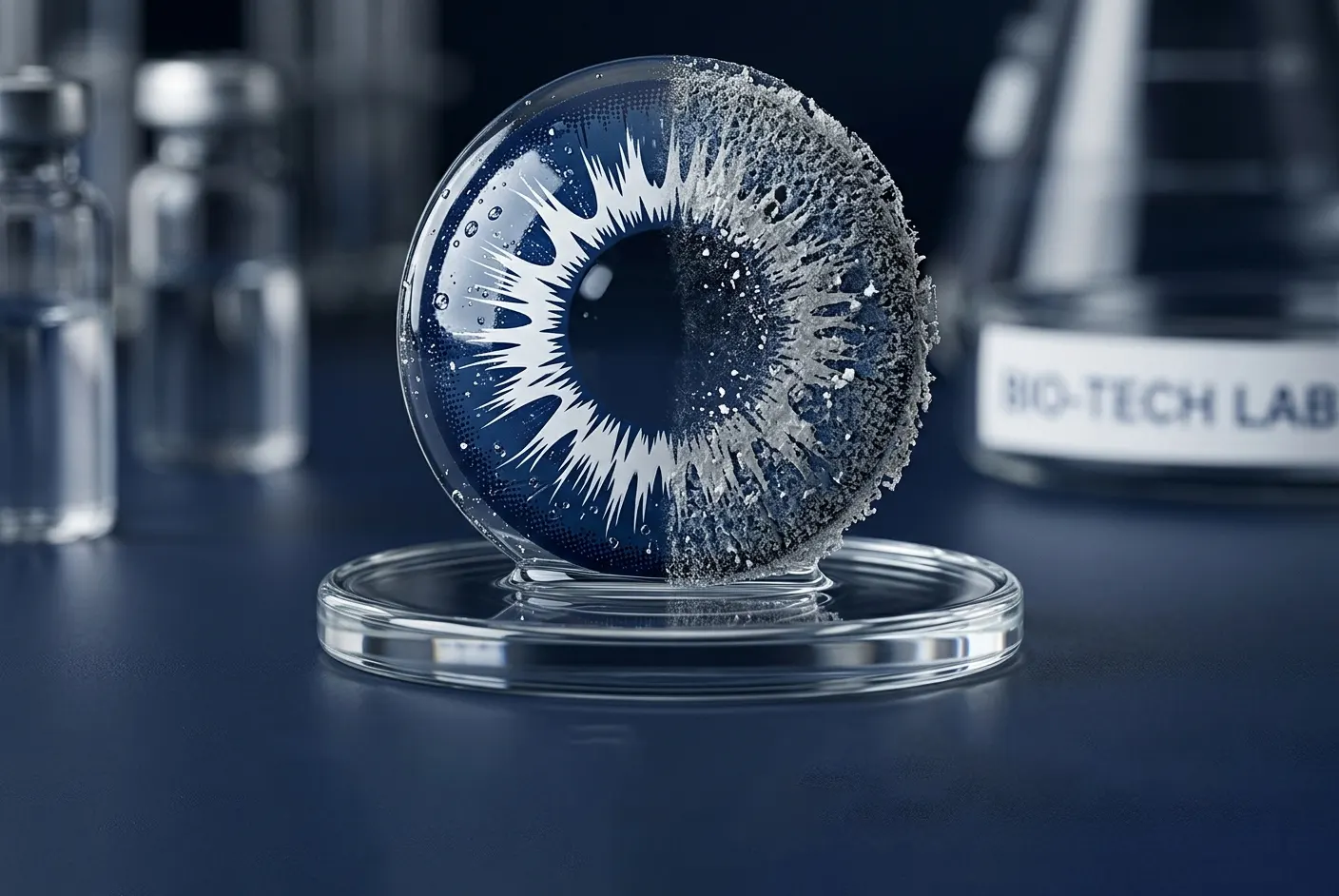
1. The "Kitchen Sponge" Mystery: Why Contact Lenses "Go Bad"
Why does a lens that felt perfect on Day 1 feel like sandpaper on Day 30? Think of a contact lens as a High-Tech Sponge.
-
Material Degradation (The Aging Sponge): Over time, a sponge gets stiff, loses its shape, and starts to crumble because of the water, soap, and scrubbing. This is Degradation. In colored contact lenses, it’s the polymer breaking down due to tears, oxidation, and cleaning.
-
Protein Deposits (The Dirty Sponge): Even if the sponge is strong, if it fills up with grease and food particles, it stops absorbing water and becomes "slimy." This is Protein Deposits. Your tears contain proteins (like Lysozyme) that stick to the lens surface or "hide" inside its pores.
Why this matters to your customers:
When these two things happen, the lens becomes "foggy," "scratchy," and "dry." It’s the #1 reason users switch brands or stop wearing color lenses altogether.
2. The Four Material Rivals: How They Handle the "Dirt"
Not all materials handle this "aging" the same way. Here is the breakdown for brand purchasers:
A. Ionic HEMA (The "Magnet" Sponge)
This is the most common material in budget annual lenses, but it’s a brand-killer.
-
The Problem: These lenses carry a negative electric charge. Your tear proteins carry a positive charge.
-
The Result: The lens acts like a magnet, pulling proteins onto the surface. Within hours, these lenses can accumulate 10x more protein than other materials. They turn white and "foggy" very quickly.
B. Non-Ionic High-Water HEMA + NVP (The "Balanced" Sponge)
This is our core technology. By adding NVP/PVP to the HEMA base, we create a lens that is "electrically neutral."
-
The Advantage: Because it is non-ionic, it doesn't "pull" proteins in. Instead of being a magnet, it’s like a deep-well filter.
-
The Logic: It stays clear much longer than ionic lenses. While it can eventually "soak up" small proteins over months, it avoids the rapid, aggressive buildup that causes eye irritation (GPC).
-
Best For: Brands that want a "Luxury Daily" or "Premium Monthly/Yearly" feel with a soft, wet sensation.
C. Standard Non-Ionic HEMA (The "Tight" Sponge)
Low water, tight structure.
-
The Advantage: Very stable. It doesn't have many pores, so it’s hard for proteins to get inside.
-
The Downside: It’s stiffer and can feel "harder" on the eye after a few hours of wear. It degrades by slowly becoming brittle.
D. Silicone Hydrogel (The "Oil-Lover")
The "Pro" material for high breathability.
-
The Surprise: While it resists protein better than HEMA, it loves lipids (oils).
-
The Problem: It can suffer from "Protein Denaturation." The few proteins that do stick to silicone change their shape (denature) and become "angry" and irritating to the eye. It doesn't turn white/foggy like HEMA, but it can feel "greasy" or "sticky."
3. Why Color Lenses Age Faster
Color lenses are more sensitive than clear ones. Why? Because the Pigment Layer (the Sandwich) creates tiny microscopic ledges where proteins love to hide.
-
The edges of the color pattern create tiny "micro-ledges."
-
Proteins and lipids love to hide in these pattern borders.
-
If the material is a cheap Ionic HEMA, the color pattern will turn yellow or white with deposits within weeks.
Our Solution: By using Non-Ionic HEMA+NVP, we ensure the pigment layer stays protected and the surface remains "invisible" to deposits.
4. Comparison Summary for Brand Purchasers
| Material Type | Protein Attraction | Life Expectancy | Hand-feel / Comfort | Best For |
| HEMA + NVP | Low (Neutral) | High | Ultra-Soft / Wet | Mass Premium Brands |
| Ionic HEMA | Very High | Low | Initial Softness | Budget / "Disposable" |
| Silicone Hydrogel | Very Low | Very High | Firm / High-Oxygen | High-End / "Pro" |
5. Strategic Advice: Retention is the Only Metric That Matters
A customer buys the first pair because of the Color.
They buy the second pair because of the Comfort.
If your lenses "degrade" or "collect protein" too fast, you might make a sale today, but you’ve lost the customer for life. By choosing a Non-Ionic HEMA + NVP base, you are choosing a material that stays as fresh as your designs.
"Would a user feel the difference after 30 days?"
With Ionic HEMA, the answer is usually "Yes, it's worse."
With our Non-Ionic HEMA+NVP, the answer is "It still feels like Day 1."
That is the secret to a successful brand.