A first order can go perfectly and still tell you very little about whether a contact lens supplier will be reliable six months later.
The products arrive on time. The specifications match. The documentation is complete. The cartons are packed correctly.
Nothing appears wrong.
Then one of those products becomes a regular seller.
You return for a repeat order and discover that several important powers are unavailable. The expected replenishment time has changed. A packaging detail has been updated. Or the supplier can no longer give you a useful date for the next quantity.
The first shipment was successful.
The supply relationship is now facing a different test.
A first order proves that a supplier can deliver once. Long-term distribution requires evidence that the supplier can keep supporting the business after the first order is over.
That evidence does not appear all at once.
It appears across repeat orders.
This guide focuses on what distributors, optical wholesalers, and professional retailers should watch as that evidence accumulates.
It does not replace manufacturing due diligence, compliance verification, or product documentation checks. Those determine whether a supplier deserves consideration in the first place.
Replenishment reliability asks a later question:
What happens when you need the same commercial relationship to work again?
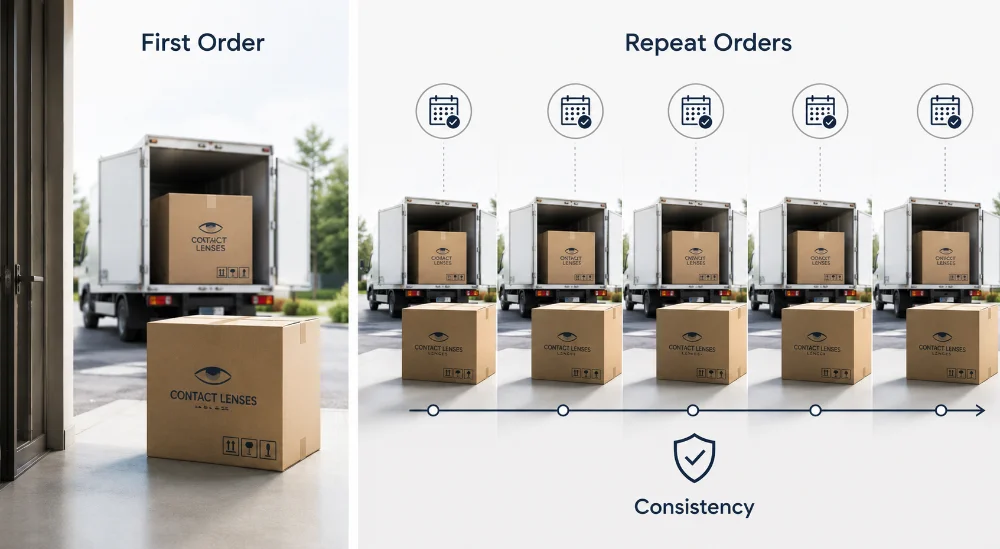
Start with the Products Your Business Actually Depends On
A large catalog matters when you are exploring a supplier.
It matters less once your own market starts deciding which products are important.
A distributor may launch 20 products and discover after several months that only six are responsible for most repeat demand.
Those six now matter differently.
They may already have:
- established product listings;
- recurring retailer orders;
- common prescription powers;
- trained sales staff;
- repeat customers;
- inventory allocated around their expected sales.
At that point, the useful question is no longer:
How many products can this supplier offer?
It is:
Can I keep buying the products around which my business is starting to form?
A SKU can still exist in a catalog while becoming difficult to support commercially.
The design may still be active, for example, but several important powers are frequently unavailable.
Or a product technically remains orderable, but replenishment gaps have become long enough that the distributor must either hold unusually deep inventory or accept regular stockouts.
For prescription products, this distinction becomes even more important.
A clear lens range with many listed powers can look complete until the same commercially important powers repeatedly disappear during replenishment.
That is one reason the ideas in How to Build a Reliable Prescription Clear Contact Lens Portfolio for Distribution extend beyond assortment planning. A reliable portfolio also depends on whether its commercially important configurations can remain available.
The same applies when deciding which contact lens SKUs deserve deeper inventory.
The more capital a distributor commits behind a SKU, the more costly weak replenishment becomes.
A Hypothetical Distributor Case: What the First Order Could Not Show
Consider a hypothetical regional optical distributor. This example is illustrative and does not represent Mislens customer data.
The distributor introduces a new contact lens range from Supplier A.
The opening assortment contains 12 commercially relevant SKUs and several common prescription powers. Four products are expected to become the core range, while the rest are included to give stores broader choice.
The first order is uneventful.
Products arrive as expected.
The information supplied during purchasing matches what the distributor receives.
Stores list the range. Staff become familiar with it. Product pages are published.
Four months later, the sales picture begins to change.
Two products—a natural brown style and a soft gray style—now account for a large share of repeat purchasing.
The distributor responds in a logical way.
It reduces inventory behind several slow-moving products and begins committing more stock to the two proven performers.
Then the third replenishment cycle begins.
Both products are still listed as active.
Nothing has officially been discontinued.
But two commonly requested powers of the brown lens are unavailable. One important power of the gray lens is waiting for the next production cycle.
The distributor asks when those configurations will return.
The supplier cannot provide a useful date.
From the supplier's catalog perspective, both products still exist.
From the distributor's operating perspective, the products have become less dependable.
That difference matters.
The distributor has already invested in demand.
Retailers expect the products.
Customers are returning for them.
Inventory decisions have been reorganized around them.
The issue is no longer simply whether Supplier A can produce a contact lens.
It is whether the distributor can confidently continue building business around those particular products.
Several months later, another test appears.
A retail chain expands the natural brown lens into additional stores, increasing the next requirement significantly.
Supplier A cannot provide the full quantity immediately.
That does not automatically mean the supplier has failed.
A realistic supply chain will sometimes face capacity or inventory limits.
What matters now is the quality of the answer.
A usable response might explain:
- what quantity is available immediately;
- which powers are constrained;
- what can ship as a partial replenishment;
- which quantity is expected in the next production cycle;
- approximately when that second quantity should become available.
The distributor may not get everything it wants.
But it can make another decision.
It might prioritize its highest-volume stores, delay a promotion, split the replenishment, or protect the most important prescription powers.
Compare that with receiving only:
“Soon.”
The supply shortage is the same.
The distributor's ability to manage it is completely different.
This is the kind of difference that the first order could never reveal.
Repeat Orders Should Still Feel Like the Same Commercial Product
Reliable replenishment is not only about whether another shipment arrives.
It also matters what arrives.
A distributor is not buying a product name in isolation. It is building listings, inventory rules, retailer expectations, and documentation around a particular product configuration.
Repeat orders therefore need reasonable continuity in areas such as:
- specifications;
- prescription range;
- replacement cycle;
- labeling;
- packaging information;
- product appearance where commercially relevant;
- supporting documentation.
This does not mean that nothing can ever change.
Packaging gets updated.
Documents are renewed.
Production arrangements evolve.
A prescription power can become temporarily unavailable.
The important distinction is whether commercially meaningful changes are controlled and communicated.
For an optical distributor, a product change can create work well beyond the physical inventory.
A specification update may require product information to be reviewed.
Packaging changes may affect existing listings or retailer materials.
Changes in prescription availability can alter how useful the product remains as part of the assortment.
Documentation may need to be checked again for the relevant product and market.
This is where the earlier supplier-evaluation work still matters.
10 Red Flags in Color Lens Manufacturing: A Buyer's Sourcing Guide helps identify risks around the way the product is made.
The 2026 Guide to Compliance, Supplier Audits, and ROI addresses another layer: whether the supplier and product deserve commercial consideration in the first place.
Repeat-order behavior tells you whether those original assumptions remain workable over time.
A distributor should not need to reopen the entire product evaluation every time another shipment is placed.
Lead Time Becomes Useful Only When You Can Plan Around It
A supplier may advertise a short lead time and still create a difficult inventory problem.
Consider two replenishment histories:
| Supplier | Recent Replenishment Times | Variability | Inventory Planning |
|---|---|---|---|
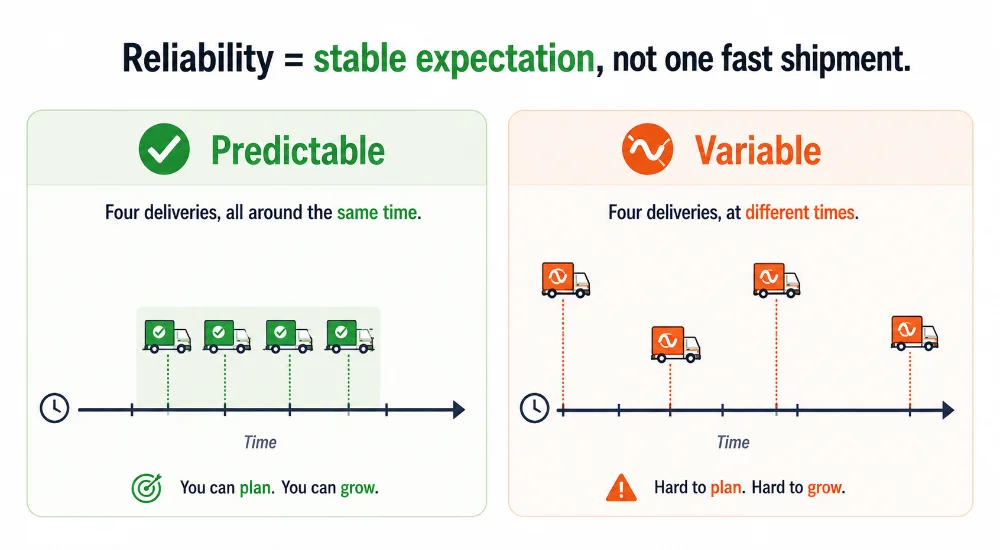
| Supplier A | 24, 26, 25, 27 days | Low | Easier |
| Supplier B | 18, 42, 23, 51 days | High | Harder |
Supplier B has delivered faster.
Once.
It has also taken nearly twice as long on another order.
For the distributor, that variation affects inventory.
If replacement stock normally arrives within a narrow range, the buyer can build a replenishment plan around that range.
If the same supplier sometimes takes three weeks and sometimes seven, the distributor has to protect against a much wider possibility.
That usually means one of two things:
hold more inventory,
or accept more stockout risk.
The hidden cost of inconsistent replenishment can therefore sit in the distributor's own warehouse.
More capital is being held not because customer demand requires deeper inventory, but because the buyer cannot confidently predict when the next order will arrive.
A consistently long lead time can still be a commercial disadvantage.
The point is not that predictability makes slow supply good.
The point is that a known constraint can be managed.
An unstable one forces the buyer to keep compensating for uncertainty.
Useful questions include:
- What does normal replenishment actually look like?
- How wide is the usual timing range?
- How often does reality fall outside that range?
- When delays appear, how early does the buyer learn about them?
- Does the revised timing become more accurate once the issue is identified?
These answers become much more informative after several orders than they were during the initial quotation.
Normal Orders Are Not the Hardest Test
Many supply relationships look reliable when demand behaves exactly as forecast.
The more revealing moments tend to happen when the distributor's business changes.
A strong SKU accelerates.
A retailer adds more stores.
One prescription range sells faster than expected.
An ecommerce channel suddenly begins generating larger repeat orders.
A distributor that has already committed deeper inventory to a proven SKU now needs the supplier to respond to a different level of demand.
The supplier does not need unlimited stock.
That is not a realistic standard.
What the distributor needs is visibility.
If the full quantity is not available:
What is?
If several powers are constrained:
Which ones?
If the next production cycle matters:
When is it expected?
If only part of the requirement can be fulfilled:
Can the order be split?
These are operational answers.
They allow the distributor to choose what to do next.
That ability becomes increasingly valuable as a SKU moves from “something we sell” to “something our downstream customers expect us to have.”
Changes Matter Less When They Stop Being Surprises
No supplier can promise that every shipment, production schedule, product configuration, and document will remain unchanged forever.
That is not a useful standard for evaluating a real supply chain.
A better standard is whether meaningful changes become visible early enough to manage.
Imagine that a production issue will delay the distributor's next shipment by two weeks.
If the buyer knows early, there may still be time to move inventory between customers, delay promotional activity, protect important accounts, or revise the next purchase.
If the same information only appears after the original delivery date passes, those options narrow quickly.
This is why communication around:
- SKU availability;
- production timing;
- specification changes;
- packaging updates;
- documentation;
- replenishment timing
is part of the operating relationship rather than simply a customer-service feature.
The distributor is not looking for a supplier that never encounters difficult news.
It is looking for enough notice to avoid turning every difficult development into an emergency.
Do Not Judge the Supplier by One Bad Shipment Either
The same logic works in the other direction.
If one successful first order does not prove reliability, one difficult shipment does not automatically prove unreliability.
A temporary power shortage can happen.
A transport disruption can delay a shipment.
A carton problem can occur.
What matters is what happens next.
Does the cause become clear?
Is there a realistic corrective action?
Does normal performance return?
Or does the same uncertainty appear again?
A recurring problem begins to look different:
the explanation changes from one conversation to another;
important information repeatedly arrives late;
the same core SKU becomes unavailable again;
lead times continue moving outside the expected range;
the distributor keeps making emergency inventory decisions.
At that point, the issue is no longer one shipment.
It is the pattern behind the shipments.
That distinction is important because long-term supplier evaluation should be strict without becoming unrealistic.
The standard is not perfection.
It is whether the business becomes more predictable as the relationship develops—or less.
What Repeated Orders Actually Reveal
After several replenishment cycles, the distributor knows things that the first quotation and first shipment could not show.
It knows whether successful SKUs remain commercially replenishable.
It knows whether product information stays stable enough to support existing listings and downstream customers.
It has seen whether typical replenishment timing becomes easier to anticipate.
It has observed how the supplier responds when demand exceeds the normal order pattern.
It has also seen how shortages, changes, and delays are communicated.
None of these requires a branded framework.
They are simply pieces of evidence accumulated over time.
That is why a long-term supplier relationship should gradually become easier to understand.
By the third, fourth, or fifth repeat order, the distributor should have a better idea of:
- which products it can safely build around;
- how much inventory it needs to protect;
- what replenishment timing normally looks like;
- how exceptions are handled;
- whether operating surprises are becoming rarer or more frequent.
If every repeat order still feels like a new experiment, that itself is information.
Evaluate Reliability Before the Supplier Becomes Expensive to Replace
The easiest time to change suppliers is before the business depends heavily on one.
That becomes harder after several successful sales cycles.
By then, the distributor may have built:
- product listings;
- retailer relationships;
- staff familiarity;
- prescription coverage;
- inventory rules;
- customer expectations;
- marketing assets;
- repeat-order routines.
around the existing products.
Changing supplier at that stage is no longer just a purchasing decision.
Replacement products may need to be evaluated.
Documentation may need to be checked again.
Listings may need revision.
Old and new inventory may overlap.
Retailers may need updated information.
Customers may notice that a familiar product has changed.
That is why replenishment reliability deserves attention before repeated problems force the distributor to act.
A supplier that delivers one good shipment has shown something useful.
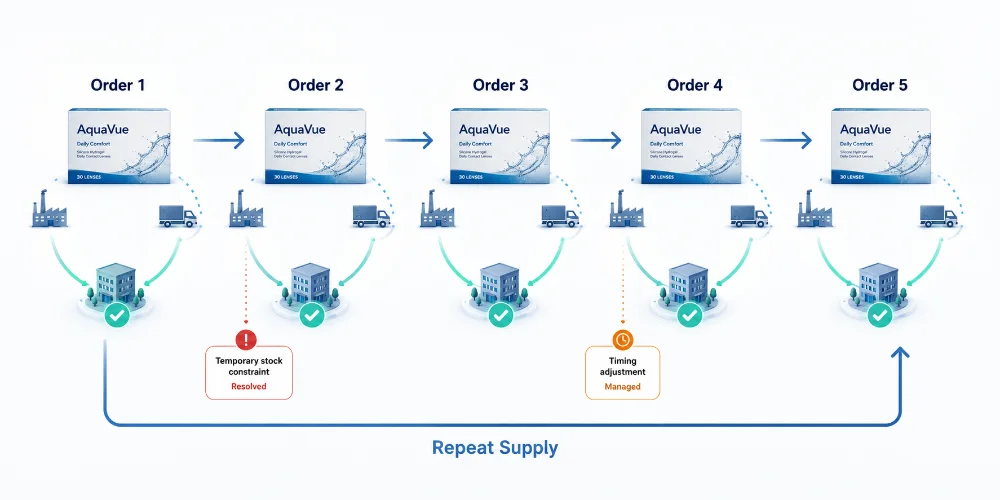
A supplier that continues supporting the same commercial relationship through the third, fifth, and tenth replenishment cycle has shown something much more valuable.
And that evidence cannot be compressed into the first sample, first quotation, or first purchase order.
It has to accumulate.
For distributors evaluating long-term cooperation with Mislens, product specifications and documentation are therefore only part of the discussion. Product continuity, prescription requirements, repeat-order expectations, and how future supply changes are communicated can all affect whether a product range fits a long-term distribution plan. Mislens content and cooperation should remain focused on professional B2B distribution, product and documentation credibility, and long-term commercial fit rather than unsupported promises about stock or delivery.
Before starting that discussion, it helps to prepare:
- your destination market;
- sales channel;
- product category;
- expected repeat-order pattern;
- prescription or SKU requirements;
- documentation requirements.
Those details provide a much better basis for evaluating long-term cooperation than the first quotation or first shipment alone.
Request Product and Distribution Information or Discuss Distribution with Mislens to review the product and distribution requirements for your market.