Most people think sourcing a dramatic, vibrant colored contact lens is simple: just pick the brightest colors in the catalog.
That sounds logical, but it misses the real issue.
If you just print bright, high-saturation color onto a lens, it doesn't look like a striking human eye. It looks like a piece of plastic. The real reason a multiracial style colored contact lens succeeds is its ability to reconstruct the biological structure of a naturally light-colored iris.
Once you understand that consumers are not buying "a color," but rather an entirely new optical structure, everything about how you source vibrant lenses changes.
What Are Vibrant Colored Contacts?
Vibrant colored contacts (often called multiracial style or exotic lenses) are highly pigmented cosmetic lenses designed to completely mask a naturally dark eye and replace it with a striking, light-colored illusion. For wholesale distributors, sourcing high-quality opaque colored contacts for dark eyes requires evaluating three things: brightness lift, structural definition, and layered transparency.
The First Principle: What Makes a Vibrant Lens "Qualified"?
At its core, a vibrant lens is not a color. It is a visual objective.
The goal of these lenses is to give the wearer the optical characteristics of a naturally light-colored iris—such as a striking grey, brilliant blue, or radiant hazel.
Therefore, as a distributor, your evaluation standard should never be "is this color pretty?" The evaluation standard must be:
*Does it successfully lift the brightness of a dark eye?
*Does it feature a realistic iris structure?
*Does it possess 3D depth?
If a SKU fails any of these three rules, it will look flat, artificial, and ultimately fail in the market.
The 3 Pillars of a High-Quality multiracial style SKU
When selecting vibrant lenses for your catalog, ignore the color names. Instead, look at these three structural dimensions.
1. Iris Brightness Lift (Escaping the Dark Pupil)
The defining feature of a multiracial style colored contact lens is its ability to significantly elevate the overall "lightness" of the eye.
A premium SKU must:
·Visually separate the iris from the wearer's naturally dark pupil.
·Maintain color recognition even in dim indoor lighting.
·Deliver a striking, radiant effect under natural sunlight.
·Highly effective color palettes for this effect:
*Ice Gray
*Blue-Gray
*Hazel / Amber
*Olive Green
*Light Ash Brown
Danger Signals (What to avoid):
Lenses labeled "gray" that are too dark and just make the eye look muddy.
Brown lenses that offer no brightening effect.
High saturation lenses that lack transparency, resulting in a "zombie eye" effect.
2. Iris Structure Definition (The Magic Engine)
This is where the true value of a striking lens is built.
What does "structure definition" mean? It means the lens must look like it was designed by biology, not by a printer. The eye must look like it has anatomical depth.
A high-quality structure features:
Clear Radial Fibers: Fine lines that radiate outward from the pupil, providing direction and mimicking human muscle tissue. This is the primary source of the "light-eye" illusion.
Multi-Layer Texture: It should never be a single layer of ink. It must contain at least 2 to 3 overlapping visual structures with varying light and dark tones.
Density Variation: Some areas of the pattern should be tightly clustered, while others remain slightly transparent. This controlled irregularity creates realism.
Danger Signals:
Gear-like, repeating patterns.
Perfectly symmetrical concentric circles.
Mechanical shapes. These immediately destroy the illusion of authenticity.
3. Enhanced Limbal Definition (The 3D Anchor)
The limbal ring is the outer edge of the iris. In vibrant, light-colored lenses, the limbal ring is crucial because it provides visual containment.
Without an outer ring, a bright lens bleeds into the white of the eye (the sclera), making the wearer look terrified or unnatural.
*A premium outer ring must be:*
Defined, but not rigid: It should have a subtle darkening effect with a blurred transition.
Visually focusing: It should shrink the visual center, pushing the bright inner colors forward, creating a deep, 3D "piercing" look.
*Danger Signals:*
Pure black, thick, solid rings (creates a cheap, cartoon effect).
Absolutely no outer ring on a very light lens (looks flat and reptilian).
Abrupt, sharp boundaries with no gradient.
People do not buy features. They buy certainty. A well-designed limbal ring gives the consumer the certainty that their eyes look deep and naturally striking.
The Secret to the "Premium Look": The 3-Layer Architecture
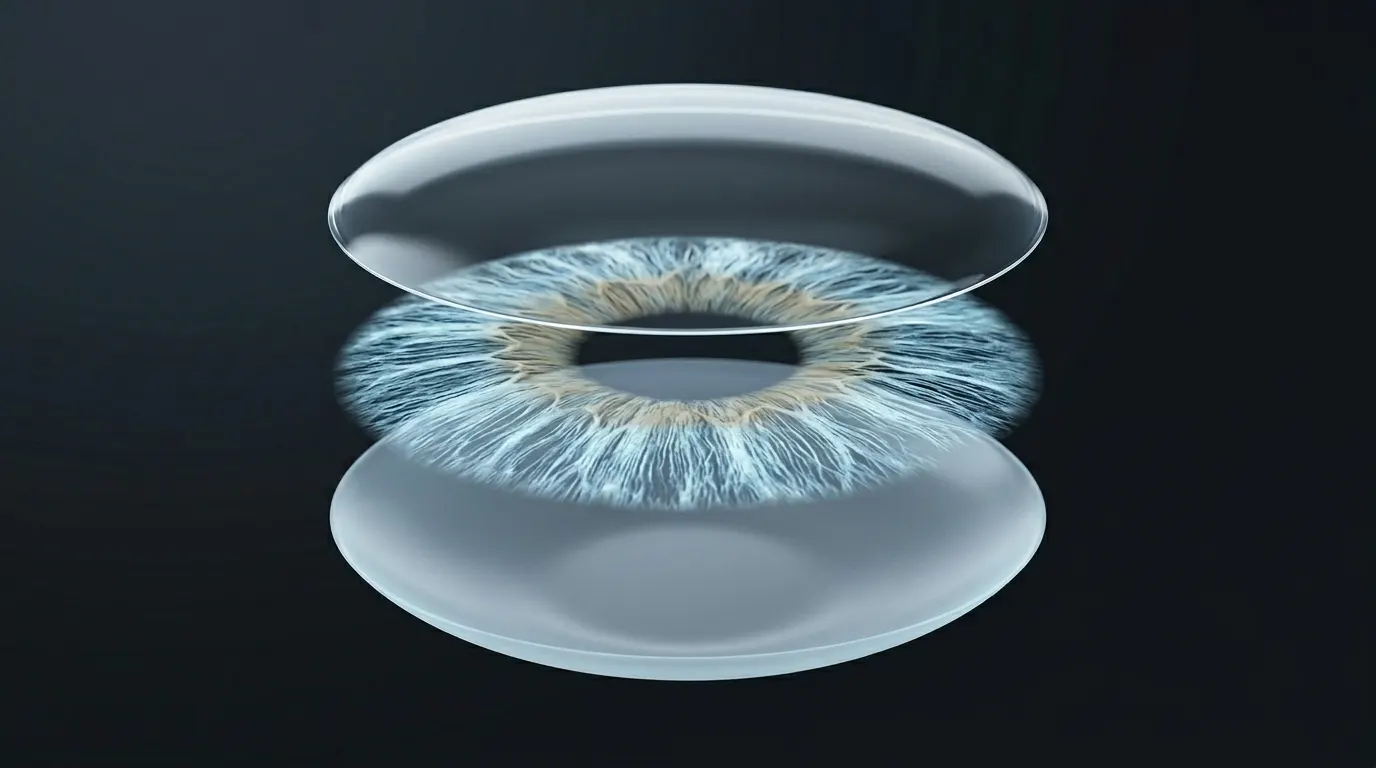
A mature, high-end vibrant lens design is rarely just one layer of pigment. It is built using a precise three-layer visual system.
Layer 1: The Base Tone
This layer determines the overall color direction (e.g., an ash-gray base, or an olive-green base). It acts as the canvas.
Layer 2: The Iris Fiber Layer
This is the architectural layer. It contains the radial patterns, broken fibers, and local light/dark variations that trick the brain into seeing a real anatomical iris.
Layer 3: The Optical Depth Layer
This is the enhancement layer. It adds local highlights, micro-reflections, and transparent overlays. It simulates how light bounces off a naturally light-colored eye.
The takeaway for buyers:
The core of a vibrant lens is not its color formula. It is its three-layer visual system.
The 4-Step Sourcing Framework for Distributors
How do you sort through thousands of wholesale options to find the winners? Use this 4-step practical framework.
Step 1: The Brightness Test
Ask yourself: Does this lens distinctly lighten the eye? Is the color change instantly recognizable?
If the answer is unclear, or the change is too subtle, it is not a true multiracial style SKU. Drop it.
Step 2: The Macro Structure Test
Zoom in on the high-resolution product photos.
*Are there distinct radial fibers?
*Is there a layered structure?
*Do the fibers have directional flow?
*If the lens looks like a flat, solid sheet of color, it will fail on the consumer's eye.
Step 3: The Limbal Boundary Test
Examine the outer edge.
*Is there a soft boundary?
*Does it have a natural gradient?
*Does it create a 3D shrinking effect?
The quality of the outer ring dictates the "premium feel" of the lens.
Step 4: The Lighting Test (Crucial)
A vibrant lens must survive different environments. You must test the SKU in:
*Dim indoor light
*Bright natural sunlight
*Flash photography
Does the structure hold up? Do the layers still show depth? Or does it suddenly look like "dead, flat color"?
Consumer Psychology: What Are They Actually Buying?
To sell these lenses, you must understand your customer better than they understand themselves.
Consumers who buy high-opacity, striking lenses are not just trying to "look pretty." Their core desire is transformation.
They want the illusion of a naturally light eye, overcoming their native dark pupil.
They are buying:
The light-eye optical illusion
A 3D, striking iris
An exotic, transformative aura
High-impact camera performance
The 3 Commercial Tests for Your Catalog
As a distributor, your ultimate goal is sales volume. Before committing to a large order of vibrant lenses, run them through these three commercial filters:
1. Camera Performance (The Social Media Test)
Does this lens pop in photos and videos? The primary battleground for multiracial style colored lenses is Instagram and TikTok. If it doesn't look good on a screen, it won't sell.
2. Lighting Flexibility
Does the aesthetic hold up across different environments? A good SKU looks dramatic but acceptable in an office, and stunning outdoors.
3. The Recognition Balance
Is the color change obvious enough to be thrilling, but structured enough to be worn outside of a costume party? The best SKUs balance high impact with biological realism.
A Final Sourcing Rule
The real issue in the colored contact industry is that too many brands sell flat ink as if it were a finished design.
**Premium vibrant lenses = Distinct Brightness Lift + Clear Iris Structure + Soft Limbal Definition + Multi-Layer Transparency.**
If you are comparing suppliers today, stop looking at color swatches on paper. Ask about their fiber patterns. Ask about their optical depth layers.
If you want to dominate the striking/vibrant lens market, your catalog must offer a visual architecture that your competitors simply cannot match.
Ready to see the difference for yourself?
Contact our B2B sourcing team today. Request a sample pack of our 3-layer multiracial style colored contact lenses, test them under a macro lens, and see exactly what true structural definition looks like.