Many consumers feel nervous when they hear that their color contact lenses are made in Asia, especially in China or Korea.
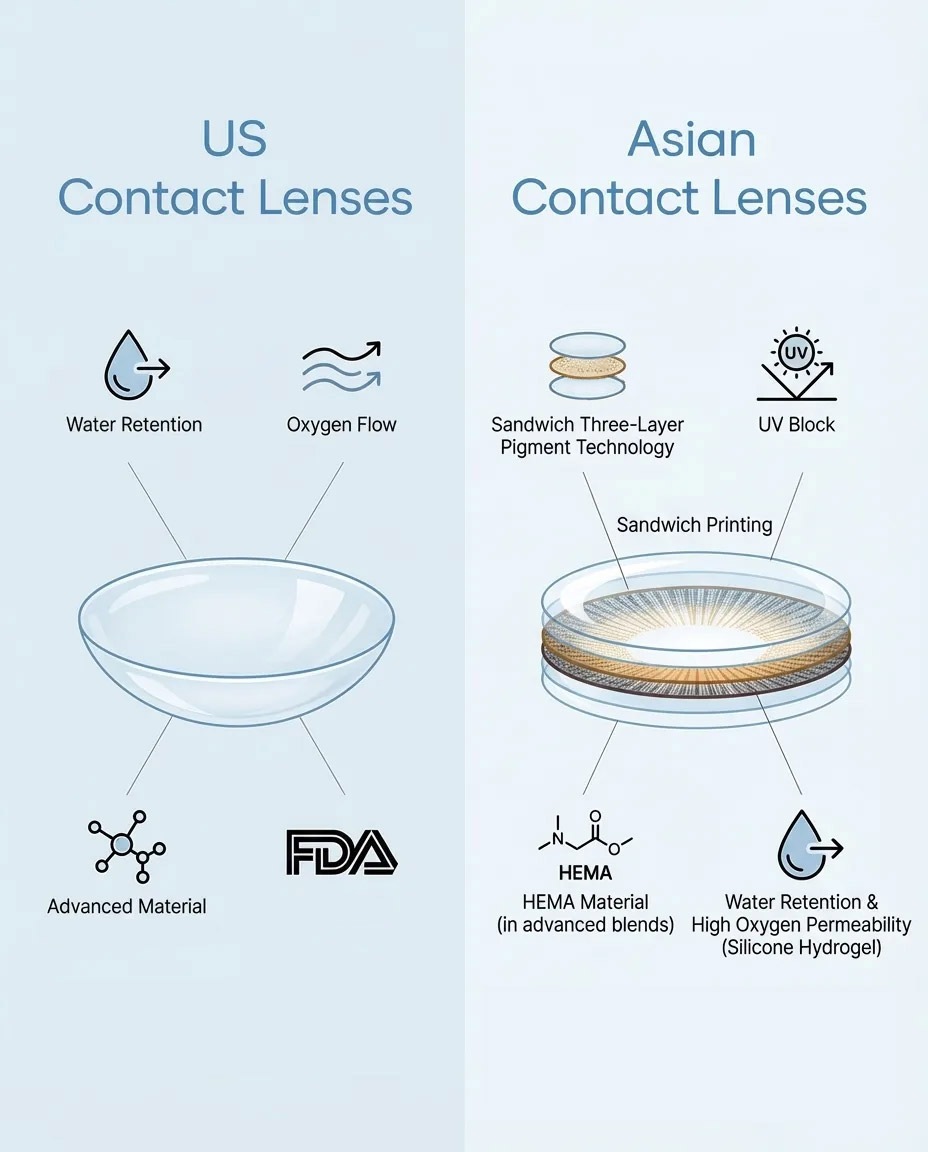
This article has one key message: when we compare the mainstream color contact lenses made in the United States, Europe, and Asia (especially China and Korea), the core manufacturing technologies and materials are very similar. What really differs are regulatory frameworks, product positioning, and quality control – not “who is technologically advanced and who is backward.”
At the same time, we must stress: contact lenses are products that sit directly on your eyes. They must only be manufactured and sold by companies with proper licenses and approvals.
1.How do consumers in different regions feel about color contacts?
1.1 United States: Strongest focus on safety and strict regulation
In the U.S., the law treats all contact lenses – including plano (non-prescription) colored contacts – as medical devices. A valid prescription from an eye doctor is required for legal purchase.
Most American consumers and many Chinese Americans emphasize:
-
“Do not buy lenses without a prescription.”
-
“Always check whether they are FDA approved.”
In the U.S. market, everyday color contacts tend to be subtle and natural looking. Brands highlight comfort, oxygen permeability, and safety. Consumer concerns focus on:
-
Risks of buying lenses without a prescription or from unknown sources.
-
Whether dramatic Halloween or cosplay lenses are properly regulated and safe.
Overall, trust is highest for “branded products + doctor’s prescription,” and very low for ultra-cheap, unregulated colored lenses.
1.2 Europe: Less daily wear, concerns about limited choices and unclear regulation
In many European countries, some colored lenses are not always managed as strictly as in the U.S., and in some cases may be classified more like cosmetics or decorative lenses. This makes some consumers worry that regulation is not as strict or consistent.
Color contacts are not as commonly worn on a daily basis. They are more often used for:
-
Parties and special events (like Halloween).
-
Cosplay or stage performances.
Common complaints from European users include:
-
Limited local options, colors can look artificial or unnatural.
-
To get “K-beauty style” natural lenses, they have to order from overseas, which means higher shipping costs, longer waiting, and worries about customs and authenticity.
Their concerns are therefore a mix of safety, aesthetics, and convenience.
1.3 Asia (especially China and Korea): High demand, strong beauty focus, growing safety awareness
In Asia – especially China, Korea, and Japan – color contacts have become part of the daily beauty routine for many people. For a lot of young consumers, “full makeup” means: base, eye makeup, plus colored lenses.
K‑pop, K‑beauty, and social media trends continue to drive demand for natural-looking, eye‑enlarging designs.
When Asian consumers review color contacts, they focus on:
-
Color design: whether it looks pretty, natural, and enlarging.
-
Comfort: dryness, irritation, or foreign-body sensation.
-
Brand legitimacy: certifications, approvals, and negative case reports.
In recent years, as more eye doctors and media talk about risks, many consumers have become much more aware that:
-
Overwearing lenses, sleeping in them, or using expired lenses can seriously harm the cornea.
-
“Three-no products” (no license, no manufacturer info, no batch number) and counterfeits are extremely risky.
2. Are there big differences in technology and materials between regions?
Many people assume that the U.S. and Europe must be using “more advanced” materials, and that Asian products are somehow behind.
In reality, contact lens manufacturing is a global, mature industry. The mainstream materials and processes used in the U.S., Europe, China, and Korea are closely related and often identical in principle.
2.1 Materials: The same “hydrogel family” worldwide
Most soft contact lenses, including colored lenses, are made from:
-
Traditional hydrogels (often based on HEMA and related monomers).
-
Modified hydrogels (adding hydrophilic or moisturizing components to adjust water content and comfort).
-
Silicone hydrogels (adding silicone-containing monomers to greatly increase oxygen permeability and reduce hypoxia during extended wear).
Both U.S. brands and reputable Chinese/Korean manufacturers use these same material families. The main differences lie in:
-
Exactly which formulation is chosen (water content, oxygen transmissibility, stiffness, etc.).
-
Whether the lens uses higher-end silicone hydrogel and/or additional surface-wetting technologies.
In other words:
-
There is no “mystery material” that only Western brands use and Asians do not.
-
In fact, many Western brands have their lenses manufactured in Asia, using the same international-standard materials.
2.2 Processes: Similar coloring and encapsulation techniques
The “coloring process” is also very similar across regions, with two core goals:
-
Print a stable pattern and color onto/into the lens.
-
Make sure the pigment does not directly touch the cornea.
The most common techniques include:
-
Printing the color pattern inside the mold, then curing the lens material around it so that the color layer is sealed inside.
-
Using multilayer structures so that the pigment is sandwiched in the middle.
Whether a lens is made in the U.S., Europe, China, or Korea, responsible manufacturers all stress that the color layer should not be in direct contact with the eye.
The production flow typically includes:
-
Mold preparation and cleaning.
-
Pattern printing and coloring.
-
Filling with monomer and polymerization.
-
Demolding, hydration, and surface finishing.
-
Inspection (defects, optical parameters, color consistency).
-
Sterilization and packaging.
Differences between factories come down to:
-
Degree of automation.
-
Strictness of inspection standards.
-
Use of extra surface treatments (for example, plasma treatment or wetting coatings).
Again, this is about “good factories versus poor ones,” not “Western factories versus Asian factories.” Asian facilities often produce for global brands and meet the same high standards.
3. What really matters: regulation and quality control, not the country on the box
Even though the underlying technology and materials are broadly similar, several factors directly affect real-world safety:
-
Regulatory classification
-
United States: all contact lenses are medical devices, requiring prescriptions and rigorous testing.
-
Europe: classification and regulation differ by country; in some cases, decorative lenses are regulated less strictly than in the U.S.
-
Asia: China, Korea, Japan, and others have been tightening regulations, requiring medical-device-level licenses and approvals, and setting clearer rules for advertising and online sales.
-
Factory qualifications and quality systems
Regardless of where the factory is located, key questions are:
-
Does it have proper medical device manufacturing licenses or equivalent?
-
Does it operate clean rooms, validated sterilization, and full batch traceability?
-
Is it regularly audited by regulators or reputable third parties?
-
Brand responsibility and transparency
A responsible brand will clearly disclose:
-
Material type (hydrogel vs silicone hydrogel, and basic water content range).
-
Regulatory approvals and registration numbers.
-
Instructions for use, replacement schedule, and risk warnings.
By contrast, products that only emphasize being cheap or “influencer style,” with no regulatory info, no manufacturer details, and no batch numbers, are risky regardless of whether they claim to be “imported from Europe” or “Korean style.”
4. How should consumers think about origin and safety?
As a consumer, you can use a few simple rules:
-
Do not blindly assume “Made in the West = safer”
-
Many Western brands have lenses manufactured in Asia.
-
Safety comes from regulation, factory standards, and quality control – not from the country printed on the box.
-
Do not panic just because a lens is “Made in China” or “Made in Korea”
-
China and Korea have many high-level factories serving global brands and using mature, international-grade lens technologies.
-
Products from legitimate channels with proper licenses and documentation are not inherently less safe than Western ones.
-
Stay away from unlicensed, untraceable products
-
If a product has no clear certification, no manufacturer information, and no batch code, it is best to avoid it completely.
-
Ultra-cheap lenses with poor packaging and no instructions are high-risk, no matter what they claim about origin.
-
Even the best lenses must be worn correctly
-
Get an eye exam first and confirm you are suitable for contact lens wear.
-
Follow the replacement schedule strictly; do not overwear.
-
Never sleep in lenses unless specifically prescribed and approved.
-
Stop wearing lenses and see a doctor if you feel pain, redness, or discomfort.
Conclusion
From the perspective of technology and materials, modern color contact lenses are part of a globalized, mature industry. Reputable manufacturers in the U.S., Europe, China, and Korea commonly use similar hydrogel and silicone hydrogel materials and comparable encapsulated-color processes.
What truly determines safety and comfort is: proper licensing and regulation, the factory’s and brand’s commitment to quality, and the user’s own habits.
By focusing on these essentials instead of stereotypes about origin, consumers can enjoy the beauty-enhancing effects of color contacts while protecting their eye health.