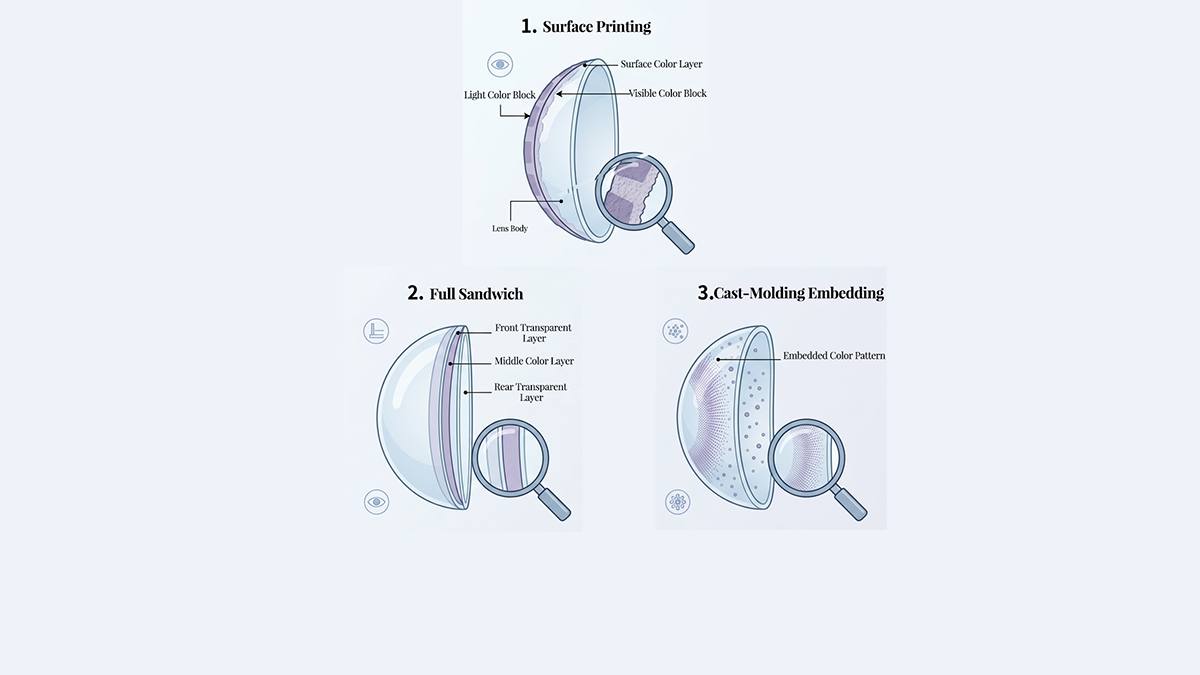
Origins: Surface Printing (1980s)
The first commercial colored contacts used silk-screen or pad printing on soft hydrogel lenses.
In silk-screening, a mesh stencil transferred opaque pigment ink directly onto the lens front surface (10-14mm iris pattern), followed by air-drying or thin protective coating.
Pad printing improved this by using a silicone pad to pick ink from an etched metal cliché and transfer it precisely to the curved surface—faster and more accurate for automation.
Key Drawbacks: Pigment layers (2-5μm thick) wore off during wear/cleaning, risking eye irritation or leaching into tears; uneven adhesion led to high rejection rates.
Transitional: Semi-Embedded Printing (1990s)
Semi-embedded bridged the gap by pad-printing patterns onto concave molds before injecting monomer liquid (e.g., HEMA).
The front mold received the color layer, then the convex mold pressed in liquid hydrogel, partially burying the pigment ~10-20% into the final lens during UV/thermal curing.
Improvements: Better pigment protection than pure surface methods, thinner lenses with decent oxygen permeability.
Limitations: Still partial exposure risk; not fully isolated like later techniques.
Gold Standard: Full Sandwich Process (1990s-Present)
The full sandwich (or "three-layer") method revolutionized safety by encapsulating color between two transparent hydrogel layers—now the most emphasized technique for buyers.
Detailed Workflow
-
Base Color Layer: Print a 2-4μm hydrophilic carrier film (monomers + dispersants) onto the female mold's concave surface.
-
Pattern Printing: Pad-print opaque pigment ink (biocompatible, non-leaching) onto specific iris zones of the carrier.
-
Monomer Pour: Inject lens precursor (HEMA/silicone hydrogel) to cover the entire pattern.
-
Mold Closure: Align male mold, dwell 30-500s for interpenetration, then cure via UV/heat—forming front/rear transparent barriers (20-50μm each).
-
Demold & Hydrate: Extract lens, hydrate to finalize ~38-60% water content.
Core Advantages
-
Zero Pigment-Eye Contact: Full encapsulation prevents fading, migration, or corneal irritation—FDA/CE Class III certified, <0.5% adverse events.
-
Durability & Consistency: Batch-stable colors, suitable for daily/monthly disposables; oxygen transmission >100Dk in silicone variants.
-
Natural Aesthetics: Refractive index matching creates lifelike iris halos and edge blends.
-
Scalability: Automated molding yields low defect rates; costs now competitive at 1.5x pad printing.
Buyer Tip: Verify "sandwich" claims via cross-section SEM images or supplier certifications—essential for premium private-label runs.
Modern Evolution: Cast-Molding Embedding (2000s+)
mold-embedded technology: integrates pigments directly into the molding process:
Pre-mix micro-pigments (<5μm) into monomer or coat molds, then high-pressure cast (50-200bar) for seamless fusion during polymerization—no distinct layers.
Safety Edge: Arguably equals or exceeds sandwich via uniform material integration, superior oxygen flow in ultra-thin (<0.08mm) dailies.
Cast-Molding Embedding Vs. Sandwich: No delamination risk, 30% higher throughput; slightly costlier pigments.
Current Market Adoption (2026)
| Process | Safety Level | Market Share (Asia) | Best For | Leading Brands |
| Surface/Pad | Low | <5% (low-end only) | Budget novelties | None |
| Semi-Embedded | Medium | ~10% | Transitional stock | Regional OEMs |
| Full Sandwich | High | 55-70% | Premium dailies/monthlies | J&J, Alcon, Bausch, Constar, Realcon, Iris |
|
Cast-Molding Embedding |
High+ | 25-35% (rising) | Ultra-thin dailies | Acuvue Define |
Sandwich dominates reliable supply chains, but embedding gains for next-gen disposables. For procurement, prioritize sandwich-certified suppliers to balance cost, compliance, and consumer trust—especially as regulations tighten globally. This progression from exposed pigments to fully embedded designs underscores a safety-first industry; savvy buyers focus on verified processes over marketing claims.
Contact Lens Wholesale Supplier>>>