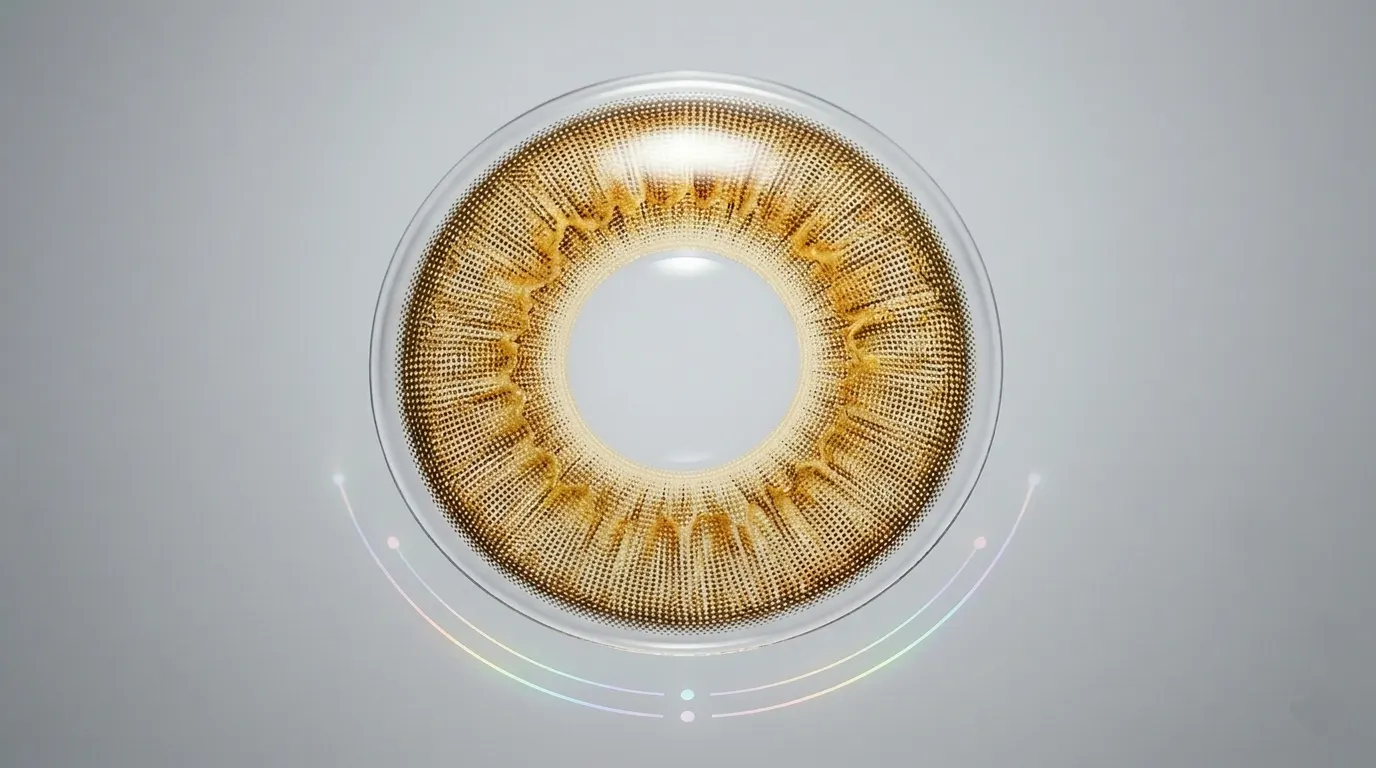
1. The Orientation Paradox
Most distributors ask: "Why do color contacts look fake?"
The answer isn't usually the print quality or the moisture content. It's the direction. Natural eyes have a single light source reflection. Highlight colored contact lenses attempt to mimic this "glow," but they face a physical reality: the human eye is a rotating sphere.
When a highlight meant for the 12 o'clock position rotates to 5 o'clock, the visual "logic" breaks. The eyes look mismatched, artificial, and—frankly—unsettling.
2. Solving the Rotation Issue
The primary reason why highlight contact lens rotates is the lack of a stabilization zone to counteract the natural torque of the eyelid. To solve this, we have moved beyond "visual design" and into "physical control." By implementing a Lower-Zone Ballast Alignment System, we provide a self-orienting lens that ensures the highlight stays where it belongs.
3. Why Highlight Lenses Fail in the Wild
In a lab setting, every lens looks perfect. In a customer's eye, things change.
-
The Rotation Problem: Every time a user blinks, the eyelid applies pressure. Without a stabilization mechanism, the lens drifts.
-
The Asymmetry Issue: If the left eye rotates 30 degrees left and the right eye rotates 45 degrees right, the "glow" effect becomes chaotic.
-
The "Fake" Aesthetic: This inconsistency is exactly why consumers feel their lenses look artificial.
4. The Solution: Lower-Zone Ballast Directional Stabilization
We have engineered a solution that borrows from Toric (astigmatism) lens principles but optimizes them for mass-market cosmetic use.
The Technical Mechanism:
-
Zone Thickening: We add a precision moon-shaped thickening (approx. 0.03mm) to the bottom of the lens.
-
Gravity & Eyelid Interaction: This "weight" works with the pressure of the lower eyelid to naturally guide the lens into the correct orientation.
-
Orientation Convergence: Unlike "axis locking" which is rigid and uncomfortable, our system uses convergence. The lens finds its optimal "home" position through natural blinking.
5. Technical Comparison: Stabilization Methods
| Feature | Standard Highlight Lenses | Our Directional Stabilization |
| Stability | Random Rotation | Self-Orienting |
| Consistency | Low (Mismatched eyes) | High (Balanced Glow) |
| User Effort | Needs manual adjustment | Automatic (Adjusts via blinking) |
| Realism | Often looks "fake" when drifted | Natural light-mimicry |
| SKU Complexity | Low | Low (One-size-fits-all) |
6. How to Fix Contacts When They Rotate
Retailers often get asked by customers: "How to fix contacts when they rotate?"
With traditional lenses, the only answer is manual adjustment—literally touching the eye to move the lens. Our technology removes this friction. By utilizing the blink cycle to reset the lens position, the user experience becomes "set it and forget it."
7. The Business Logic
Why should a distributor care about 0.03mm of thickness?
-
Lower Return Rates: Most "aesthetic" complaints are actually "orientation" complaints.
-
Repeat Purchases: Once a user experiences a lens that doesn't require constant adjustment, they rarely go back to "random" rotation lenses.
-
High-Value Positioning: You are no longer selling a "pattern"; you are selling a "system" for realism.
8. Technical Boundaries & Expectations
It is important to remain objective:
-
Not a Toric Replacement: This system is for visual orientation, not for correcting high-degree astigmatism.
-
Adjustment Time: The "self-orienting" behavior takes 1–3 minutes of blinking to reach optimal stability.
9. Conclusion: Highlight Lenses Should Rely on Design, Not Luck
The industry is shifting. Consumers are becoming more sophisticated and can spot the "fake" look caused by misaligned highlights. By offering lenses with Lower-Zone Ballast Alignment, you provide the certainty that the design the customer sees in the box is the same design they see in the mirror.
Stop relying on luck for your highlight collections. [Request a Sample of our Directional Stabilization Lenses Today].