How to Choose the Right Contact Lens Size for Your Eyes (Especially Big Size Circle Lenses)
Many people think the diameter of contact lenses must exactly match their pupil size in millimeters, but that is not true in practice.
First, how big is the human pupil?
Under typical indoor lighting, an adult’s pupil is usually around 3.5–5.5 mm in diameter and can dilate to roughly 4–6 mm in dim light. Pupil size constantly changes with light, mood, and age, so it is not a fixed value.
Then what is the usual contact lens diameter?
Soft contact lenses, including colour contacts, usually have a total diameter of about 13.5–14.5 mm, mainly to fully cover the 11–12 mm cornea and allow some lens movement. So the total lens diameter is much larger than the pupil and is not chosen to match a 3–5 mm pupil size. The part that really relates to pupil size is the central “optical zone” or “clear zone,” which determines whether you see dark rings, halos, or dimming around your vision.
In low light, the pupil may enlarge to 4–6 mm; if the optical zone is smaller than this, you may notice dark edges or blur at the periphery of your vision.
For certain specialty lenses (multifocal, orthokeratology, etc.), the optical zone is usually designed slightly larger than the pupil plus some allowance for lens movement, so the pupil stays within the optical zone under various lighting conditions.
Based on the above, let us now return to the topic of contact lenses.
-
What Does “Contact Lens Size” Actually Mean?
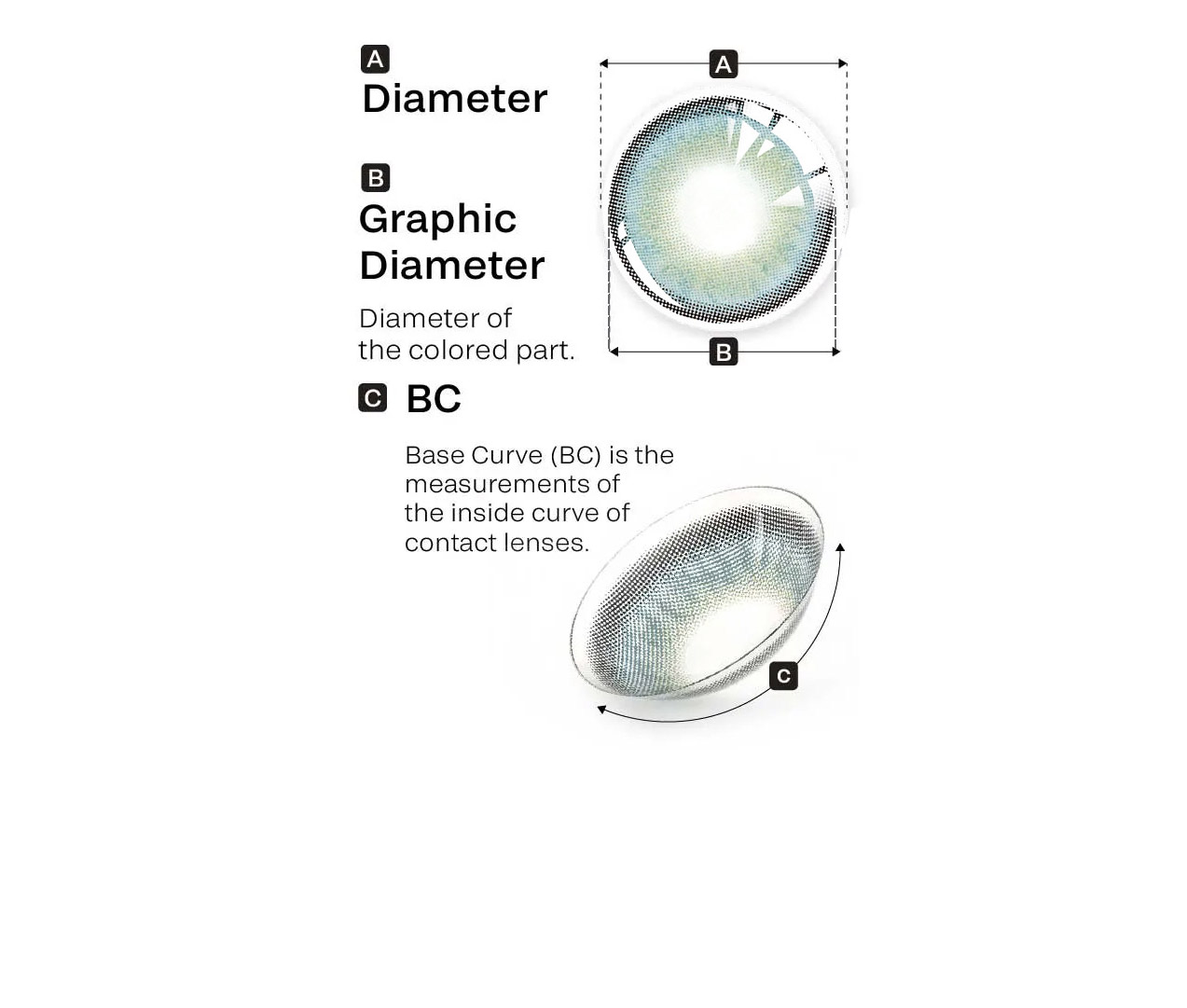
When people talk about contact lens size, they usually refer to two numbers:
- Total diameter (DIA)
- Graphic / color diameter (for circle lenses)
Total diameter (DIA)
- Common values: 14.0 mm, 14.2 mm, 14.5 mm and even 22mm for cosplayer.
- This shows how large the lens is overall and how much of your cornea it covers.
Graphic / color diameter
- This is the diameter of the printed or colored area.
- It directly affects how big your iris appears and how strong the “circle lens effect” looks.
Simple way to think about it:
- A 14mm contact lens is usually more natural and subtle.
- 14.5 mm circle lenses are designed for a noticeable enlarging effect and are often marketed as big size contact lenses.
-
Best Contact Lens Size for Different Eye Types
A. Small iris or small eye opening – want a natural everyday look
Features:
- Your natural iris looks relatively small, with more visible white around it.
- Your eye opening (the visible eye area) is not very wide.
Recommended:
- Start with 14.0–14.2 mm total diameter.
- Choose a smaller graphic diameter, around 11.0–13.0 mm, for a gentle enlarging effect.
Why:
- Very big size contact lenses can overpower small eyes and make the eyes look “overfilled” or alien‑like.
- A more modest contact lens size keeps the look natural while still brightening your gaze.
B. Medium iris – want bigger but not “too fake”
Features:
- Your eyes look proportionate without lenses.
- You want clearly bigger eyes in photos, but still work‑or‑school friendly.
Recommended:
- 14.0–14.2 mm total diameter is a sweet spot.
- Graphic diameter around 12.5–13.3 mm works well for “everyday glam”.
Why:
- This contact lens size for big eyes gives visible enlargement, but still leaves some white around the iris so the eyes don’t look flat or overly black.
C. Large iris or big eyes – want dramatic, doll‑like effect
Features:
- Your iris already looks quite large.
- You like K‑beauty, cosplay, stage makeup or intense selfie looks.
Recommended:
- You can safely explore 14.5 mm circle lenses.
- Look for graphic diameter 13.6–14.0 mm if you really want that “doll eye” effect.
Why:
- On big eyes, smaller lenses may look almost like clear lenses.
- A truly big size contact lens will show its design fully and still match your proportions.
-
Why Some People Don’t Get Along With 14.5 mm Circle Lenses
Not everyone can comfortably wear 14.5 mm circle lenses, especially people with:
- Small irises and narrow eye openings
- Sensitive or dry eyes
- Short wearing schedules but long screen time
Common issues include:
- Eyes look “too full,” with almost no visible white area
- Strong foreign body sensation or dryness from the larger coverage
- Lenses shifting or decentering more easily
If that sounds like you, choosing a smaller contact lens size (14.0–14.2 mm with a modest graphic diameter) will usually look better and feel more comfortable.
-
Can Stores Measure Your Iris Size for You?
Many people wonder if they can walk into a colored contacts shop and get their iris size measured for a perfect fit.
In some optical or specialty contact lens stores:
- Staff may visually estimate your visible iris or corneal diameter using a ruler, fitting chart, or digital tools.
- They can then recommend whether you’re better suited to 14mm contact lens designs or can go up to big size contact lenses like 14.5 mm circle lenses.
However, this kind of measurement is usually approximate, not a full medical eye exam. It’s helpful for choosing style and size, but it does not replace professional assessment of eye health.
- When Do You Need an Eye Clinic or Hospital?
For accurate and safe fitting, especially if you have any vision correction or eye health concerns, you should visit an eye clinic or hospital. There, an optometrist or ophthalmologist can:
- Measure corneal diameter and curvature (important for base curve and fit)
- Check pupil size under different lighting
- Assess tear film quality and dryness
- Look for any signs of inflammation, allergy, or existing corneal problems
You should especially consider a clinical exam if:
- You have myopia, hyperopia, or astigmatism and want prescription circle lenses
- Your eyes often feel red, dry, or irritated
- You plan to wear big size contact lenses regularly, not just for occasional photos
- A Simple Step‑by‑Step Guide to Find Your Size
You can also present a quick decision flow like this:
-
Decide your target look
- Super natural: go for 14mm contact lens or similar with small graphic diameter.
- Everyday big eyes: 14.0–14.2 mm lenses with moderate graphic diameter.
- Dramatic / cosplay: consider 14.5 mm circle lenses and other big size contact lenses.
-
Match to your eye type
- Small eyes / small iris → stay on the smaller end of the range.
- Medium eyes → mid‑range works best, with occasional big size for photos.
- Large eyes → you can handle bigger contact lens size for big eyes without looking overdone.
-
When in doubt, test and get checked
- Try one natural pair and one slightly bigger pair to compare.
- Book a professional eye exam if you plan to wear lenses long‑term or have any discomfort.
Don’t just copy someone else’s favorite diameter – the best contact lens size is the one that fits your own iris, eye shape, and lifestyle, so your eyes look big, but still healthy.