Most new distributors ask the wrong question.
They ask, “Which colored contact lenses are the most popular?”
That sounds reasonable. But popularity is not the same as profitability. A lens design can look beautiful in a catalog, perform well on social media, and still move slowly in a real shop. Another design may look simple, almost boring, but sell every week because customers feel safe wearing it every day.
Your first colored contact lens wholesale order is not just a purchase.
It is your first market test.
The goal is not to predict the perfect bestseller. The goal is to build a small, balanced SKU mix that shows you what your customers actually want before you commit too much cash to the wrong inventory.
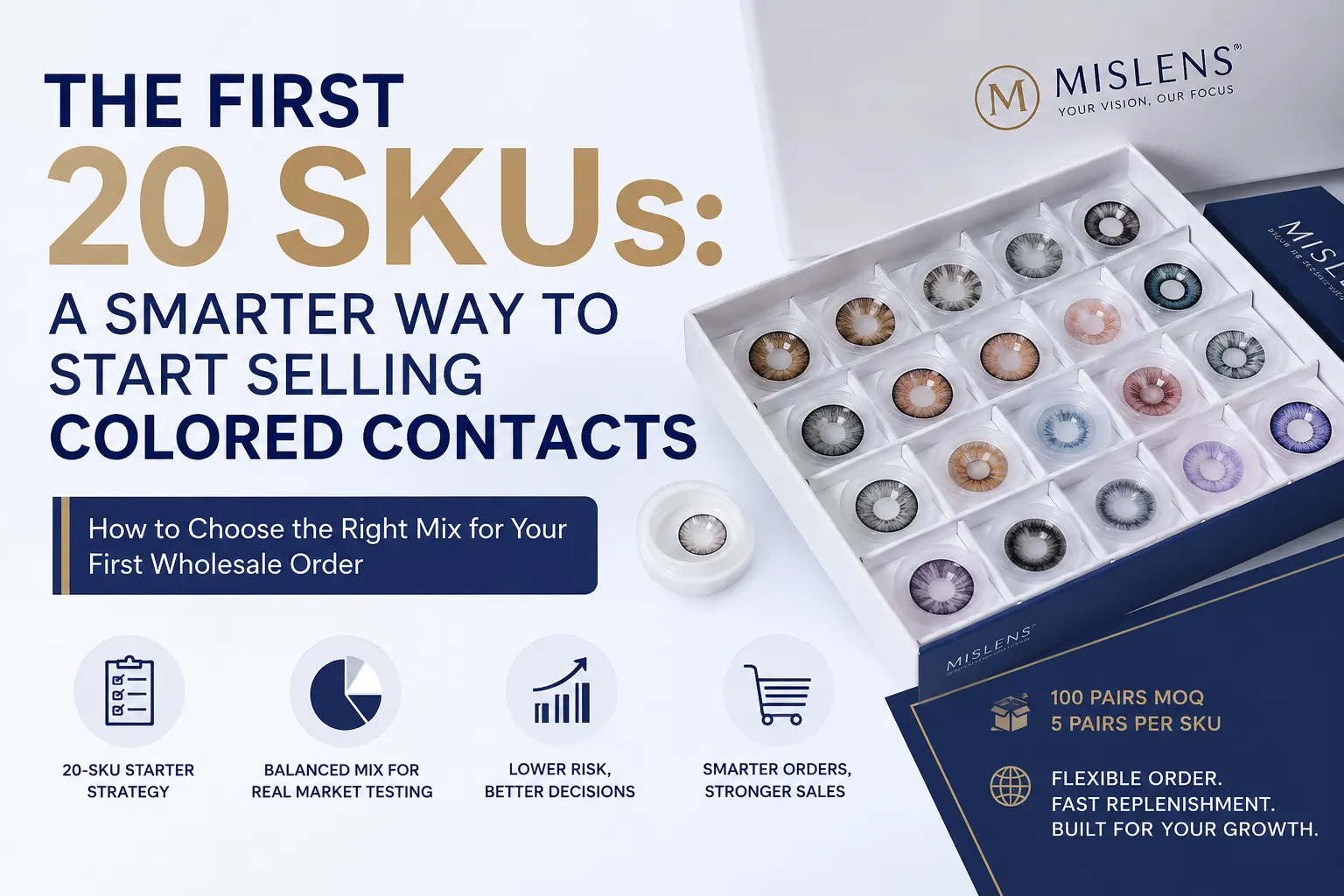
For new distributors, a 20-SKU starter order is often smarter than buying a large quantity of only a few styles. It gives you enough variety to test colors, diameters, wearing cycles, and customer reactions while keeping inventory risk under control.
The first order should teach you before it traps you.
Why Your First Wholesale Order Should Not Be Too Large
A large first order feels confident.
But confidence without data is expensive.
Many new colored contact lens distributors make the same mistake: they see several attractive designs, choose the ones they personally like, and buy too many units before they know how their local market will respond.
The problem is that colored contact lenses are not sold only by design. They are sold by habit, trust, occasion, comfort expectation, price level, and customer identity.
A student may want soft brown lenses for daily makeup. A beauty store customer may prefer enlarging lenses that make the eyes look brighter. A cosplay buyer may only purchase before events. A TikTok seller may need dramatic colors to create attention, even if those styles are not the fastest repeat sellers.
One market can have several different demand layers.
That is why your first wholesale order should not be built like a final product line. It should be built like a test portfolio.
A test portfolio helps you answer questions such as:
-
Which colors sell fastest?
-
Which styles attract attention but do not convert?
-
Which diameter feels safest for your customers?
-
Which products generate repeat orders?
-
Which styles create complaints or hesitation?
-
Which price points feel comfortable for your market?
You cannot answer these questions from supplier photos alone.
You answer them by selling.
The 20-SKU Rule for New Colored Contact Lens Distributors
A 20-SKU structure gives new distributors a practical balance between variety and control.
Too few SKUs limit your learning. Too many SKUs make your inventory hard to manage.
Twenty SKUs are enough to test different customer preferences without making your first order chaotic. The goal is to create a small but intelligent product map.
A strong first 20-SKU order may look like this:
| SKU Type | Suggested Quantity | Main Purpose |
|---|---|---|
| Natural daily styles | 6–8 SKUs | Stable daily sales |
| Enlarging or big-eye styles | 4–5 SKUs | High demand in beauty-focused markets |
| Trend colors | 3–4 SKUs | Social media attention |
| Bold or cosplay styles | 2–3 SKUs | Seasonal and niche demand |
| Reorder test styles | 2 SKUs | Measure repeat-purchase potential |
This structure does not force every distributor to buy the same products. Instead, it gives you a logic for choosing.
Natural styles create the base.
Enlarging styles create visible transformation.
Trend colors create marketing content.
Cosplay styles create event-based demand.
Reorder test styles help you identify what customers come back for.
A good SKU mix is not a collection of pretty lenses. It is a sales system.
Start With Natural Colors First
Natural colors are rarely the loudest part of a colored contact lens catalog.
But they are often the safest foundation for wholesale business.
Brown, chocolate, hazel, gray, and soft black lenses are easier for customers to imagine wearing. They work with daily makeup, office looks, school looks, and casual beauty routines. They also reduce the emotional risk of trying colored contacts for the first time.
This matters because many customers do not start by asking for the most dramatic lens.
They start by asking, “Will this look natural on me?”
That question is important. It means the customer wants beauty without embarrassment. They want change without feeling exposed.
For a new distributor, natural styles help create steady movement. They may not always produce the most viral photos, but they often produce more repeat buyers.
Natural colors do not create the loudest reaction. They create the most repeat orders.
For your first 20 SKUs, natural styles should take the largest share. Choose different effects within the natural category:
-
soft brown for everyday wear
-
gray-brown for a cooler makeup style
-
chocolate or dark brown for subtle enhancement
-
hazel for warmer skin tones
-
soft black or ring-style lenses for a larger-eye effect
-
light gray for customers who want visible change without looking too bold
This gives your product line range without becoming risky.
Add Trend Colors, But Do Not Let Them Control the Order
Trend colors are important.
They help your store look fresh. They give social media sellers something to post. They attract customers who are bored with basic styles. Pink, violet, blue, green, and multi-tone lenses can create strong visual appeal in photos and short videos.
However, trend colors should not control your first order.
The mistake many new distributors make is confusing attention with sales stability.
A bright violet lens may get more comments online than a soft brown lens. But comments are not the same as repeat purchases. A blue lens may look stunning on a model, but customers in your market may only wear it for parties, photoshoots, or special occasions.
That does not mean trend colors are bad.
It means they should have the right job.
In your first 20-SKU order, trend colors should act as traffic drivers, not inventory anchors. They help your store feel exciting, but they should not take most of your budget.
A practical approach is to choose 3–4 trend SKUs:
-
one soft pink or rose tone
-
one violet or purple tone
-
one blue or gray-blue tone
-
one multi-tone or high-definition design
This gives you content potential without overexposure.
The product that gets attention is not always the product that pays the rent.
Choose Wearing Cycles Based on Sales Logic
Wearing cycle is not just a product specification.
It changes how customers buy, how often they return, and how you manage inventory.
New distributors often focus only on price. But the wearing cycle affects the whole business model.
Yearly lenses may appeal to price-sensitive markets because customers feel they are getting long-term value. They can be easier to introduce in markets where customers already understand traditional colored contacts.
Half-year lenses sit between value and freshness. They can be useful when customers want a longer wearing period but are becoming more aware of hygiene and replacement habits.
Monthly lenses can create faster repeat orders, but they may require more customer education. Customers need to understand why replacing lenses more frequently can support comfort, hygiene, and style variety.
Daily lenses are convenient and attractive for premium or occasional-use customers, but they may have higher price sensitivity and require careful inventory planning.
Here is a simple way to think about it:
| Wearing Cycle | Best For | Wholesale Consideration |
|---|---|---|
| Yearly | Price-sensitive buyers, traditional markets | Slower replacement cycle |
| Half-year | Balanced value and replacement | Good bridge category |
| Monthly | Repeat sales and style rotation | Needs customer education |
| Daily | Convenience and premium use | Higher inventory discipline |
For a first order, avoid putting all 20 SKUs into one wearing cycle unless your market already has strong demand.
A better strategy is to build a mixed structure. Use yearly or half-year lenses for value-driven customers. Add monthly styles to test repeat potential. Use daily lenses only if your sales channel can explain the benefit and handle the price point.
The question is not which wearing cycle is best.
The question is which wearing cycle matches your customers’ buying behavior.
Use Small Quantity per SKU to Test Real Demand
The best first order is not the biggest order.
It is the order that gives you the most useful information.
This is where small quantity per SKU becomes powerful. If your supplier allows flexible SKU selection, you can test multiple styles without buying too deeply into each one.
For example, instead of buying 100 pairs across only 4 styles, a new distributor may test 20 styles with smaller quantities per SKU. This creates more learning opportunities. You can see which colors customers touch first, which styles they ask about, which ones sell quickly, and which ones stay on the shelf.
A flexible first order also helps you avoid emotional buying.
Without structure, buyers tend to choose what looks good to them. With small SKU testing, the market becomes the judge.
For MISLENS wholesale customers, the low-risk structure is especially useful because orders can start from 100 pairs, with a minimum of 5 pairs per SKU. This allows new distributors to build a broader starter mix and test more designs before increasing inventory depth.
That matters because the first sale is only one signal.
The reorder is the real signal.
If a customer buys once because a design looks attractive, that is interest. If customers return for the same style, recommend it to friends, or ask when it will be restocked, that is product-market fit.
A smart distributor does not guess the next order. They let the first order write it.
Match SKUs to Your Sales Channel
There is no universal perfect SKU list.
The right 20 SKUs depend on how you sell.
An optical store should not choose the same starter order as a TikTok seller. A beauty shop should not stock exactly like a cosplay reseller. A marketplace seller may need reliable, easy-to-understand styles, while a social media seller may need designs that stop the scroll.
Your channel decides what kind of lens can win.
Optical Stores
Optical stores need trust first.
Customers may ask more questions about comfort, safety, prescription options, replacement cycle, and natural appearance. For this channel, your starter SKUs should focus on natural colors, soft enlargement, and styles that are easy to recommend.
Avoid making the first order too dramatic. Optical-store customers often need confidence before they try stronger colors.
Beauty Shops
Beauty shops can handle more visual transformation.
Customers are often already thinking about makeup, lashes, skincare, and appearance. They may respond well to brown, gray, hazel, and enlarging styles.
For beauty shops, choose SKUs that pair well with daily makeup and popular beauty looks.
TikTok and Instagram Sellers
Social media sellers need visual hooks.
They should include more trend colors, high-definition patterns, and before-after styles. But they still need natural bestsellers underneath the content-driven products.
The front of the store can be dramatic.
The back of the business still needs repeat sales.
Cosplay and Event Sellers
Cosplay sellers should include bold colors, special patterns, and high-opacity designs.
However, these styles are often seasonal. They may sell strongly before Halloween, anime conventions, festivals, or photoshoot seasons, but they can move slowly during normal months.
For a first order, keep cosplay styles limited unless your audience is already cosplay-focused.
Marketplace Sellers
Marketplace sellers need clarity.
Customers scroll quickly and compare many options. Simple product names, natural colors, competitive pricing, and clear photos matter.
For this channel, avoid too many niche designs at the beginning. Start with styles that are easy to understand and easy to search.
Track the Right Data After the First Order
Your first 20 SKUs are only useful if you track what happens.
Many distributors sell the first order and then reorder based on memory. That is risky. Memory usually remembers the loudest customer, not the most profitable product.
You need simple data.
Track these points from the first 7 to 30 days:
-
Which SKUs sold first?
-
Which SKUs received the most questions?
-
Which SKUs had high interest but low purchase?
-
Which colors were tried but not bought?
-
Which styles generated repeat orders?
-
Which products caused confusion or complaints?
-
Which styles worked best in photos or videos?
-
Which products customers asked to restock?
This information turns your second order into a business decision instead of another guess.
The second order is where profit improves.
Your first order tests. Your second order focuses.
Common Mistakes When Choosing the First 20 SKUs
The first mistake is buying only what you personally like.
Your taste matters, but your customer’s behavior matters more. A distributor is not buying for self-expression. A distributor is buying for sell-through.
The second mistake is choosing only viral designs.
Viral styles can bring traffic, but they are rarely enough to build a stable wholesale business. You need designs that customers can wear repeatedly.
The third mistake is ignoring natural colors.
Natural styles may look ordinary in a supplier catalog, but they often become the backbone of repeat sales.
The fourth mistake is buying too many units of too few styles.
This makes your first order fragile. If one style fails, too much cash gets stuck.
The fifth mistake is not thinking about diameter and effect.
Some markets prefer subtle enhancement. Others prefer larger-eye effects. If all your SKUs create the same visual result, you learn less from the test.
The sixth mistake is forgetting replenishment.
A good SKU is only useful if you can restock it when demand appears. Slow reorder speed can turn a winning product into a missed opportunity.
The final mistake is treating the first order like a final answer.
It is not.
It is the beginning of your data.
Key Takeaway: Your First 20 SKUs Are a Market Test
The real issue is not whether you can find one bestseller.
The real issue is whether you can build a first order that helps you discover what your market will buy again.
Natural colors give you stability.
Trend colors give you attention.
Different wearing cycles help you test buying habits.
Small quantities per SKU reduce risk.
Channel-based selection makes the product line easier to sell.
And reorder data tells you where to invest next.
For a new colored contact lens distributor, the smartest first order is not the largest one. It is the one that creates the clearest next decision.
If you are planning your first colored contact lens wholesale order, MISLENS can help you build a 20-SKU starter selection based on your market, sales channel, and customer style preferences.
Start with a small, structured test.
Then let the market tell you what to scale.