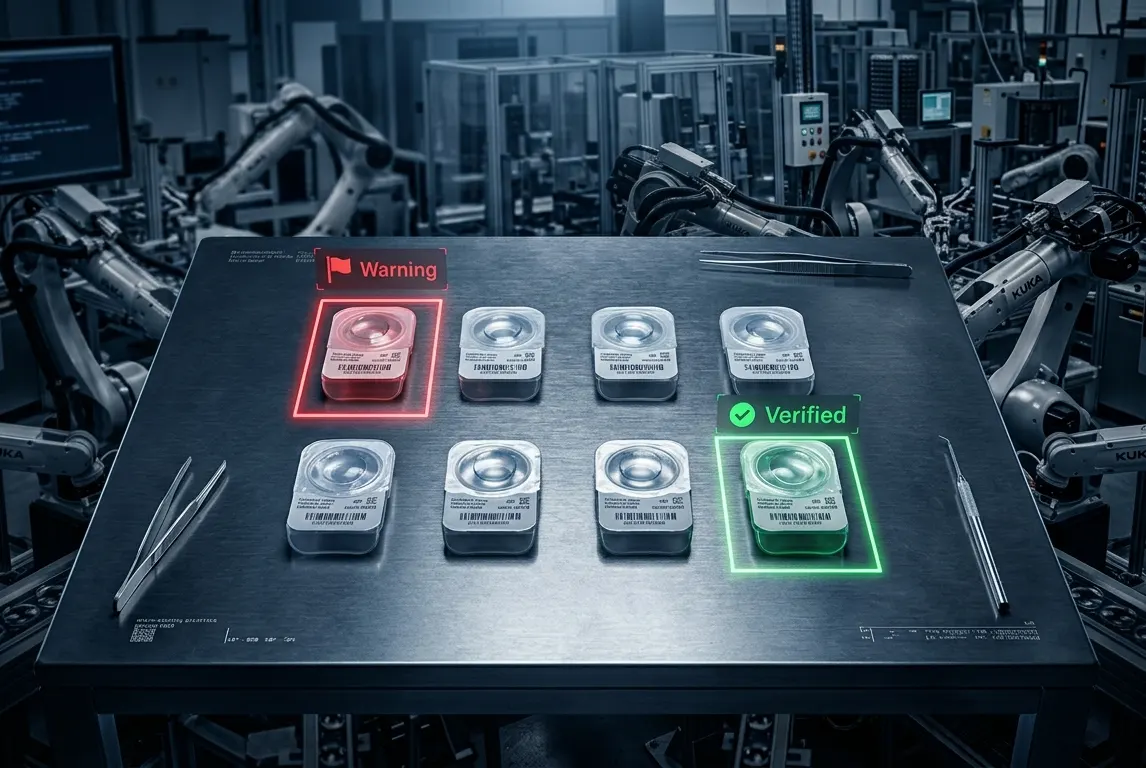
Most color lens distributors begin their journey with a spreadsheet. They compare Price A to Price B and assume that if the certificates look real, the products are identical.
This is a trap. The factory is not a commodity vendor; they are the engine of your business. In a market where 80% of lenses look similar on Instagram, the real "profit" is found in the things you can't see: material consistency, pigment safety, and supply chain reliability.
If you want to scale a brand in 2026, you must stop being a "price hunter" and start being a "system auditor." This guide will show you how to peel back the layers of a supplier to find the 5% that are actually worth your investment.
Layer 1: The Technical Foundation (The "Safety First" Filter)
If the lens isn't safe, your business is a ticking time bomb. This layer is non-negotiable. If a supplier fails here, the audit ends immediately.
1. The Material Science: Beyond "HEMA"
Every factory says they use HEMA (Hydroxyethyl methacrylate). But not all HEMA is equal.
-
The Trap: A factory claims "58% water content" to sound premium. However, high water content in a low-quality material creates a "sponge effect"—the lens sucks moisture out of the wearer's eye, leading to dryness and complaints.
-
The Audit Question: "Is this Ionic or Non-Ionic material?"
-
Data Point: Non-Ionic materials (like PolyHEMA) are more resistant to protein deposits. For a distributor selling "Yearly" or "Monthly" lenses, Non-Ionic is the gold standard for long-term comfort.
-
-
The Silicone Hydrogel Lie: Many suppliers claim to offer Silicone Hydrogel (SiHy) at HEMA prices.
-
The Truth: Real SiHy requires specialized manufacturing and has much higher oxygen permeability (Dk/t). If the price seems too good to be true, they are likely selling "modified HEMA" and labeling it as SiHy.
-
2. The Pigment Lockdown: Sandwich Technology
Color contact lenses are a "sandwich." The pigment must be sealed between two layers of clear material.
-
The Red Flag: "Surface Printing." Some low-end factories print the color directly on the lens surface to save costs. This leads to color migration—where the pigment literally leaches into the wearer's eye.
-
How to Verify: Ask for a leach test report or a high-magnification cross-section image of the lens. A professional factory will proudly show you their "Triple-Layer Sandwich" structure.
3. The Oxygen Blind Spot: Dk vs. Dk/t
Most buyers ask for the Dk (the material's oxygen permeability). Professional buyers ask for the Dk/t (the actual oxygen that reaches the eye through the thickness of the lens).
「Dk/t represents the oxygen transmissibility of a contact lens. For color lenses, the 't' (thickness) is critical because the pigment layers increase bulk, making Dk/t more important than the material's raw Dk.」
-
The Insight: Color lenses are thicker than clear lenses because of the color layers. If a lens is too thick (high 't'), the Dk doesn't matter—the eye will suffocate, leading to redness and irritation.
-
The Trap: Factories that provide "thin" samples but deliver "thick" bulk orders to reduce breakage during production.
Layer 2: Production & QC (The "Consistency" Filter)
The biggest challenge in this industry isn't making one good pair of lenses; it's making one million identical pairs.
1. Batch Stability: The "Ocean Blue" Nightmare
Imagine your customer buys "Ocean Blue" in January. They love it. They reorder in June, but the new batch is slightly more "Green." You just lost a customer for life.
-
The Audit Question: "What is your Delta-E tolerance for color consistency?"
-
The Standard: Top-tier factories use automated colorimeters and keep Batch Retain Samples for at least 2-5 years. If they don't have a library of previous batches, they can't guarantee consistency.
2. The "Hidden Cost" of Yield Rates
A factory quotes you $1.00 per pair. Another quotes $1.20. You choose the $1.00 supplier.
-
The Reality: The $1.00 supplier has an 80% yield rate. This means 20% of their lenses have micro-defects (scratches, edge chips) that their QC missed.
-
The Result: You spend more on customer service, replacements, and shipping than the $0.20 you "saved."
-
The Insight: Professional factories (like Mislens partners) use AOI (Automated Optical Inspection) to ensure yield rates of 98%+.
3. Sample vs. Bulk Discrepancy
This is the oldest trick in the book. A factory uses a "hand-made" specialized line for samples and a "mass-market" low-precision line for bulk orders.
-
The Solution: Request a "Random Pull" from a current production run, not a specially prepared sample kit.
Layer 3: Commercial & Cooperation Logic (The "Scaling" Filter)
Once you've confirmed the quality, you need to know if the supplier can support a growing brand.
1. OEM/ODM Tiers: Know Who You Are Dealing With
-
Tier 1 (The Basic Factory): They only do "Private Label." You put your logo on their existing designs. No innovation.
-
Tier 2 (The Creative Factory): They have a design team. They can help you develop custom patterns.
-
Tier 3 (The Strategic Partner): They offer Market Protection. They won't sell your "exclusive" design to your direct competitor in the same country.
-
The Trap: Factories that claim "Exclusivity" but sell the same pattern under 10 different names to 10 different distributors.
2. The MOQ Structure Trap
Many factories offer a "Low total MOQ" but require a "High per-SKU MOQ."
-
Example: 1,000 pairs total, but 100 pairs per power/color.
-
The Problem: If you sell 50 colors, you are forced to carry massive amounts of "dead stock" for unpopular powers. Look for suppliers who offer Agile MOQ—lower per-SKU requirements to keep your inventory lean.
3. Transparent Pricing
A low "lens price" often hides "Packaging Surcharges," "Labeling Fees," and "Export Handling Fees."
-
The Audit: Demand an All-In Landed Cost estimate. If the price keeps creeping up after the first deposit, the supplier is not professional.
Layer 4: Compliance & Platform Readiness (The "Legal" Filter)
In 2026, selling on TikTok, Amazon, or Shopee requires more than just a CE certificate. It requires a supplier who understands digital compliance.
1. The Export Document Gap
Can your supplier provide an MSDS (Material Safety Data Sheet) for air freight? Can they provide a CFS (Certificate of Free Sale) for your local health ministry?
-
The Risk: Without these, your goods will be stuck in customs for weeks, incurring daily storage fees that wipe out your profit.
2. E-commerce Assets
A modern supplier should provide:
-
High-resolution "Eye Shots" and "Lens Shots."
-
Compliant ingredient lists and warning text in multiple languages.
-
KOL Support: Do they have influencers already wearing the lenses that you can use for marketing?
Layer 5: The "Soft" Audit (The "Trust" Filter)
The best buyers look at the "Soul" of the company.
-
The Client Portfolio: Ask: "Who else do you supply?" If they supply major optical chains or global "Alpha" brands, they are used to high-pressure QC audits. If they only sell to anonymous wholesalers, proceed with caution.
-
Responsiveness: Does the salesperson understand technical questions, or do they just say "Yes, friend, no problem" to everything? In the medical device world, "No problem" is a red flag. A professional rep will say, "Let me check the material formulation and get back to you."
-
The "Over-Promise" Trap: If a factory says they can develop a new custom pattern, manufacture 10,000 pairs, and ship them in 15 days—they are lying. Quality color lenses require a physical curing and sterilization time that cannot be bypassed.
The 10 Traps: Your "Audit Cheat Sheet"
| Trap | Description | Risk Level |
| 1. Registration vs. Approval | Using an "FDA Establishment Registration" to claim "FDA Product Clearance." | 🚨 High |
| 2. Surface Printing | Pigment is on the outside of the lens, not "sandwiched." | 🚨 High |
| 3. Fake Silicone Hydrogel | Modified HEMA sold as SiHy. | ⚠️ Medium |
| 4. The Sample Bait | Samples are 10/10; Bulk orders are 6/10. | 🚨 High |
| 5. Low Yield / High Scrap | Hidden defects leading to 20% return rates. | ⚠️ Medium |
| 6. The "Yes" Factory | Over-promising on lead times and technical capabilities. | ⚠️ Medium |
| 7. Expired MDR | Using old EU certificates that are no longer valid. | 🚨 High |
| 8. "Borrowed" 510(k) | Using a competitor's FDA clearance number on their own invoices. | 🚨 High |
| 9. Hidden Packaging Costs | Surcharges for boxes and labels not mentioned in the quote. | 💸 Profit Risk |
| 10. No Market Protection | Selling your "exclusive" design to the guy next door. | 💸 Profit Risk |
The Buyer’s Selection Formula
A successful partnership is calculated like this:
Total Value = (Compliance Integrity) × (Batch Consistency) × (Communication Speed) ÷ (Total Landed Cost)
If any of the top factors is zero, your total value is zero—no matter how low the cost is.
Final Strategy: How to Start the Audit
Don't ask: "Do you have certificates?"
Ask: "Can you send me the COA for your last three batches of 42% water content HEMA lenses, and show me the AOI rejection logs for those runs?"
The way they answer that question will tell you everything you need to know about their professionalism.
Ready to Master the Business Side?
Now that you know how to choose a supplier, it’s time to look at the money. In the final part of our series, we break down the ROI and ROI Modeling for color lens distributors.
👉 [GO TO FULL BLUEPRINT: The 2026 Guide to Compliance, Supplier Audits, and ROI]
Compliance is the floor; your growth is the ceiling. Now that you know the standards, join the partner who exceeds them.
🎊[Explore the Mislens Distributor Portal and Scale with Certainty]🎊