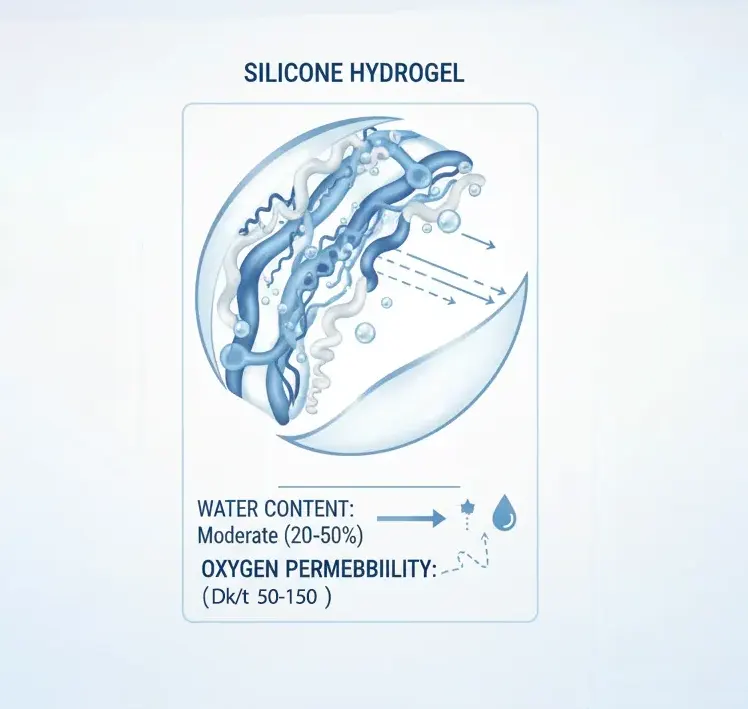
In the colored contact lens industry, material choice shapes both wearing comfort and product positioning. Silicone hydrogel has become widely recognized as the gold standard for premium colored contacts not simply because it is more advanced, but because it offers a better balance between oxygen permeability, comfort, safety, and brand value.
For consumers who care about eye health and long-wear comfort, traditional HEMA-based hydrogel lenses remain popular because they are mature, cost-effective, and widely available in many styles. However, when lenses are worn for long periods, users may experience dryness, heaviness, or a stuffy feeling. Silicone hydrogel was developed to address these limitations. Its higher oxygen transmission helps the lens feel lighter on the eye and makes it a strong choice for premium cosmetic lenses, professional contact lens lines, and selected high-end daily disposables.
For brands and distributors, the value of silicone hydrogel goes beyond material performance. It supports a stronger product narrative: better wearing experience, clearer technical differentiation, stronger premium positioning, and often higher repeat purchase potential. In other words, it is not just a material upgrade — it is a brand upgrade.
What Is Silicone Hydrogel?
Silicone hydrogel is a color contact lens material that combines silicone-based components with hydrogel. This structure preserves the softness expected from a soft lens while significantly increasing oxygen transmission through the lens. Since the cornea depends on oxygen to stay healthy, low-oxygen materials can become uncomfortable during prolonged wear.
The key advantage of silicone hydrogel is that it improves the balance between comfort and corneal health. It is not simply about being softer or wetter; it is about pushing the material performance higher. That is why silicone hydrogel is often used in contact lenses that demand more from the lens, including long-wear contact lenses, premium colored contacts, and high-performance daily disposables contact lenses.
Three Key Material Parameters
1. Oxygen Permeability (Dk/t)
Oxygen permeability is one of the most important indicators when evaluating whether a contact lenses material is suitable for long wear. Traditional HEMA hydrogel lenses typically have a Dk/t value around 8.4–34, while silicone hydrogel lenses often reach 50–150.
This significant difference means silicone hydrogel allows much more oxygen to pass through the lens to the cornea, helping reduce hypoxia-related discomfort during extended wear.
2. Water Content
Many people assume that higher water content automatically means less dryness, but that is not always true. Water content and dryness need to be balanced: a high-water lens may feel more moisturizing at first, but it can also lose moisture more quickly in dry environments, which may increase dryness later in the day.
Silicone hydrogel does not rely on high water content alone; instead, it improves wearing comfort through its higher oxygen transmission.
3. Modulus / Lens Stiffness
Silicone hydrogel is usually slightly firmer than some traditional hydrogel materials, but that is not necessarily a disadvantage. A moderate modulus helps the lens keep its shape, improves manufacturing consistency, and can make handling easier for first-time users.
For brands, this material behavior also supports more stable and consistent product performance.
Why It Works So Well for Premium Colored Contacts
Premium colored contacts are not only about attractive colors. They also need to deliver comfort, stability, safety, and a strong brand image. Silicone hydrogel fits premium positioning for four main reasons.
First, it offers higher oxygen permeability. Higher oxygen flow helps reduce the feeling of eye fatigue during wear, especially for people who work long hours, spend time on screens, or commute frequently.
Second, it is better suited for longer wear. Many users do not just ask whether the lenses look good right away; they want to know whether the lenses still feel comfortable after several hours. Silicone hydrogel usually performs better in that scenario.
Third, it supports a more professional brand perception. When a brand highlights silicone hydrogel as a key feature, customers naturally associate the product with technology, quality, and premium value.
Fourth, it helps create differentiation. In a market where colors, diameters, and water content often look similar, the lens material itself can become a meaningful point of distinction.
Silicone Hydrogel vs. HEMA + NVP
HEMA + NVP is another common hydrogel route, and many annual, semi-annual, or mass-market colored lenses use this material system. Its biggest strengths are mature manufacturing, broad supply chain availability, flexible color development, and lower cost.
From a premium-product perspective, however, HEMA + NVP and silicone hydrogel play different roles. HEMA + NVP is better suited for large-scale mass contact lenses, while silicone hydrogel is more aligned with premium functional lenses. The former supports wider style variety and longer replacement cycles, while the latter is more often associated with daily disposables, shorter cycles, and a more advanced user experience.
That is also why silicone hydrogel lenses often come in fewer colors and fewer variations. This is not because the material is inferior — it is because the production process is more demanding, the development cost is higher, and color matching is more complex.
Why Pigment Sandwich Technology Matters
In colored contact lenses, pigment placement is critical. Pigment Sandwich Technology — often described as a three-layer pigment encapsulation structure — places the pigment inside the lens rather than exposing it directly to the eye-facing surface.
This design helps preserve color visibility while reducing direct pigment contact with the eye. For colored lenses that must be both visually attractive and safe, this is a major advantage. Premium colored contacts often require more advanced layering and manufacturing techniques to achieve a natural and refined appearance.
Why Silicone Hydrogel Is Often Used in Daily Disposables
Silicone hydrogel is commonly found in daily disposable or monthly color contact lenses, and that is no accident. Daily disposable lenses are the easiest way to showcase the benefits of silicone hydrogel: clean usage, convenience, stable comfort, and fewer variables caused by cleaning solutions or long-term deposits.
Long-cycle products depend more heavily on deposition control, structural stability, and lens care. While silicone hydrogel performs very well in oxygen transmission, it is not always the easiest material to scale into long-cycle colored lenses. That is why the market often sees silicone hydrogel in premium daily disposables, while HEMA-based materials continue to dominate broader cycle categories.
Why HEMA Still Dominates the Mainstream Market
From a business perspective, HEMA remains the mainstream choice not because it is more advanced, but because it is easier to scale. HEMA-based products are easier to manufacture at volume, easier to color-match, and easier to build into a wider SKU portfolio.
For brands and distributors, HEMA products are ideal for mass-market coverage, while silicone hydrogel is better suited as a premium flagship line. HEMA drives volume; silicone hydrogel strengthens brand image and profit margin. Many successful brands use both: HEMA for scale, silicone hydrogel for premium positioning.
Final Thoughts
If the colored contact lens market were a pyramid, HEMA + NVP would form the broad middle, serving the largest user base, while silicone hydrogel would sit closer to the top, defining the premium standard. It is not always the best material for every scenario, but it is one of the strongest choices for brands that want to emphasize comfort, technology, and high-end value.
For products built around long-wear comfort, eye-friendly performance, and premium differentiation, silicone hydrogel remains a highly strategic choice. For brands aiming to build a more professional, higher-value, and more repeatable product line, it is not just a material option — it is a product strategy.