Adding private-label contact lenses can give a distributor greater control over product positioning, packaging and market differentiation.
However, customization also introduces additional decisions involving product specifications, compliance, inventory, packaging and launch planning.
For that reason, private label should not automatically be the first step for every contact lens buyer.
For many wholesalers and distributors, the more practical route is to begin with an established branded product portfolio, observe how the market responds and only introduce private-label products after the commercial opportunity has been validated.
The real question is therefore not simply:
Should we sell branded or private-label contact lenses?
A better question is:
Has our distribution business developed enough market knowledge and operational capability to support a private-label product line?
This article explains how distributors can make that decision.
Brand Distribution and Private Label Solve Different Problems
Branded distribution and private label are not necessarily competing business models.
They serve different commercial purposes.
Branded distribution helps a distributor enter or expand a category
A branded portfolio allows distributors to work with products that already have defined specifications, packaging and product positioning.
This can reduce the number of development decisions required before sales begin.
It is often suitable for distributors that need to:
- introduce a new contact lens category;
- test customer demand;
- compare product styles;
- identify suitable replacement cycles;
- supply several retail or ecommerce channels;
- develop repeat-order data;
- expand their range without building a new brand from the beginning.
The distributor can focus primarily on channel development, product selection and sales execution.
Private label helps a mature distributor create greater differentiation
Private label becomes more relevant when a distributor has already identified a clear market opportunity that existing branded products do not fully address.
The opportunity may involve:
- exclusive packaging;
- a product line developed for a specific channel;
- a more focused style or color assortment;
- a defined replacement-cycle strategy;
- a product positioned under the distributor’s own brand;
- greater control over how the collection is presented.
Private label provides more control, but it also transfers more responsibility to the buyer.
The buyer must be prepared to make decisions about the product range, packaging, compliance requirements, order planning and market launch.
Start With the Business Problem, Not the Packaging
One of the most common mistakes in private-label planning is beginning with a logo, box design or brand name before defining the commercial problem the product is meant to solve.
Packaging alone does not create a viable contact lens portfolio.
Before approaching a supplier about customization, a distributor should be able to explain:
- Which customers will buy the product?
- Through which sales channels will it be sold?
- Which existing market demand has already been observed?
- Why is a private-label product needed?
- What would make it meaningfully different from the distributor’s current branded range?
For example, a distributor might discover that optical-store customers repeatedly ask for powered clear lenses with a specific replacement cycle.
Another distributor may find that a small group of natural colored lens styles generates most repeat purchases across its ecommerce channels.
These are clearer reasons to investigate a custom project than simply wanting a box with a new brand name.
A viable private-label product should respond to a proven commercial need.
Private Label Should Usually Follow Market Validation
A distributor does not need to learn every market lesson through a custom manufacturing project.
Branded products can be used to test important commercial variables before greater resources are committed.
These variables may include:
- preferred lens colors;
- graphic diameter preferences;
- natural versus visible effects;
- prescription demand;
- replacement-cycle demand;
- customer price expectations;
- repeat-purchase behavior;
- channel-specific product preferences.
Consider a distributor serving beauty retailers and ecommerce sellers.
Instead of immediately developing a large custom collection, the distributor could begin with a structured branded assortment containing:
- several commercially accessible colored lens styles;
- a smaller number of more distinctive products;
- relevant powered clear lens options;
- selected replacement cycles;
- products suited to different customer segments.
Sales data can then reveal which categories deserve further investment.
This makes private-label development a response to market evidence rather than a prediction based mainly on personal taste.
A Practical Portfolio Development Path
Private label does not need to replace a branded portfolio.
For many distributors, it is more effective to build the business in stages.
Stage 1: Build a branded core
The distributor begins with an established branded range.
The goal is to understand:
- which products attract first orders;
- which products generate repeat demand;
- which channels perform best;
- which specifications customers request;
- which product categories are commercially sustainable.
At this stage, assortment discipline is more important than exclusivity.
Stage 2: Identify repeatable demand
After sufficient market activity, the distributor reviews actual sales and customer feedback.
The distributor looks for patterns such as:
- repeated demand for the same lens effects;
- recurring requests for a particular prescription range;
- strong performance from one replacement cycle;
- customer preference for a specific product position;
- consistent demand from a particular retail channel.
These patterns provide a stronger foundation for product development.
Stage 3: Introduce a focused exclusive line
Before building a broad private-label portfolio, the distributor may test a limited exclusive or custom-positioned line.
The objective is not to launch as many products as possible.
The objective is to confirm that the distributor can successfully manage:
- product selection;
- packaging decisions;
- sales education;
- channel placement;
- inventory planning;
- compliance documentation;
- repeat ordering.
Stage 4: Expand private label selectively
Once the first custom project has demonstrated commercial viability, the distributor can consider additional products.
Expansion should be based on demonstrated demand rather than a desire to make the catalog appear larger.

Five Signs a Distributor May Be Ready for Private Label
Private label becomes more practical when several forms of readiness are present at the same time.
1. The distributor has a clearly defined sales channel
A qualified buyer should know where the products will be sold.
Possible channels include:
- optical stores;
- beauty retailers;
- regional wholesalers;
- ecommerce platforms;
- professional distributors;
- retail chains;
- a combination of offline and online channels.
Different channels may require different product structures.
An optical channel may prioritize prescription coverage, documentation and consistent specifications.
A beauty-focused ecommerce channel may place more emphasis on visual differentiation, product photography and collection positioning.
Without a defined channel, it is difficult to design a focused private-label range.
2. Demand has already been demonstrated
The distributor should have evidence that customers want the product category.
Useful evidence may include:
- repeat sales from existing branded products;
- regular retailer requests;
- stable demand for specific specifications;
- reorder frequency;
- customer feedback;
- sales performance across multiple products in the same category.
Demand does not need to be enormous.
It does, however, need to be more reliable than an assumption.
3. The distributor understands the product’s role
Every product in a portfolio should have a commercial role.
A contact lens range may include:
- core everyday sellers;
- powered clear lenses for professional channels;
- natural colored lenses for broad customer appeal;
- more visible styles for differentiation;
- seasonal or experimental products;
- an exclusive line for brand development.
A private-label product should fill a specific gap.
It should not simply duplicate an existing product without a clear reason.
4. The business can manage operational complexity
Private-label projects require more coordination than standard branded purchases.
Depending on the project, the buyer may need to manage:
- specification confirmation;
- prescription planning;
- packaging content;
- artwork approval;
- market-specific documentation;
- order forecasting;
- inventory commitment;
- launch materials;
- retailer communication;
- future reorders.
A distributor that is still struggling to forecast ordinary wholesale inventory may not yet benefit from adding another layer of complexity.
5. The distributor has a realistic launch plan
A private-label launch requires more than product delivery.
The distributor should understand:
- who will sell the product;
- how retailers will be introduced to it;
- what product information is required;
- what sales materials will be prepared;
- how the first inventory will be allocated;
- how performance will be measured;
- when a reorder decision will be made.
Without a launch plan, even a well-developed product can remain unsold in storage.
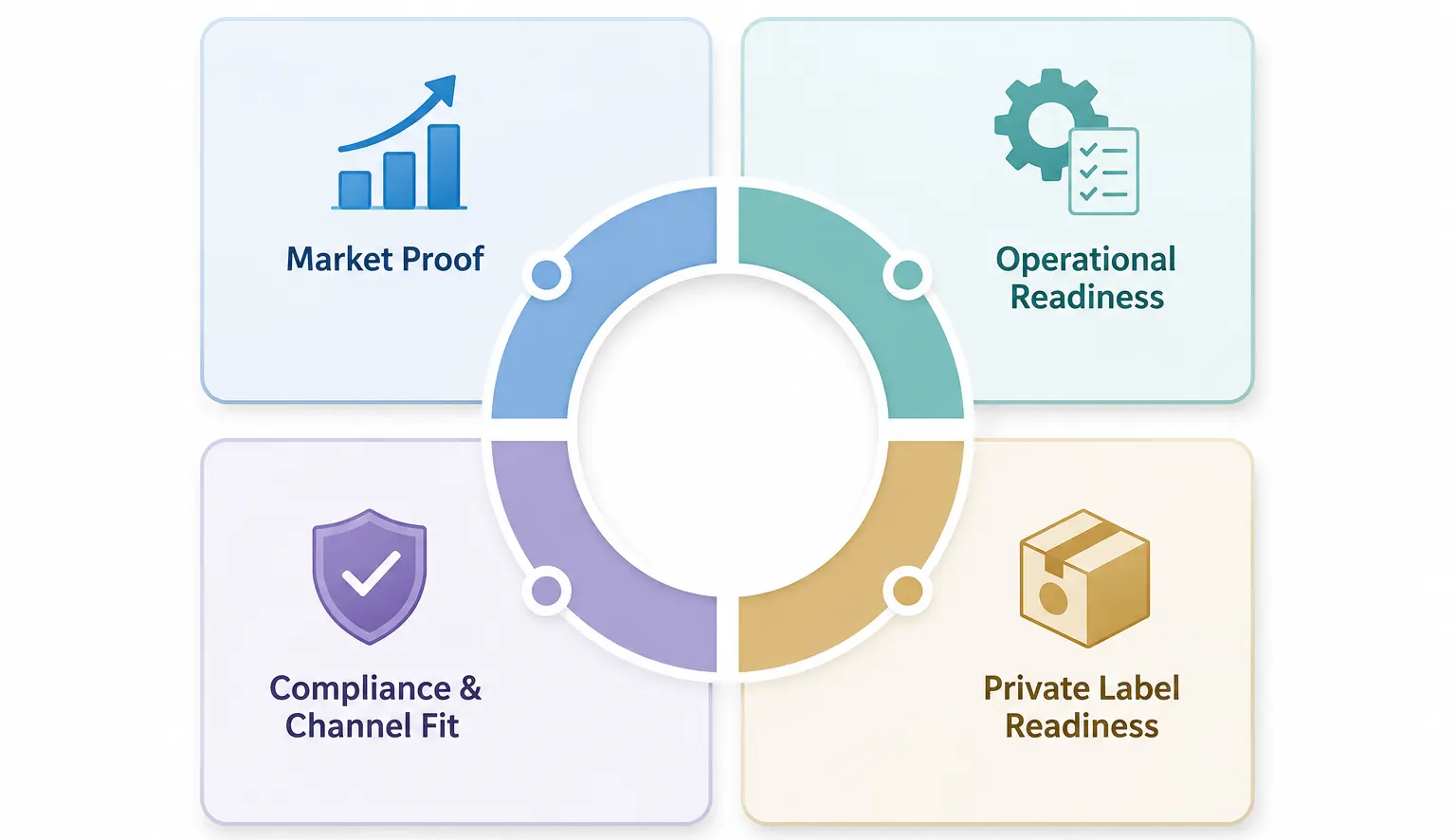
Three Readiness Areas Matter Most
The five signs above can be summarized into three essential areas.
| Readiness Area | Main Question | Evidence to Review |
|---|---|---|
| Market Proof | Is there demonstrated demand? | Sales data, repeat orders, retailer requests and customer feedback |
| Operational Readiness | Can the business manage the project? | Forecasting, inventory control, packaging decisions and launch capability |
| Compliance and Channel Fit | Is the product suitable for the intended market and channel? | Destination requirements, documentation needs, specifications and sales-channel expectations |
A distributor that is strong in only one area may still need more preparation.
For example, strong market demand without operational planning can create inventory problems.
A capable operations team without validated demand can still launch the wrong assortment.
Private label is more sustainable when all three areas support the decision.
Product Portfolio Questions to Answer Before Customizing
Private-label planning should begin at the portfolio level, not with individual colors.
The distributor should first define what role the new line will play alongside existing branded products.
Which products should remain branded?
Branded products may remain the better choice for:
- broad assortment coverage;
- products still being tested;
- lower-volume categories;
- seasonal styles;
- products with uncertain repeat demand;
- categories where the existing brand already provides suitable positioning.
There is no commercial requirement for every product in the distributor’s business to carry the distributor’s own label.
Which products may justify private label?
Private label is more logical for products with:
- stable repeat demand;
- a clearly defined customer group;
- reliable sales-channel support;
- long-term portfolio importance;
- clear differentiation potential;
- specifications the distributor understands well.
A small number of validated products is usually a stronger starting point than an oversized collection.
How many specifications are commercially necessary?
Every additional specification can increase planning complexity.
A custom assortment may involve decisions about:
- colors;
- prescription powers;
- replacement cycles;
- lens effects;
- graphic diameters;
- packaging formats;
- product naming;
- market positioning.
Launching too many combinations can divide inventory across products that have not yet proven their demand.
A focused range makes it easier to:
- communicate the product;
- train sales teams;
- manage stock;
- compare performance;
- plan reorders.
A Simple Distributor Scenario
Consider a regional distributor serving optical stores, beauty retailers and online sellers.
The distributor initially carries a branded Mislens portfolio containing colored contact lenses, powered clear lenses and selected specialty products.
Over time, the distributor observes that:
- natural colored lens styles generate consistent repeat orders;
- optical partners regularly request powered products;
- one replacement cycle performs more reliably than others;
- some retailers want a product line with more exclusive local positioning.
The distributor does not immediately replace the branded range.
Instead, it keeps branded products as the core assortment and investigates a focused private-label line for the best-validated opportunity.
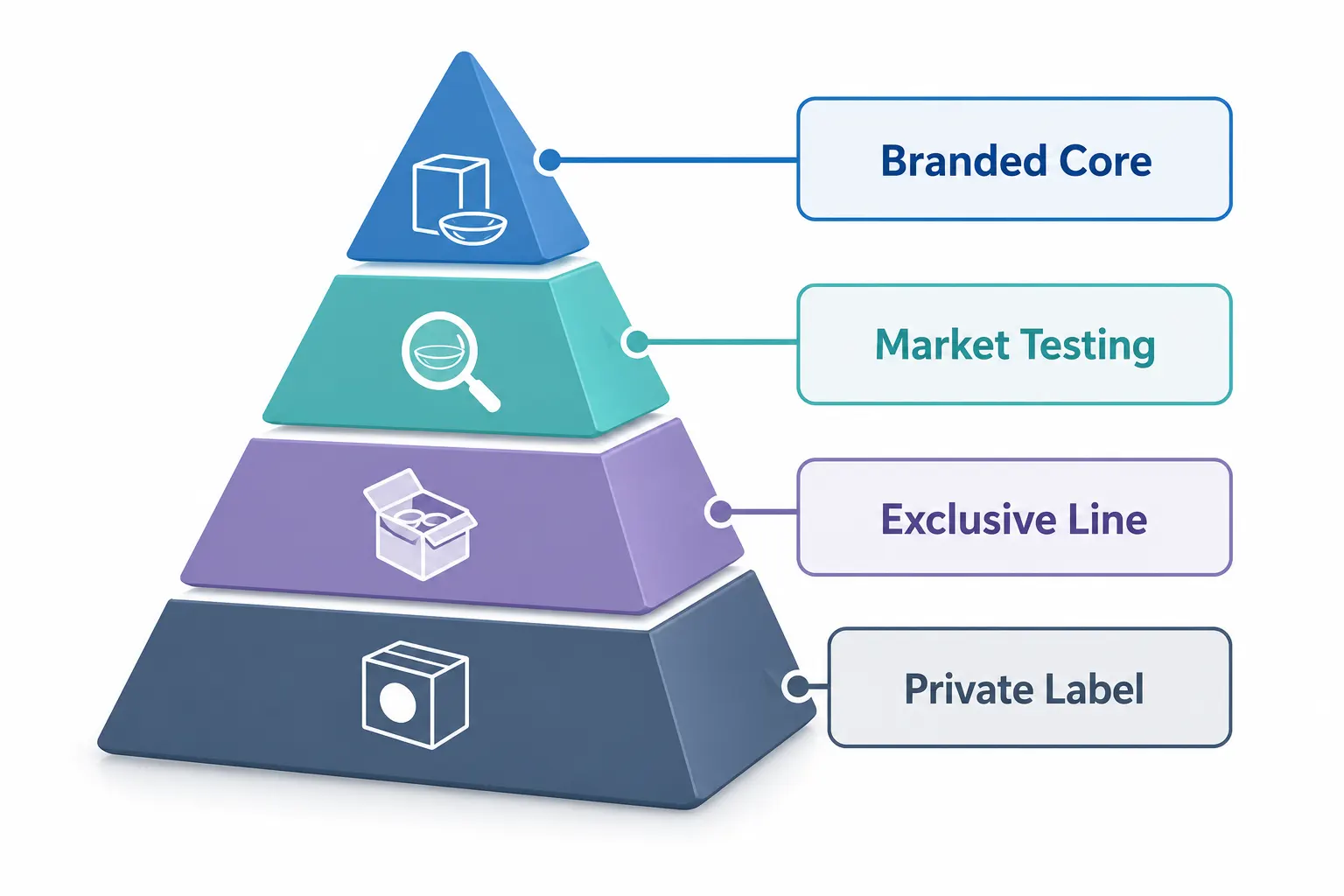
The resulting portfolio may look like this:
| Portfolio Layer | Commercial Role |
| Branded Core | Provides established products, broader assortment and ongoing market testing |
| Market-Test Products | Measures demand for newer styles, specifications or categories |
| Exclusive Line | Creates differentiation for selected channels |
| Private Label | Supports a proven opportunity under the distributor’s own positioning |
This hybrid structure protects assortment flexibility while allowing the distributor to build greater ownership in selected product categories.
When Branded Distribution Is Still the Better Choice
Private label is not a required stage of business development.
Some distributors can build a strong and profitable operation through branded distribution alone.
Branded distribution may still be the more practical option when:
- the business is entering the contact lens category;
- customer preferences remain unclear;
- order volume is difficult to forecast;
- the buyer wants access to a broader range;
- the internal team cannot yet manage product development;
- compliance requirements are not fully understood;
- the buyer needs to test several markets;
- retailer demand is still changing;
- the business prefers to focus on sales and distribution.
In these situations, branded cooperation allows the distributor to continue learning without prematurely committing to a custom product structure.
This is not a weaker business model.
For many professional distributors, branded products remain the foundation of the portfolio even after private-label products are introduced.
Why a Hybrid Portfolio Often Works Better
A distributor does not need to choose one cooperation model for the entire business.
A hybrid portfolio can combine the advantages of both.
Branded products can provide:
- broader product coverage;
- easier market testing;
- lower product-development complexity;
- access to established product positioning;
- flexibility across different channels;
- a practical route for testing new demand.
Private-label products can provide:
- greater exclusivity;
- stronger control over presentation;
- focused channel positioning;
- ownership of selected product categories;
- differentiation where demand has already been validated.
The key is to assign each product a purpose.
Branded distribution can remain the commercial foundation, while private label is applied selectively where the distributor has enough evidence and capability to justify it.
Questions to Prepare Before Requesting a Private-Label Quotation
A supplier can provide more useful project guidance when the buyer submits a clear commercial brief.
Before requesting a quotation, prepare the following information.
Market and channel
- Which country or region will the product enter?
- Will it be sold through optical, beauty, wholesale or ecommerce channels?
- Is the buyer already operating in this market?
Product direction
- Is the project for colored or clear contact lenses?
- Which replacement cycle is required?
- Are powered products needed?
- Which specifications are commercially important?
- Is the product based on existing market demand?
Portfolio role
- Will the product replace an existing item?
- Will it complement a branded range?
- Is it intended for one channel or several?
- What makes the proposed product necessary?
Packaging and branding
- Is standard packaging acceptable?
- Is custom artwork required?
- Which languages must appear on the packaging?
- What information is required for the destination market?
Commercial planning
- What is the estimated order volume?
- How will the first order be distributed?
- What is the planned launch period?
- Who will manage sales and retailer onboarding?
- What would trigger a reorder?
Exact project requirements can vary by product, packaging scope and destination market.
A serious private-label discussion should therefore begin with the buyer’s market and project details rather than an isolated unit-price request.
What a Contact Lens Supplier Should Clarify
A professional supplier should not encourage a distributor to customize products without first understanding the business context.
Before a project moves forward, the supplier should clarify:
- the target market;
- the intended sales channel;
- product specifications;
- prescription requirements;
- documentation expectations;
- packaging scope;
- estimated project quantity;
- launch timing;
- the buyer’s existing distribution capability.
The supplier should also be willing to explain when branded distribution may be the more suitable starting point.
A supplier that treats every inquiry as a packaging order may not be helping the buyer build a commercially sustainable product line.
How Mislens Approaches Branded and Private-Label Cooperation
Mislens primarily works with B2B distributors, wholesalers, agents and professional channel partners serving Europe, North America and the Middle East.
Branded product distribution remains the main cooperation model.
This allows partners to develop their market using a product portfolio that may include colored contact lenses, powered clear lenses and vitamin B12 clear lens options where relevant to the buyer’s channel and market.
Private-label and custom projects are also available for qualified partners.
These discussions are most productive when the buyer already has:
- a defined market;
- an established sales channel;
- realistic demand expectations;
- clear product requirements;
- awareness of relevant compliance responsibilities;
- an operational plan for launching and reordering the product.
Mislens does not treat private label as the automatic next step for every distributor.
The objective is to identify whether branded distribution, a focused custom project or a hybrid portfolio offers the strongest long-term commercial fit.
Choose the Cooperation Model That Matches Your Current Stage
Private label can be valuable, but only when it solves a real and validated business need.
Distributors should not measure progress by how quickly they place their name on a contact lens box.
A stronger measure is whether the business has developed enough market knowledge to make deliberate product decisions.
For many distributors, the most sustainable path is:
- build a structured branded portfolio;
- collect sales and channel evidence;
- identify repeatable demand;
- test a focused exclusive opportunity;
- introduce private label selectively;
- retain branded products where they continue to serve the business effectively.
This approach reduces unnecessary complexity while still creating a route toward stronger differentiation and portfolio ownership.
Discuss the Right Cooperation Model
Are you deciding whether to expand through Mislens branded products, develop a focused private-label project or combine both models?
Share your target market, sales channel, product direction and current distribution experience with the Mislens team.
We can discuss which cooperation structure is better aligned with your present stage and long-term portfolio plans.