
What Contact Lens Distributors Should Confirm Before Every Repeat Order
Repeat orders are supposed to get easier.
The supplier is familiar. The SKUs are already in your system. Product details have been discussed before. There is even a previous purchase order ready to copy.
That makes reordering faster. It can also make the previous order look more relevant than it really is.
A PO records what your business needed at one point in time. Since then, products have sold at different speeds, inventory has changed, retailers may have reordered certain styles, and the supplier’s current availability may no longer match the previous order.
There are really three different moments involved:
The previous PO belongs to the past. Your inventory shows where you are today. The new order has to work for the stock position you expect when it actually arrives.
So a repeat order should require less discovery than a first order—but it still requires a new decision.
The goal is not to rebuild the previous PO. It is to find out what has changed since then.
Look at What Happened Since the Last Order
Before asking the supplier about the next shipment, start with your own side of the business.
A previous purchase order tells you what entered your inventory. It cannot tell you what happened after those products reached retailers or customers.
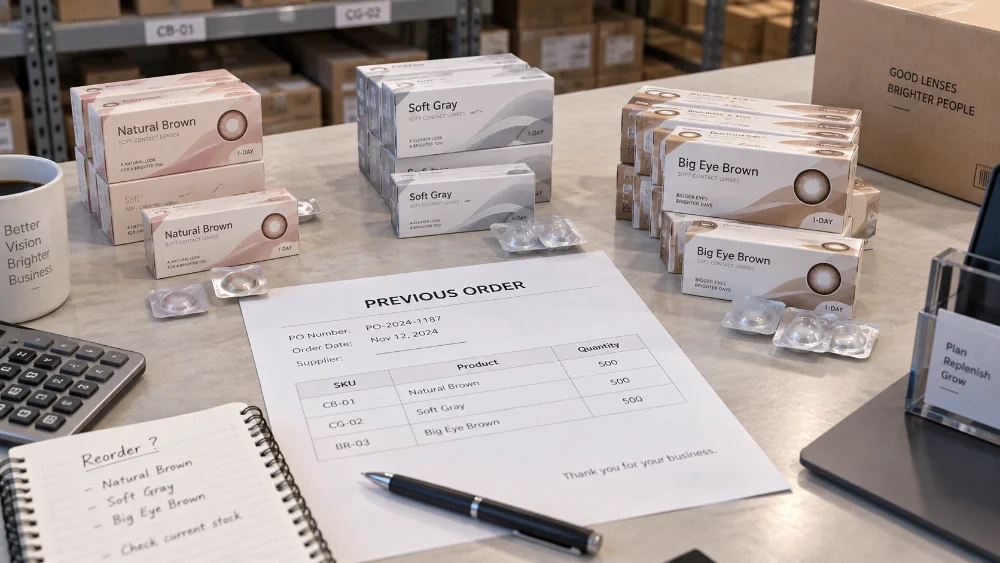
Suppose several colored contact lens SKUs were purchased in similar quantities.
By the next replenishment cycle, Natural Brown may be generating steady retailer reorders. Soft Gray may still be selling but have enough inventory remaining. Another style may have moved quickly during a promotion and then slowed.
Those SKUs began on the same PO. They no longer necessarily deserve the same replenishment decision.
For products showing sustained demand, the next order may need more depth. Others may need less, while some may not need replenishment yet.
This is where sales and inventory history become more useful than the old PO itself. Our guides on which contact lens SKUs deserve deeper inventory and how to identify slow-moving colored contact lens SKUs before they become dead stock examine those decisions in more detail.
But there is another variable: time.
Today’s stock is not the stock you are replenishing
Imagine that a Natural Brown SKU is running low today.
A reorder may clearly be necessary. The current stock level alone, however, does not tell you how much to buy.
The product will continue selling while the next order is being prepared, supplied, and delivered. By the time new inventory arrives, today’s remaining stock may be much lower—or demand may have slowed and left more inventory than expected.
The purchasing decision therefore has to look beyond today’s warehouse.
You are replenishing the stock position you expect to have when the new inventory arrives.
This is an important distinction because it connects quantity with timing. A SKU cannot be evaluated only by how much is left now; the distributor also needs to consider what is likely to happen before replenishment becomes available.
Is It Still the Product You Expect to Receive?
Once the assortment and quantities begin to take shape, attention shifts to the product.
A repeat order does not require a complete product evaluation from zero. But familiarity with a SKU should not automatically mean that every detail can be assumed.
Before confirming the order, the distributor should know whether the next supply still corresponds to the product currently being sold.
Depending on the order, that may include the established product specifications, lens or color identity, packaging version, labeling, and other previously confirmed details that matter to the distributor’s market.
The practical question is simple:
Is anything different from the product version we are currently selling?
This becomes particularly relevant when previous inventory will still be in the warehouse or market after the next shipment arrives.
If a relevant change exists, learning about it before the order is finalized gives the distributor more room to decide how to handle it.
This is where repeat-order confirmation connects with why batch consistency matters more than samples in long-term contact lens distribution. That broader issue concerns continuity across repeated supply. At the PO level, the task is narrower: make sure you know what product the next order represents.
Can This SKU Mix Be Supplied When You Need It?
Now the question moves from the product to the current supply situation.
A previous order may have arrived within a certain period. That history is useful, but the next order may contain different SKUs and different quantities.
Availability can also be uneven within a single reorder.
Imagine a distributor preparing to replenish 12 SKUs. Eleven fit the expected supply schedule, while one important SKU requires additional time.
The relevant question is no longer simply:
“What is your normal lead time?”
It is:
Can this planned SKU mix be supplied within the timing this replenishment requires?
That difference matters.
The distributor may decide that the later SKU can wait. It may adjust the assortment, change quantities, or discuss another arrangement with the supplier. There is no single correct response for every business.
What matters is knowing the current situation before inventory planning is built around an outdated assumption.
This is also different from evaluating a supplier’s overall replenishment reliability. That evaluation helps determine whether a supplier is suitable for an ongoing relationship. A repeat order deals with something more immediate: what is available for this order now?
At this point, the distinction between different types of confirmation becomes useful.
Not everything needs to be asked of the supplier.
The distributor should first confirm internally what needs to be replenished and in what quantity. The supplier can then confirm what is being supplied and under what current timing. Finally, both sides need the PO to reflect the same order.
That is much lighter than repeating the entire first-order evaluation.
It is also more useful than simply writing “same as last time.”
Four Things to Confirm Before the PO Is Final
1. Are we reordering the right SKUs and quantities for the stock position we expect at arrival?
Start with what has happened since the previous purchase, not with the quantities printed on it.
Current inventory matters, but so does the demand likely to occur before the next shipment becomes available.
A SKU with strong sales may need more depth. Another may still have enough stock to wait. The objective is not to reproduce the previous assortment—it is to replenish what the business is likely to need next.
2. Are the product, packaging, and labeling details still what we expect?
This should be a focused confirmation, not a new supplier audit.
The next shipment should correspond to the product the distributor believes it is replenishing. If a relevant detail has changed, it is better to understand that while the order is still adjustable.
3. Can the planned SKU mix be supplied within the timing this reorder requires?
Ask about the actual order.
A general lead-time estimate is less useful when availability differs across the assortment. One SKU with different timing may or may not affect the purchasing plan, but the distributor needs that information before deciding.
4. Does the final PO reflect what both sides have confirmed?
This is the simplest check and one of the easiest to overlook.
Quantities may have changed during discussion. A product detail may have been clarified. Current timing may differ from the previous order.
Make sure those decisions reach the final PO rather than remaining scattered across messages.
The conversation and the purchase order should describe the same order.
Repeat Ordering Should Become Smarter, Not Just Faster
Stable supplier relationships should reduce purchasing friction.
A distributor should not have to rediscover the supplier, relearn the entire product line, or repeat every first-order check whenever inventory needs replenishment.
Previous orders create useful history.
The advantage of that history is not that it eliminates judgment. It tells the buyer where judgment is still needed.
Known, stable information can remain in the background. Attention can move toward the variables that have actually changed: demand, expected inventory, relevant product details, availability, and timing.
That is how repeat purchasing becomes more efficient without becoming automatic.
The goal of a repeat order is not to repeat the previous order. It is to make the next order with better information.
Do Not Let Familiarity Replace Purchasing Judgment
A first order asks many questions because almost everything is new.
A repeat order should ask fewer questions—but better ones.
Between two purchase orders, the distributor has gained something the first order did not have: actual sales history, actual inventory movement, and experience with the supplier’s previous supply.
That information should change the quality of the next purchasing decision.
Before the next contact lens repeat order is finalized, ask:
What is still the same, what has changed, and does the next order reflect it?
Planning a repeat order with Mislens? Bring the current SKU mix, quantities, and any product or timing questions into the discussion before the order is finalized.
Discuss Your Next Order
Tell us which products and quantities you are planning to replenish. Our team can help you review the current order requirements before your next purchase.
Need to Evaluate This for Your Market?
Tell us about your market, sales channel or purchasing plan, and our team can discuss the next step with you.