A large clear contact lens catalog does not automatically create a reliable distribution portfolio.
A distributor may carry several products, multiple replacement cycles, and a wide prescription range while still losing ordinary orders because the powers customers request most often are unavailable. At the same time, slower prescriptions may remain spread across several overlapping products.
On paper, the range looks complete. In practice, it cannot consistently serve recurring demand.
The problem is rarely a lack of products. It is usually a lack of structure.
A reliable prescription clear contact lens portfolio should cover repeat demand without creating unnecessary inventory complexity. Each product needs a defined commercial role, important prescriptions need appropriate stock depth, and the entire range must be supported by clear product information and a realistic replenishment plan.
This guide explains how contact lens distributors, optical wholesalers, professional retailers, and qualified ecommerce sellers can build a clear lens range that remains commercially useful after the first order.

Start with the Market and Channel You Actually Serve
A prescription clear lens portfolio should reflect the customers and channels the distributor already serves.
The same assortment will not perform equally well through an optical-store network, a wholesale distribution business, and an ecommerce platform. Each channel creates different demands around product explanation, prescription availability, documentation, stock visibility, and repeat ordering.
Optical stores
Optical stores need a range that staff can explain clearly and reorder consistently.
That usually makes the following factors important:
- A practical prescription range
- Stable product specifications
- Clear replacement-cycle information
- Consistent packaging and labeling
- Product-specific documentation
- Reliable access to repeat inventory
A product can look attractive in a catalog but become difficult for store staff to recommend when common powers are repeatedly unavailable or the specifications change between orders.
Optical channels also benefit from a portfolio that is easy to understand. When several products appear almost identical, employees may struggle to explain their differences, and stock becomes divided across too many similar ranges.
Wholesale distribution
A wholesaler must consider the needs of downstream buyers, not only direct consumer demand.
The portfolio needs to support questions such as:
- Can core powers remain available across repeat orders?
- Are product specifications consistent between batches?
- Can the range serve more than one professional sales channel?
- Is the documentation relevant to the destination market?
- Can future orders follow a predictable structure?
The wider the downstream customer base, the more important it becomes to keep the range commercially clear.
Adding products does not always make a wholesaler more capable. In many cases, it only creates additional overlapping SKUs, weaker stock depth, and more complicated ordering.
Ecommerce channels
Online sellers face a different challenge: product information must remain clear without an employee explaining it in person.
The portfolio therefore needs to support:
- Easy prescription selection
- Consistent product-page information
- Clear replacement-cycle descriptions
- Packaging that matches the online listing
- Accurate stock status
- Practical handling of unavailable powers
A customer who reaches a product page but cannot select the required prescription is not experiencing a broad portfolio. That customer is experiencing a stock gap.
For ecommerce sellers, incomplete power availability can also reduce the value of advertising and organic traffic. A product may continue attracting visitors while being unable to complete ordinary orders.
Define the Role of Every Product Before Adding It
A reliable portfolio is not a group of products that happen to be available from the same supplier.
Every range should serve a defined business purpose.
| Portfolio Role | Business Purpose |
|---|---|
| Core Product | Covers dependable, recurring demand |
| Coverage Product | Expands useful prescription availability |
| Differentiation Product | Gives professional buyers a clearer reason to choose the range |
| Test Product | Measures demand without requiring deep inventory |
This four-layer structure helps prevent a common mistake: treating every new product as though it deserves the same stock commitment.
Core products
A core product should be commercially dependable.
It normally has:
- A clear position in the portfolio
- Stable product information
- Useful prescription coverage
- Repeat-order potential
- Relevance to the main sales channel
- A realistic replenishment path
Core does not necessarily mean basic or inexpensive. It means the product can support recurring business.
A distributor should be able to explain who the product is for, why it belongs in the range, and how its most important prescriptions will remain available.
Core products should receive the strongest inventory support, but that support still needs to follow actual demand. A core designation should not become a reason to hold excessive stock.
Coverage products
Coverage products fill commercially useful gaps that the core range does not fully address.
They may extend:
- Prescription availability
- Replacement-cycle options
- Channel suitability
- Packaging formats
- Product features
Their role is not to compete directly with the core product for the same customer and the same order.
A coverage product should make the range more complete. When it simply duplicates an existing product with little practical difference, it creates complexity rather than coverage.
Differentiation products
Differentiation products give the distributor a stronger product story.
They help professional buyers understand why the range is not interchangeable with every ordinary clear lens offer on the market.
Vitamin B12 prescription clear contact lenses can serve this role when positioned accurately. B12 should be presented as a defined product feature within the clear lens range, not as an unsupported medical or therapeutic claim.
The product still needs:
- Clear specifications
- Defined prescription availability
- Appropriate replacement-cycle information
- Relevant documentation
- Consistent packaging
- A practical repeat-order path
A differentiator is valuable only when the commercial explanation remains credible.
It should strengthen the portfolio, not distract from weaknesses in the core range.
Test products
A test product should enter the portfolio with limited inventory and a defined review period.
Before ordering, the distributor should decide what evidence will determine whether the product stays. That may include:
- Repeat demand
- Prescription-level sales
- Channel response
- Customer questions
- Reorder requests
- Operational reliability
A product that remains in permanent “test” status without a decision eventually becomes slow inventory.
Testing should lead to one of three outcomes:
- Expand
- Maintain selectively
- Stop regular reordering
Build Power Coverage Around Real Demand
Prescription coverage is one of the most important parts of a clear lens portfolio.
It is also one of the easiest areas to mismanage.
A distributor may claim to offer a wide prescription range while repeatedly running out of the powers customers request most often. Meanwhile, less frequently requested prescriptions may remain overstocked across several product lines.
The range appears complete on a spreadsheet but fails during ordinary sales.
Separate breadth from depth
Power breadth refers to how many prescriptions are offered.
Power depth refers to how much inventory is held within each prescription.
These are different decisions.
Broad coverage can help a distributor serve more buyers, but it does not mean every power should receive the same stock quantity.
Equal inventory across all powers may look organized on a purchase order. It rarely reflects how prescription demand behaves in the market.
A more practical approach is to group powers according to observed demand.
| Power Tier | Inventory Approach |
|---|---|
| High-demand powers | Deeper core inventory |
| Regular powers | Stable standard coverage |
| Lower-frequency powers | Controlled inventory |
| Unproven powers | Test before expanding |
The exact grouping should come from the distributor’s own sales records, destination market, channel mix, and current product range.
A prescription pattern observed in one country or one optical chain should not automatically be copied into another market.
A simple portfolio problem
Consider a distributor carrying three powered clear lens ranges.
All three products cover similar prescriptions, but stock is divided evenly between them. One range is positioned as the main product, another has a different replacement cycle, and the third has a differentiated feature.
After several sales cycles, the distributor still holds substantial total inventory. However, the most requested prescriptions in the core range are unavailable.
The business now has two contradictory problems:
- Too much stock overall
- Not enough sellable stock where demand is concentrated
Adding another product would not solve this.
The correct response would be to review the role of each range, reduce unnecessary overlap, and move more inventory depth toward the prescriptions and products that support recurring orders.
Watch for false availability
A product may technically remain in stock while no longer being commercially complete.
For example, the distributor may still hold several lower-frequency powers, but the prescriptions required for common orders are already unavailable.
This creates several problems:
- The sales team continues presenting a product that cannot satisfy normal demand.
- Customers encounter repeated gaps and may move to another supplier.
- Remaining inventory becomes harder to sell because the useful range is incomplete.
- Marketing and product-page traffic continue pointing toward a partially unavailable offer.
Power coverage should therefore be reviewed as a connected system, not as isolated boxes in a warehouse.
A reliable portfolio is not defined by how many prescription labels appear in the catalog. It is defined by whether the useful range remains available when buyers need to reorder.
Avoid Building the Portfolio Around One Product Alone
A strong clear lens product can become the foundation of a portfolio. It should not become the portfolio’s only support.
Heavy dependence on one product creates risk when:
- Important powers become unavailable
- Supply is interrupted
- Packaging or specifications change
- Market requirements shift
- The product does not fit every channel
- Buyers request a practical alternative
This does not mean the distributor should add several nearly identical products.
Three ranges with similar specifications and the same commercial role may divide demand, complicate staff training, and spread inventory across too many overlapping SKUs. The portfolio becomes larger without becoming more useful.
A more disciplined structure is often stronger:
- One clear core product
- One coverage product with a distinct purpose
- One differentiated option
- A small number of controlled test products
The objective is resilience without duplication.
A supporting product should solve a specific weakness in the core range. It might extend prescription availability, suit a different replacement-cycle preference, or provide a clearer point of differentiation. When it does none of these things, it is probably adding complexity rather than protection.
Compare Replacement Cycles by Commercial Role
Replacement cycle is more than a technical specification.
It affects:
- Purchasing frequency
- Inventory turnover
- Customer expectations
- Reorder planning
- The number of powered SKUs the distributor must maintain
The useful question is not:
Which replacement cycle is best?
It is:
Which replacement cycle fits the distributor’s channel, demand pattern, and operating model?
| Factor | Distributor Question |
|---|---|
| Purchase frequency | How often is repeat demand expected? |
| Inventory turnover | How quickly can stock reasonably move? |
| Customer commitment | Is the product easy to introduce through this channel? |
| Power complexity | How many prescription SKUs must be maintained? |
| Reorder planning | How predictable is repeat purchasing? |
| Documentation | Is the product suitable for the intended market? |
A product associated with more frequent repeat purchasing may support faster inventory turnover, but it also requires closer replenishment management.
A longer replacement cycle creates a different buying rhythm. It may reduce purchase frequency while increasing the importance of customer retention and clear product positioning.
Neither model should be assumed to be commercially superior without reviewing the actual product range, destination market, and sales channel.
For that reason, replacement cycle should be treated as part of the portfolio architecture—not as a specification added at the end of a product listing.
Use B12 Clear Lenses as a Defined Portfolio Layer
Vitamin B12 clear lenses should not be added simply because they are different.
They should have a clear commercial role inside the portfolio.
That role may include:
- A differentiation product for professional channels
- An alternative within the powered clear lens range
- A product story that helps buyers distinguish the assortment
- A specialized range supported by clear specifications and documentation
This positioning is stronger than treating B12 as an isolated marketing claim.
Distributors still need to review:
- Prescription availability
- Replacement cycle
- Material information
- Packaging
- Product-specific documentation
- Destination-market relevance
- Repeat-order availability
B12 should be described as a defined product feature. It should not be presented as a treatment, medical solution, or unsupported guarantee of comfort.
Readers who need more product-level context can review how B12 prescription clear contact lenses differ from ordinary clear lenses and what distributors should verify before buying B12 clear lenses for distribution.
The wider portfolio still needs a dependable core.
A distributor offering only differentiated products may struggle to cover recurring demand. A distributor offering only standard products may struggle to explain why professional buyers should choose its range.
The strongest structure combines reliability with a credible reason to differentiate.
Evaluate Documentation Before Expanding the Range
Every additional product creates an additional documentation responsibility.
Before expanding the portfolio, the distributor should confirm that the available information corresponds clearly to the product being considered.
This may include:
- Product specifications
- Prescription range
- Material information
- Replacement cycle
- Packaging details
- Manufacturer or responsible-party information
- Product-specific documentation
- Destination-market relevance
A certification logo or general company document should not automatically be treated as proof that every product is suitable for every market.
The distributor needs to understand:
- Which product the document covers
- Which manufacturer or responsible company is identified
- Whether the document remains current
- Whether it is relevant to the destination market
- Whether additional local requirements may apply
This becomes more important as the range expands.
A portfolio containing several materials, replacement cycles, or differentiated features can easily outgrow an informal documentation process. Product names, packaging references, specifications, and supporting files must remain connected.
When those details cannot be matched confidently, expansion should pause until the gap is clarified.
Plan Inventory by Product Role
Once the portfolio roles are clear, inventory depth should follow those roles.
The core range should not receive the same quantities as coverage or test products.
Core inventory
Core inventory supports the most dependable part of the business.
It should receive priority when planning:
- Frequently requested prescriptions
- Main sales channels
- Repeat customers
- Safety stock
- Replenishment timing
The stock must be deep enough to support ordinary demand without creating immediate shortages.
At the same time, “core” should not become an excuse for uncontrolled purchasing. Inventory depth still needs to be reviewed against actual turnover.
Coverage inventory
Coverage inventory makes the range more useful without carrying the same expected volume as the core.
It may support:
- Additional prescriptions
- Secondary channels
- Alternative product preferences
- Less frequent but commercially relevant demand
The quantities can remain lower because the objective is availability, not primary volume.
Coverage inventory is valuable when it completes real orders. It is less valuable when it merely makes the catalog look broader.
Differentiation inventory
Differentiation products often deserve selective rather than deep inventory.
Their value may come from:
- A distinct product story
- Professional-channel interest
- Buyer differentiation
- A specialized feature
- A clearer reason to compare the range
Lower volume does not automatically make such a product unsuccessful.
The relevant question is whether it performs the role it was added to perform.
Test inventory
Test inventory should remain intentionally limited.
It can be used to evaluate:
- A new product
- A new prescription segment
- A different replacement cycle
- A new professional channel
- A differentiated product feature
- An emerging buyer request
The distributor should define the review date and decision criteria before placing the order.
Otherwise, “testing” becomes a permanent category for inventory that no one has decided how to manage.
Equal quantities may look organized on a purchase order, but they rarely reflect how prescription demand behaves in the market.
Inventory should follow role, demand, and replenishment risk—not symmetry.
Check Restocking Reliability Before Increasing SKU Count
The first order shows whether a supplier can deliver a product.
Repeat orders show whether the product can support a distribution business.
Before increasing the number of prescription clear lens SKUs, confirm:
- Whether the product remains in active supply
- Whether the prescription range stays consistent
- Whether packaging and specifications remain aligned
- Whether current inventory can be confirmed
- Whether repeat orders require major changes
- How product changes are communicated
- Whether updated documents can be provided
- Whether important powers are routinely available
A portfolio is only as reliable as its weakest repeat-order point.
A distributor may have an attractive catalog and strong initial availability, yet still struggle when the same core powers become unavailable during the next order cycle. That weakness affects more than one SKU. It can interrupt customer relationships, reduce staff confidence, and make the entire range harder to sell.
For that reason, SKU expansion should follow replenishment confidence—not precede it.
Adding more products before understanding repeat-order reliability often makes the problem worse. Inventory becomes more fragmented, while the distributor still lacks confidence in the products that should form the core.
Use a Portfolio Review Matrix
A simple portfolio matrix can help distributors decide how each product should be treated.
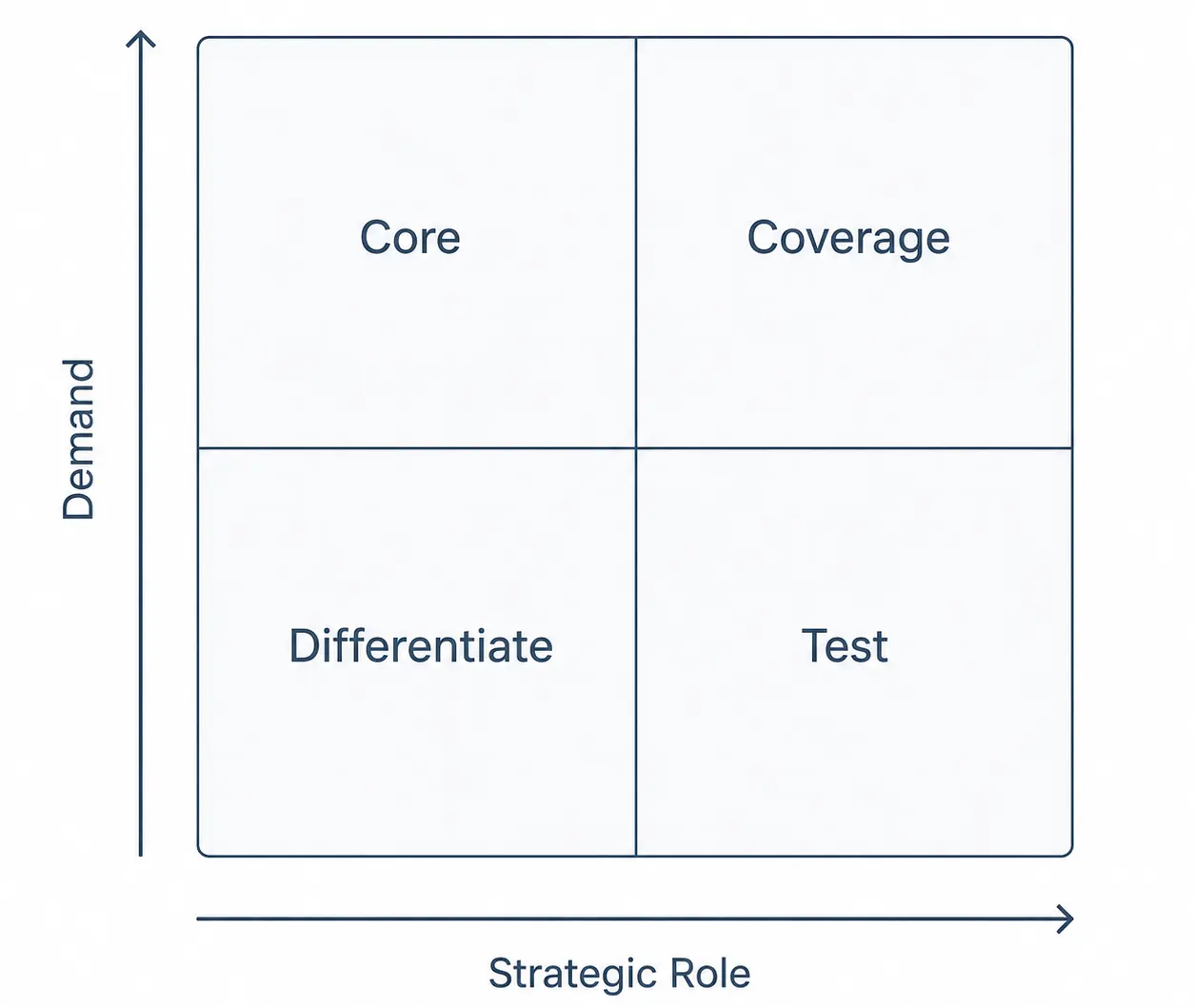
The matrix should be used as a decision tool rather than a sales chart.
Products with strong demand and a clear recurring purpose belong in Core.
Products that improve useful prescription availability belong in Coverage.
Products with a distinct commercial story belong in Differentiate, even when their total sales volume is lower than the core range.
Products with unverified demand belong in Test until sales, channel response, and repeat-order evidence become available.
The matrix prevents every product from being judged only by total sales.
A differentiation product may deserve a place without deserving deep inventory. A coverage product may remain commercially important even when it moves more slowly than common prescriptions.
The relevant question is not simply:
How much did this product sell?
It is:
What role does this product perform, and does the evidence justify keeping it in that role?
Review the Portfolio as a System
A prescription clear lens portfolio should not be reviewed product by product in isolation.
A distributor may have several individually reasonable products but still operate an unreliable portfolio because the ranges overlap, important powers remain unavailable, or inventory is allocated to the wrong places.
A regular review should examine five areas.
1. Core product strength
Confirm that the core range still supports the main channel and recurring customer demand.
Review:
- Important power availability
- Repeat-order consistency
- Product information stability
- Sales concentration
- Replenishment timing
A product should not remain “core” only because it was part of the original order.
2. Prescription coverage
Check whether the range can complete normal orders, not merely whether many powers appear in the catalog.
Look for:
- Frequently missing prescriptions
- Slow powers held too deeply
- Coverage split unnecessarily across similar products
- Product pages or sales materials showing unavailable options
This is where total inventory can be misleading. The distributor may hold plenty of units while lacking the combinations needed to complete ordinary orders.
3. Product-role overlap
Review whether two or more products are serving the same buyer, the same channel, and the same commercial purpose.
Overlap is justified only when it provides a clear operational benefit, such as:
- Better prescription coverage
- A different replacement-cycle option
- A credible differentiation feature
- A practical alternative during supply disruption
Without a defined benefit, overlapping products divide sales and weaken inventory depth.
4. Documentation and product consistency
Confirm that specifications, packaging, and supporting documents remain connected to the products being sold.
The review should identify:
- Changed product names
- Updated packaging
- Revised specifications
- Expired or replaced documents
- Missing market-specific information
- Differences between current stock and current product materials
Documentation should be treated as part of portfolio maintenance, not as a one-time task completed before the first order.
5. Test-product decisions
Every test product should eventually move into a clearer role.
After the agreed review period, decide whether to:
- Expand it
- Keep it selectively
- Reposition it
- Stop regular reordering
New products should not be added continuously while old test inventory remains unresolved.
A disciplined portfolio improves by replacing weak assumptions with real evidence.
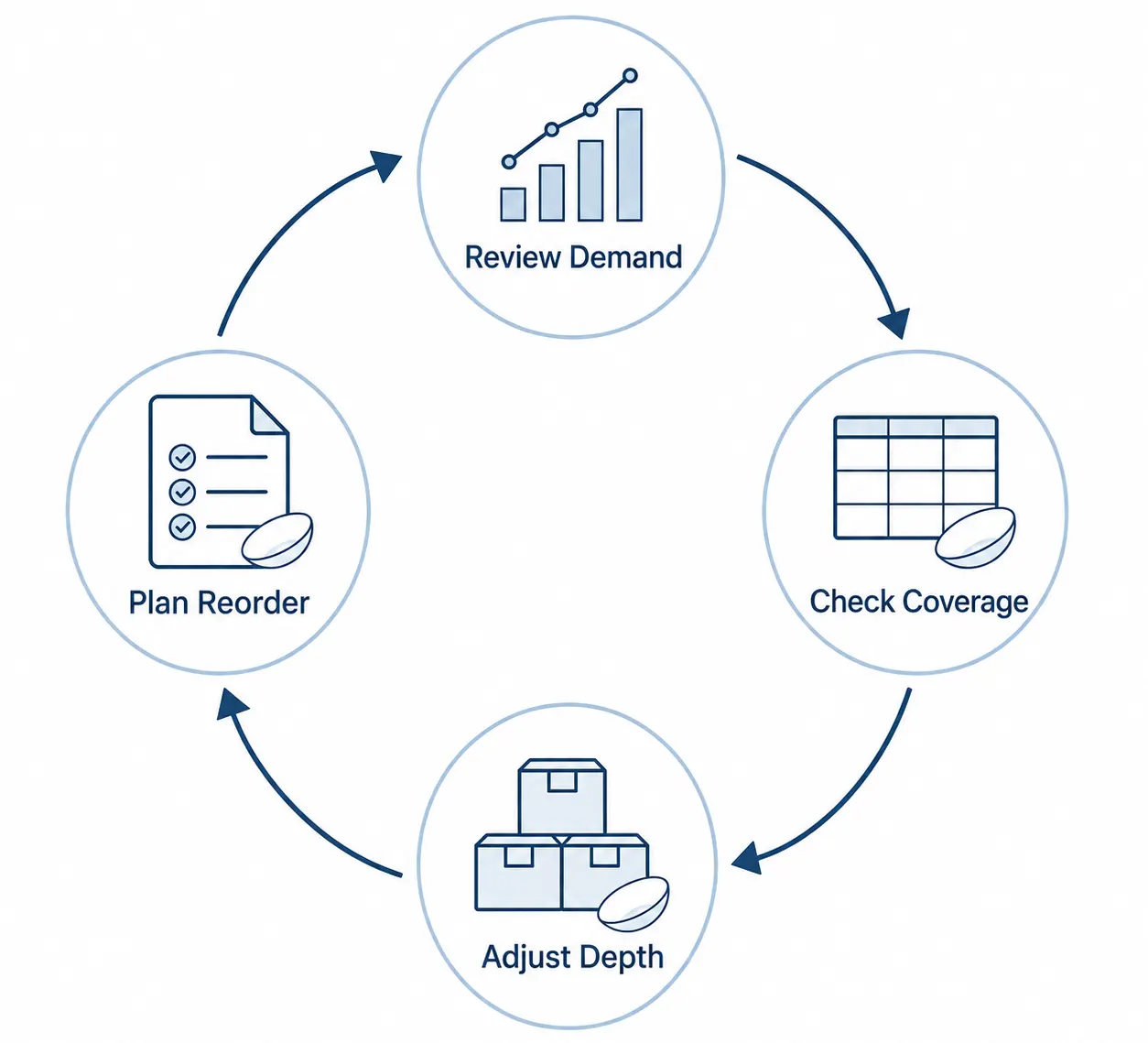
The purpose of this cycle is to show that portfolio planning is not completed after the first order.
A useful operating cycle is:
Review demand → Check coverage → Adjust depth → Plan reorder
Each cycle should make the portfolio more accurate.
The distributor learns which products deserve more support, which powers require deeper stock, which products should remain selective, and which ranges no longer justify routine replenishment.
Warning Signs of an Unreliable Portfolio
A portfolio may need restructuring when it shows several of the following signs.
Too many products serving the same role
The range contains multiple products with similar specifications, similar positioning, and no clear reason for buyers to choose between them.
This often creates divided sales and shallow stock depth.
Repeated shortages in core powers
Commonly requested prescriptions are unavailable during several sales or reorder cycles.
This is a stronger warning than low stock in a test product because it affects the dependable part of the portfolio.
Equal stock across all prescriptions
Every power receives the same quantity despite clear differences in demand.
The purchase order may look balanced, but the inventory is unlikely to behave that way after selling begins.
No clear differentiation product
The portfolio may be operationally complete but commercially difficult to distinguish.
This does not mean the distributor needs a large number of unusual products. It means at least one part of the range should offer a credible, explainable reason for professional buyers to pay attention.
Product documents cannot be matched confidently
Specifications, packaging details, or supporting documents cannot be connected clearly to the current products.
This creates avoidable risk for the distributor and its downstream customers.
New products are added without reducing weak inventory
The portfolio continues growing while low-performing products remain unresolved.
More choice does not correct poor inventory allocation. It usually makes the problem harder to see.
None of these signs automatically means the entire clear lens range has failed.
They indicate that the distributor should pause expansion, review the current structure, and correct the weakest points before adding more SKUs.
Build the Portfolio Around Repeat Distribution
The strongest prescription clear contact lens portfolio is not the one with the most products.
It is the one that can:
- Cover recurring prescription demand
- Remain understandable to professional buyers
- Maintain useful stock availability
- Support consistent product information
- Provide a clear point of differentiation
- Continue through reliable repeat purchasing
Building that kind of portfolio requires discipline rather than simply expanding the product range.
Distributors should know which products form the foundation of the business, which products extend prescription coverage, which products provide meaningful differentiation, and which products are still being evaluated.
The portfolio should become more accurate after every sales cycle.
Products that consistently support repeat orders deserve stronger inventory commitment. Products that fill important prescription gaps should remain available without becoming overstocked. Differentiation products should be judged by the commercial role they perform—not only by total sales volume. Test products should eventually lead to a clear decision.
A reliable portfolio is never static.
It improves through continuous review.
Demand shows where the portfolio is strong.
Stock gaps show where it is weak.
Repeat orders show whether it can support a sustainable distribution business.
Before discussing a new or expanded prescription clear lens range, prepare the following information:
- Destination market
- Primary sales channel
- Current clear lens portfolio
- Required prescription coverage
- Preferred replacement cycle
- Expected order structure
- Documentation requirements
- Known replenishment challenges
This information creates a much more productive discussion than simply requesting a complete catalog or a general wholesale price list.
It allows both the distributor and supplier to review:
- Which product should anchor the portfolio
- Where prescription coverage should be expanded
- Which products overlap unnecessarily
- Where a differentiated product such as a Vitamin B12 clear lens can add value
- Which specifications and documents require confirmation
- Whether repeat-order availability supports the intended market
For distributors considering Vitamin B12 clear lenses, the same principle applies.
B12 should not be introduced simply because it is different. It should occupy a clearly defined role within the portfolio and be supported by accurate product information, appropriate prescription coverage, relevant documentation, and a dependable replenishment strategy.
The objective is not to build the largest portfolio.
It is to build one that distributors—and their customers—can rely on year after year.
Plan a Reliable Prescription Clear Lens Range
Every distribution business serves a different market, customer group, and prescription profile.
Instead of expanding product lines without a clear structure, begin by defining the role each product should perform and the level of prescription coverage your customers actually require.
The Mislens team can help review:
- Current prescription clear lens options
- Product positioning within the portfolio
- Prescription coverage planning
- Vitamin B12 product integration
- Available product specifications
- Product documentation
- Repeat-order planning
- Market-specific product suitability
Product availability and supporting documentation should always be confirmed for the specific products and destination markets being discussed.