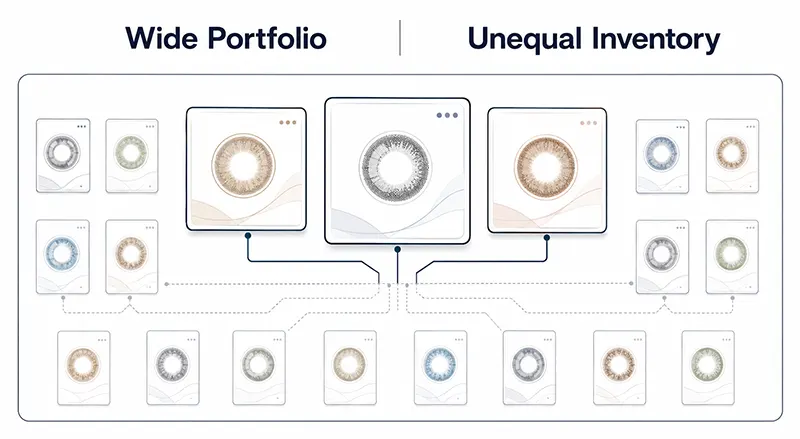
A contact lens distributor can carry a broad product range and still have an inefficient inventory structure.
The problem is often not the number of products. It is that too much working capital is spread too evenly across them.
Some SKUs are proven repeat sellers. Some are needed to keep a prescription range commercially useful. Others differentiate the portfolio or are still being tested.
All may deserve to remain available.
They do not all deserve the same stock depth.
That creates an important distinction:
A portfolio decision asks whether a SKU should remain available.
An inventory-depth decision asks how much working capital that SKU should receive.
A good SKU is not automatically a deep-stock SKU.
Inventory depth should be earned—not assumed.
Start with Why the SKU Exists
Before looking at sales volume, define the job the SKU performs in the portfolio.
This prevents every product from being judged by the same metric.
A core seller earns attention because it generates repeat demand and creates a meaningful cost when unavailable.
A coverage SKU may sell less but still be necessary to support a practical prescription range.
A differentiation SKU gives the portfolio a reason to exist beyond a generic assortment. That may come from product concept, replacement cycle, material positioning, or a differentiated clear-lens option such as Vitamin B12.
A test SKU exists because the business is still collecting evidence.
The mistake is assuming that product importance automatically equals deep stock.
It does not.
Product role explains why the SKU matters.
The next question is whether the evidence justifies putting more capital behind it.
For buyers still deciding what should be in the assortment in the first place, The First 20 SKUs: A Smarter Way to Start Selling Colored Contacts addresses that earlier decision.
What Actually Earns Deeper Inventory?
The easiest answer is sales volume.
It is also incomplete.
A SKU may sell strongly for one month because of a promotion, a large one-off customer, or a short period of unusually high attention.
The more useful question is:
Does this SKU move consistently enough to justify capital sitting behind it?
Consistency Matters More Than a Sales Spike
Consider two products.
SKU A sells 80 units during one campaign.
SKU B sells 35 to 40 units every month for six months.
If you are choosing which product had the stronger peak, SKU A wins.
If you are deciding which product deserves deeper stock for the next several reorder cycles, SKU B may be the safer commitment.
Useful signals include:
- repeated sales over multiple periods;
- successful reorder cycles;
- recurring stockouts;
- stable demand outside discounting;
- consistent performance in the intended channel.
A temporary spike may justify another order.
It does not automatically justify permanent depth.
Consistency earns depth.
Deep inventory is ultimately a bet that demand will continue.
Prescription Coverage Can Make a Lower-Volume SKU More Important Than It Looks
Prescription products make inventory decisions more complicated.
For powered clear lenses and powered colored lenses, the product family is only one part of the inventory structure. The available prescription range matters too.
A lower-volume power may still be necessary to maintain a credible product line.
This is why:
Low volume and low importance are not the same thing.
Common powers may justify deeper stock because the cost of being unavailable is higher.
Less frequently requested powers may only need enough coverage to keep the range commercially useful.
The objective is not equal stock across every prescription.
It is reliable coverage where customers and downstream buyers expect it.
A catalog can look complete while still being difficult to sell if key powers repeatedly disappear.
For a broader discussion of this issue, see How to Build a Reliable Prescription Clear Contact Lens Portfolio for Distribution.
Here, the inventory lesson is simple:
Prescription coverage should influence depth, not just whether the SKU exists.
Replacement Behavior Changes the Rhythm of Inventory
Replacement cycle also affects how inventory moves.
Daily, monthly, and longer replacement-cycle products can generate different repurchase patterns and distributor reorder rhythms.
That does not mean one replacement cycle always deserves deeper stock.
The relevant question is:
How predictably does this product move through the channel?
A slower-moving product with reliable repeat demand can sometimes be easier to plan than a faster-moving product driven by irregular campaigns.
And demand is only one side of the decision.
Supply can change the answer.
Supply Reliability Changes How Much Stock You Need
Two products with similar demand may require different stock depth if one can be replenished reliably and the other cannot.
Useful considerations include:
- repeat-order availability;
- lead-time consistency;
- stable product specifications;
- packaging continuity;
- documentation consistency where relevant;
- visibility into future supply.
Reliable replenishment gives distributors more flexibility.
It can reduce the need to use excess inventory as insurance.
Unreliable replenishment often creates the opposite behavior. Buyers begin holding extra stock simply because they do not trust the next order to arrive predictably.
That can be reasonable for a short period.
It is a poor long-term operating model.
Deep stock should compensate for real demand and replenishment risk—not supplier uncertainty forever.
If a SKU needs permanent overstock simply because future supply cannot be trusted, the problem may be larger than the inventory plan.
It may be the supplier relationship, the product line, or the decision to treat that SKU as core inventory at all.
Turn the Evidence into Three Inventory Levels
Once commercial role, demand, prescription coverage, and supply conditions are understood, most SKUs can be managed under three broad inventory policies.
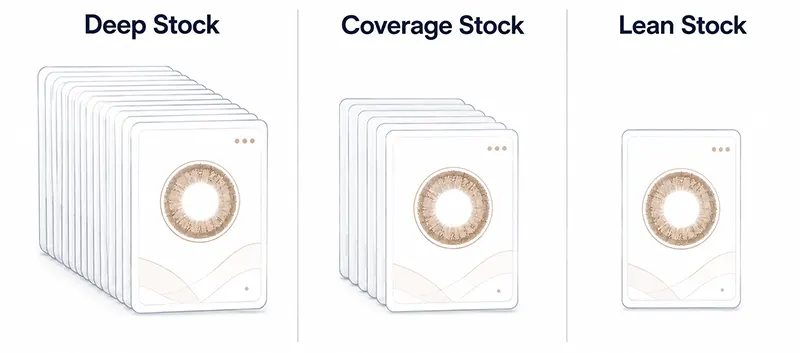
| Inventory Level | Best Fit |
|---|---|
| Deep Stock | Proven products with strong evidence and meaningful stockout cost |
| Coverage Stock | Important supporting SKUs that need availability without maximum depth |
| Lean / Test Stock | New, niche, uncertain, or still-unproven products |
Deep Stock
Deep stock is appropriate when several signals line up.
The SKU has a clear commercial role.
Demand has repeated long enough to be credible.
Stockouts create meaningful lost sales or weaken an important prescription range.
And future demand is predictable enough that additional stock is more likely to support sales than become trapped capital.
Deep stock does not mean buying as much as possible.
It means the SKU deserves a larger share of available working capital.
Coverage Stock
Coverage stock is for products that matter without needing the same depth as core sellers.
This may include:
- supporting prescription powers;
- portfolio-completion products;
- differentiated products with moderate demand;
- SKUs serving a narrower but useful channel role.
This middle category matters.
Without it, inventory decisions easily become too binary:
Best seller = stock deeply
Everything else = reduce
That is especially risky in prescription portfolios, where lower-volume products may still support the usefulness of the entire range.
Lean or Test Stock
Lean stock is appropriate when the evidence is still developing.
That includes products that are:
- newly launched;
- niche;
- dependent on a specific channel;
- inconsistent in sales;
- strategically interesting but unproven.
Keeping these SKUs shallow is not a failure.
It is a way of learning without locking too much capital into assumptions.
Before assigning depth, ask one final question:
If this SKU slows tomorrow, how much capital becomes difficult to recover?
That forces the decision beyond unit count.
Capital exposure may depend on:
- unit cost;
- power fragmentation;
- turnover speed;
- remaining selling window;
- confidence in future repeat demand.
At that point, inventory depth becomes a return-on-capital decision, not just a stock-management decision.
That connects naturally with The Colored Contacts Distributor ROI Model: Why Most Lose Money (And How to Win).
Review Depth Before the Next Major Reorder
Inventory depth should not become a permanent label.
A test SKU can become a core seller.
A long-standing core SKU can slowly lose relevance.
Important prescription powers can shift.
Supply conditions can improve or deteriorate.
Before a meaningful reorder, ask:
What changed since the last inventory decision?
If demand became stronger, deeper stock may now be justified.
If repeat sales weakened, the old stock level may no longer make sense.
If supply became less predictable, the distributor needs to decide whether more safety stock is justified—or whether the supply problem itself needs attention.
Inventory depth should be earned repeatedly.
A practical final check is to compare:
Demand Confidence
with
Strategic Value
A SKU with high demand confidence and high strategic value is the clearest candidate to deepen.
A SKU with strong strategic value but weaker demand evidence may deserve coverage rather than depth.
A product with weak demand and limited strategic importance should usually remain lean or be reduced.
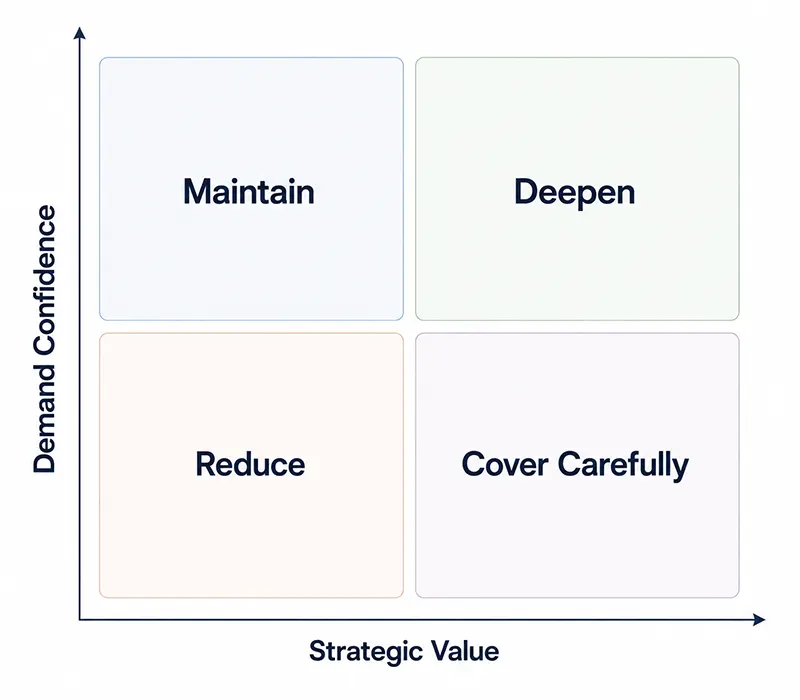
This is not a rigid formula.
Its purpose is to stop one-dimensional decisions such as:
“It sold well, so buy more.”
or:
“It sells slowly, so remove it.”
Both can be wrong.
When Inventory Complexity Becomes a Portfolio Problem
Inventory management becomes a broader portfolio issue when:
- the number of active SKUs keeps growing;
- prescription ranges become difficult to manage;
- slow stock absorbs meaningful capital;
- core products still stock out;
- reorder decisions are mostly based on habit;
- nobody can explain why certain products receive deeper inventory.
At that point, another purchase order is not the only decision that matters.
The distributor may need to review the structure of the portfolio itself.
For businesses managing colored lenses, powered clear lenses, or differentiated Vitamin B12 clear lens lines, Mislens can support discussions around product information, portfolio fit, and branded distribution options for professional channels in Europe, North America, and the Middle East.
Inventory Depth Should Be Earned
A SKU deserves deeper inventory when its commercial role, demand evidence, coverage value, and supply conditions justify the capital behind it.
A best seller is not automatically a deep-stock SKU.
A lower-volume SKU is not automatically unimportant.
And a broad catalog does not require equal inventory behind every product.
A stronger inventory system is one where different SKUs receive different levels of commitment for clear commercial reasons.
Discuss Your Distribution Portfolio
Managing a growing contact lens portfolio?
Tell the Mislens team your target market, sales channel, product types, and current inventory challenges to discuss relevant product information and branded distribution options.