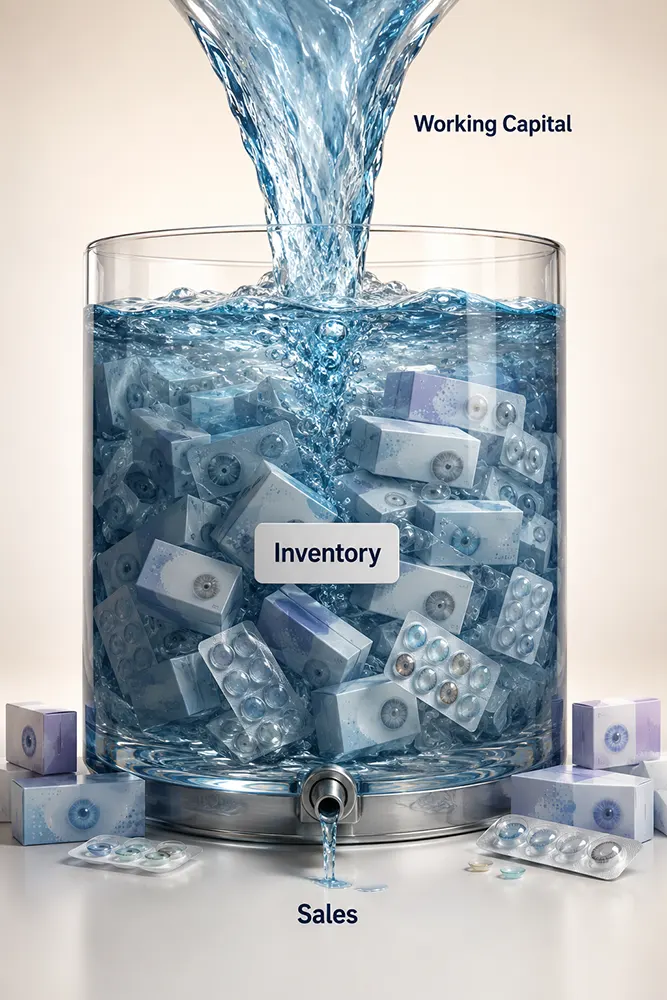
A colored contact lens SKU can still be selling and already be an inventory problem.
Imagine a style that sells four pairs per month. It still appears in orders, so there is little reason to call it dead stock.
Now add one more number: 80 pairs remain in inventory.
At the current sales rate, that is roughly 20 months of stock.
The product is active. The capital behind it may no longer be healthy.
That distinction matters because dead stock rarely appears suddenly. More often, demand weakens while the business continues carrying inventory based on assumptions that were true months earlier.
For a distributor, the useful question is not simply:
Does this SKU still sell?
It is:
Does future inventory behind this SKU still make commercial sense?
The earlier that question is asked, the more options remain. Stock can be kept lean, replenishment can be reduced, inventory can sometimes be shifted toward stronger channels, or the SKU can simply be allowed to sell through without another order.
Once a product is obviously dead stock, those choices are much narrower.
Start with Stock Coverage, Not the Number of Units Left
Thirty pairs in a warehouse can mean very different things.
Consider two products:
| SKU | Inventory | Average Monthly Sales | Approx. Stock Coverage |
|---|---|---|---|
| SKU A | 30 pairs | 15 pairs | 2 months |
| SKU B | 30 pairs | 3 pairs | 10 months |
The physical inventory is identical. The exposure is not.
A simple way to frame the difference is:
Stock Coverage = Current Inventory ÷ Average Sales Rate
The calculation is less important than the question behind it:
If demand continues at roughly its current pace, how long will this stock remain in the business?
Deep inventory can make sense for a proven core style, especially when replenishment is slower or the product serves an important account.
But depth should be supported by demand.
When a trend-sensitive color, overlapping design, or highly specific style is carrying many months of inventory, it deserves a closer look—even if it still sells occasionally.
Stock coverage tells you where to investigate. It does not tell you what action to take.
For that, the signals around the SKU matter more.
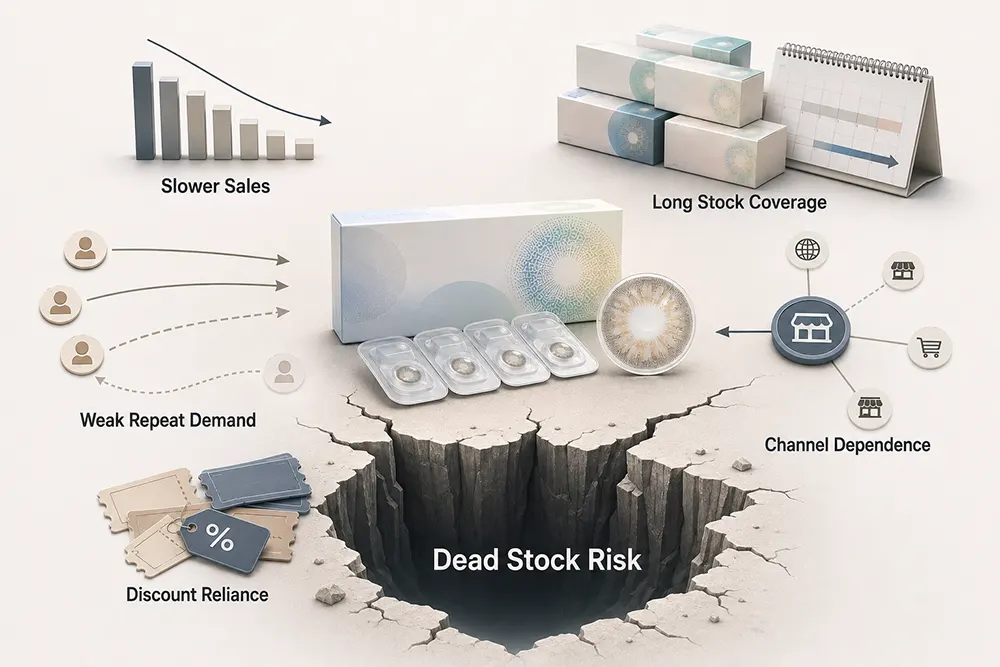
Dead Stock Risk Builds When Several Signals Move Together
A slow month is not enough evidence.
Neither is one large stock position, one promotion, or one customer accounting for a high share of sales.
Risk becomes more meaningful when several indicators start pointing in the same direction.
Sales Velocity Is Losing Momentum
A lens may move from:
12 pairs per month → 8 → 5 → 3
It remains active throughout that entire decline.
The problem is that inventory decisions may still be based on the earlier sales level.
A specialist lens that has always sold three pairs per month can be perfectly manageable if stocked accordingly. A formerly strong SKU falling from twelve to three deserves much more attention.
The issue is not simply low sales.
It is whether current demand still supports the stock assumptions already attached to the SKU.
Stock Coverage Is Expanding
This is where declining velocity becomes more expensive.
If sales slow but replenishment habits remain unchanged, a distributor can move quietly from two months of inventory to four, six, or nine.
Nothing dramatic happens.
Orders still arrive. The product still appears active. The warehouse still looks normal.
But every month of extra coverage represents capital that is taking longer to return.
That is usually the point where a slow seller starts becoming an inventory problem rather than merely a low-volume SKU.
Repeat Demand Never Becomes Convincing
Some colored contact lenses launch well because they are new, visually striking, promoted heavily, or featured by a seller with strong reach.
That first burst proves that the product can attract attention.
It does not prove that buyers will return.
For a distributor, repeat purchasing is usually the stronger signal.
A useful question is:
After the launch period, are stores, resellers, or customers coming back for this SKU?
If each new wave of sales requires another campaign, another influencer, or another discount, the product may have less durable demand than its total sales suggest.
One Channel Is Doing Most of the Work
A SKU sells 40 pairs per month.
That sounds healthy.
Now suppose 32 of those pairs come from one reseller.
The product may still deserve inventory, especially if that account is important. But the distributor should understand the concentration risk.
If that buyer reduces its order, switches focus, or disappears, the apparent strength of the SKU changes immediately.
That is the difference between:
Broad Demand
and
Channel-Dependent Demand
Both can support sales. They should not always support the same inventory policy.
The Product Needs More Help to Keep Moving
Promotions are normal.
Permanent dependence on them is not the same thing.
If a SKU increasingly needs markdowns, bundles, reseller incentives, free gifts, or clearance positioning simply to maintain normal turnover, the transaction count can hide weakening underlying demand.
The product still sells, but more margin and more effort are required to make those sales happen.
At that point, the warning is not the discount itself.
It is the growing dependence on the discount.
Taken together, these signals form a much clearer picture:
Slower Sales
Longer Stock Coverage
Weak Repeat Demand
Channel Dependence
Discount Reliance
→
Rising Dead Stock Risk
A Slow-Moving SKU Can Still Be Worth Keeping
This is where simple inventory rules often fail.
Not every low-volume SKU is a bad SKU.
Some products serve a smaller but valuable customer segment. Others provide visual differentiation, support a key retail account, or fill a role that would otherwise leave the assortment incomplete.
So the distributor needs to separate two questions:
How efficiently is this SKU using inventory?
and
Why is this SKU in the portfolio?
Those answers can lead to very different decisions.
| Situation | Likely Inventory Response |
| Strong demand + important role | Maintain or deepen |
| Low demand + important role | Keep lean coverage |
| Weakening demand + unclear role | Reduce |
| Weak demand + no role + excess stock | Exit candidate |
The second case is often overlooked.
A specialist style may deserve to remain available without deserving deep stock.
That is a very different decision from either “keep everything” or “remove every slow seller.”
Portfolio role and inventory depth should not be treated as the same thing.
A product can justify shelf space, catalog space, and commercial availability while still receiving only limited working capital.
Turn the Diagnosis into a Reorder Decision
One of the easiest mistakes is to treat low stock as an automatic reorder signal.
Suppose a SKU started with 20 pairs and now has five left.
That sounds like a replenishment opportunity.
But if those 15 pairs took nine months to sell, ordering another 20 may simply recreate the same problem.
Before replenishing, review the current reality:
- recent sales velocity;
- current stock coverage;
- repeat demand;
- the product's role in the range;
- substitute SKUs;
- replenishment flexibility.
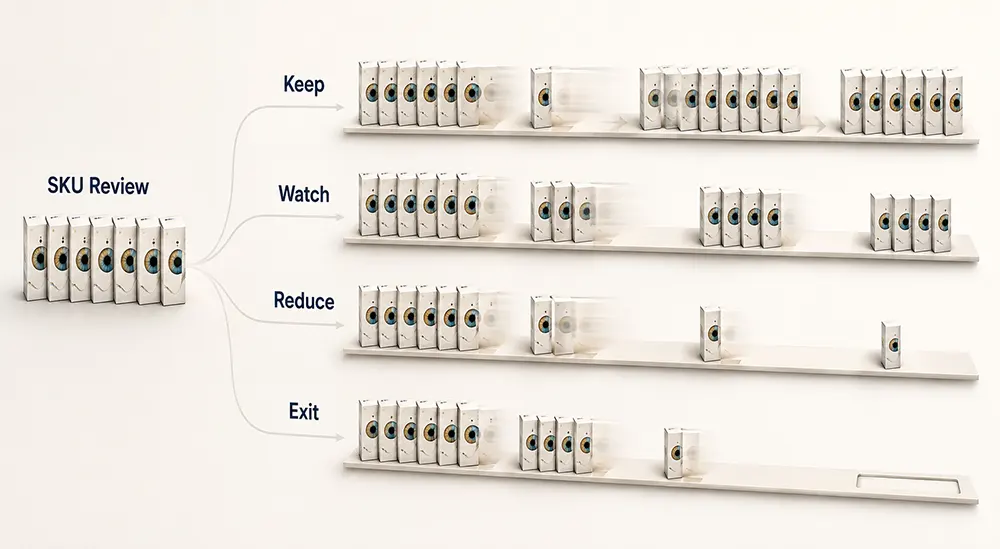
The decision then becomes more useful if it has four possible outcomes rather than only “reorder” or “discontinue.”
Keep
Use this for SKUs with healthy demand, reasonable coverage, visible repeat purchasing, and a clear commercial role.
They are doing what inventory is supposed to do.
Watch
A watch SKU has early signs of weakness, but not enough evidence for a stronger action.
The right move may simply be to avoid deepening stock and review the product again after another sales cycle.
Not every temporary slowdown needs a permanent decision.
Reduce
Reduction makes sense when weak demand and excessive coverage continue.
This may mean smaller replenishment quantities, fewer units per SKU, less power or color depth, or inventory being concentrated in the channels where demand still exists.
The objective is not to punish the product.
It is to stop adding capital faster than demand can absorb it.
Exit
An exit candidate usually shows several weaknesses at once.
Demand is persistently soft. Coverage is long. Repeat purchases are limited. Promotion dependence is rising. The product no longer adds enough strategic value to justify another reorder.
In that case, the better decision may simply be to stop replenishing and let remaining inventory sell through over time.
That is different from panic clearance.
Early diagnosis creates options. Late diagnosis often leaves only discounting.
This is also the inverse of another inventory question: which contact lens SKUs deserve deeper inventory?
Strong products compete for more capital.
Weakening products need to prove that they still deserve any new capital at all.
Sometimes Several Similar SKUs Are Splitting the Same Demand
A distributor may review four products and find that none looks bad enough to remove.
Yet the group as a whole may still be inefficient.
Imagine four natural brown lenses with similar visual effects, similar pricing, and similar customer roles.
Each generates moderate sales.
None is obviously dead stock.
But all four may be dividing essentially the same demand.
Instead of one or two SKUs turning quickly, the business is carrying four separate inventory positions.
That can lower sales velocity per SKU and increase the total amount of capital sitting behind one customer need.
Sometimes the problem is not one weak product.
It is too many similar products doing the same job.
A slow-moving SKU should therefore be reviewed not only on its own, but also against nearby substitutes in the portfolio.
That question deserves a deeper analysis of its own. For this review, the important point is simply that internal SKU competition can make otherwise reasonable products look slower—and make the combined inventory position much heavier than it needs to be.
Dead Stock Is a Late Description of an Earlier Capital Problem
By the time a product reaches zero sales, the interesting inventory decision was usually made much earlier.
The better question is not whether a SKU has completely stopped moving.
It is whether another reorder still deserves working capital.
Some slow sellers should remain available with lean stock. Some need another sales cycle before a decision. Others should simply stop receiving new inventory.
That is why an active SKU should not automatically be treated as a healthy one.
The goal is not to eliminate slow sellers. It is to recognize when slow movement has become poor capital allocation.
Review Your Next Wholesale Order with Mislens
If you are reviewing which colored contact lens styles should remain in your next order, low stock should not be the only trigger.
Demand pattern, channel concentration, existing substitutes, replenishment flexibility, and the role of each SKU all affect how much inventory makes sense.
When reviewing a wholesale catalog, it is useful to ask not only which styles are available, but also which products can be replenished in a way that matches the inventory depth your business actually needs.
Mislens works with distributors, wholesalers, optical retailers, beauty channels, and qualified ecommerce buyers. Share your destination market, sales channel, current assortment, and purchasing plan with our team to discuss suitable branded lens ranges and a wholesale approach built around your actual inventory needs.