Most physical store owners approach their inventory with the wrong question.
They ask, "What percentage of my stock should be cosplay lenses?"
That sounds logical, but it misses the real issue. The real issue is treating both types of lenses as the same category of retail product. They are not.
Once you understand that natural and cosplay lenses do entirely different jobs for your business—and require entirely different SKU strategies—everything about your buying strategy changes.
The Quick Answer for Retailers
Finding the right colored contacts inventory ratio is the secret to running a profitable contact lens store. While the standard industry ratio sits around 80:20 (Natural to Cosplay), the perfect balance depends entirely on your foot traffic, prescription distribution, and cash flow needs. A smart contact lens retail store balances natural daily wearers with eye-catching theatrical styles to maximize both customer retention and store walk-ins.
1. The Two Different "Jobs" of Your Contact Lens Inventory
Products do not just sit on shelves. They work for you.
Dead stock isn’t just lost money; it is lost shelf space for a winning product.
To avoid dead stock, you have to assign your inventory the correct job.
Natural Lenses (The Rent Payers)
Natural lenses are the foundation of your business. Customers buy these to slightly enhance their everyday look.
That matters because they wear them to the office, to school, and on dates.
The result? High lifetime value. When a customer finds a natural hazel or gray lens they love, they buy it every single month. They might look boring in a window display, but they pay the rent.
Cosplay / Dramatic Lenses (The Attention Grabbers)
Cosplay and dramatic lenses are your marketing budget.
People don’t buy cosplay lenses to see better. They buy them to be seen.
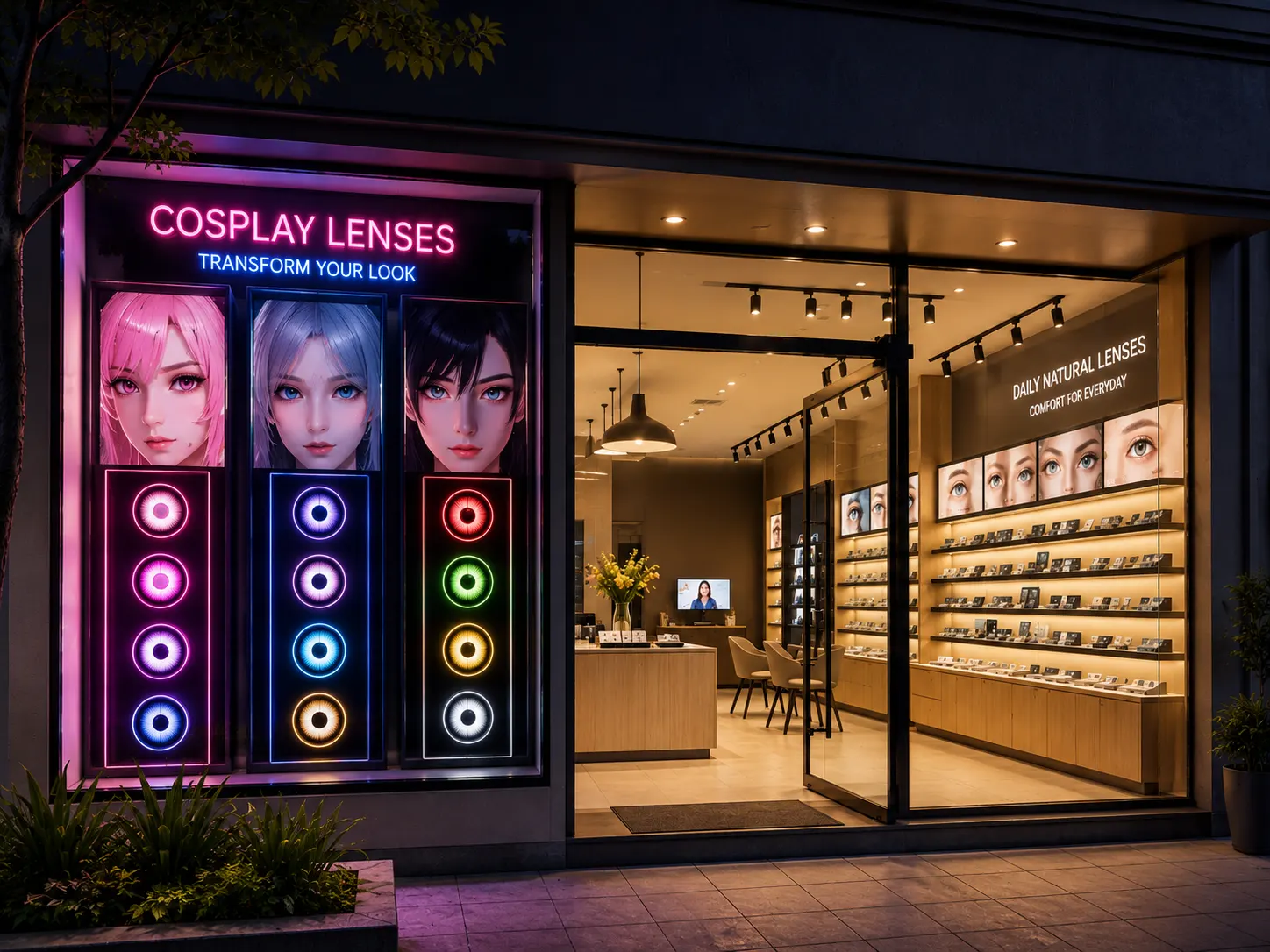
You put these in your storefront window. They are the bright red, pure white, and neon purple designs that make pedestrians stop, look, and walk inside.
Even if that customer ends up buying a natural brown lens instead, the dramatic lens did its job: customer acquisition.
2. The Hidden SKU Trap: Prescription vs. Plano
This is where most independent optical stores lose their money.
When you buy 10 styles of Natural lenses and 10 styles of Cosplay lenses, you are not buying an equal amount of stock.
-
The Natural Reality: Natural lens buyers actually need to see. You must stock a deep range of prescriptions (from 0.00 down to -8.00). One natural style might require 20 different SKUs.
-
The Cosplay Reality: Cosplay buyers prioritize the look over the vision. Often, 70% to 80% of cosplay sales are "Plano" (0.00 power).
The insight here is critical: Do not allocate your budget 50/50. If you do, your Natural lenses will constantly run out of popular prescriptions (-3.00 to -5.00), while your Cosplay prescription boxes collect dust.
Allocate broad SKU depth to Natural, and narrow SKU depth (mostly 0.00) to Cosplay.
3. Cash Flow Velocity vs. High-Margin Spikes
Smart retailers do not just measure shelf space; they measure time.
-
Cash Flow Velocity (Natural Lenses): Natural lenses have a fast turnover rate. They move every 30 days. They provide the steady cash flow needed to pay staff, rent, and electricity.
-
High-Margin Spikes (Cosplay Lenses): Cosplay lenses sit longer, sometimes up to 90 days. However, because they are specialty items, customers are less price-sensitive. You can command a higher profit margin per box.
A product is only premium if the customer feels the urgency. Keep your cosplay inventory lean to create a sense of scarcity, which protects your high margins.
4. The Trap of the "Industry Average" Ratio
Many optical shop inventory management guides suggest an 80/20 split.
However, blindly copying another store's inventory ratio will leave you with expired products. What works in a quiet suburb will bankrupt a store near a college campus.
Instead of guessing, match your natural lenses vs cosplay contacts ratio to your geography:
| Store Location | Recommended Ratio | Why This Works |
| College/University Town | 60% Natural / 40% Cosplay | High party, trend, and weekend event culture. Focus heavily on 0.00 power for cosplay. |
| Suburban Mall Kiosk | 80% Natural / 20% Cosplay | Heavy foot traffic from everyday wearers. Needs deep prescription availability. |
| Downtown/Fashion District | 70% Natural / 30% Cosplay | Mix of office workers and weekend trendsetters. Fast inventory turnover. |
In practice, your window display should lean heavily on the dramatic, while your backroom storage leans heavily on the natural.
A window display brings them in, but a reliable everyday lens brings them back.
5. The "Seasonal Flex" Strategy for Physical Stores
Retail is not static. Your inventory ratio should not be either.
The secret to maximizing profit is the "Seasonal Flex." In September, you must shift your ordering. Halloween and Anime conventions cause a massive spike in demand for theatrical lenses.
Move your ratio closer to 50/50 for the month of October.
Then, on November 1st, immediately drop back to your baseline. Never let seasonal enthusiasm turn into January's dead stock.
6. Staff Training: The "One of Each" Upsell
Your inventory ratio is ultimately controlled by your sales team.
The biggest missed opportunity in retail is letting a customer leave with just one type of lens.
Train your staff on the "Weekend/Weekday" upsell.
When a customer brings a Natural lens to the register, the staff should say: "These are perfect for work. We also have this striking ice-blue lens that people love for Friday nights. Want to try a box?"
This cross-selling technique balances your inventory movement without relying purely on foot traffic.
Frequently Asked Questions
What is the shelf life of colored contacts in retail?
Most unopened blister packs and vials last 3 to 5 years. However, aiming for a 3-month inventory turnover ensures optimal cash flow and guarantees you never hand a customer a dusty box.
How do I manage prescription (power) distribution for cosplay lenses?
Focus 70-80% of your cosplay inventory on Plano (0.00). For the remaining 20-30%, only stock the most common myopia ranges (usually -2.00 to -5.00).
Should I display natural or cosplay lenses in my store window?
Always use dramatic, highly pigmented cosplay lenses for window displays. They grab attention from 20 feet away. Keep the natural lenses clearly visible and well-lit once the customer steps inside.
Stop Guessing. Start Scaling.
The real issue is not choosing between natural or cosplay. It is finding the right balance of prescriptions, cash flow, and location to acquire new shoppers while keeping your regulars coming back.
If you are comparing wholesale colored contacts suppliers, the first thing you should ask about is flexibility. Can you adjust your orders based on your store's real-time traffic, or are you locked into rigid minimums?
At MISLENS, we provide retail store owners with flexible, data-backed wholesale options, so you can stock deep on what sells, stay lean on what doesn't, and never sit on dead stock again.