Prescription clear contact lenses are unusually easy to turn into a price comparison.
With colored lenses, visual differences are obvious. Buyers can compare natural brown with gray, subtle enlargement with a stronger limbal ring, or everyday styles with more expressive designs.
Clear lenses do not have that advantage.
On a quotation sheet, distributor catalog, or ecommerce listing, several products may appear almost interchangeable. They may differ in specifications, replacement cycle, prescription structure, material, or commercial role, yet none of those differences is obvious at first glance.
When buyers cannot see why one product deserves to be chosen over another, price becomes the simplest way to decide.
For optical distributors, that creates a difficult cycle. A lower quotation may help secure one order, but repeated discounting does little to strengthen retailer preference, improve repeat purchasing, or make the portfolio easier to manage.
The stronger approach is to make the product easier to understand commercially.
Prescription coverage, a clearly defined role in the portfolio, usable documentation, dependable availability, and appropriate channel presentation can all give buyers reasons to look beyond unit price.
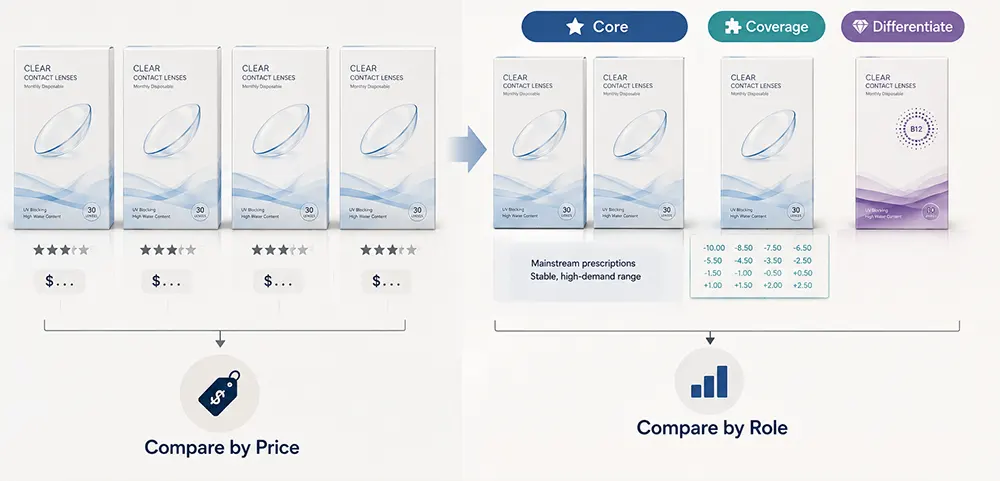
Price Competition Often Starts with Product Ambiguity
Imagine an optical distributor presenting four clear lens products.
Every catalog page contains roughly the same information:
-
Diameter
-
Base curve
-
Water content
-
Replacement cycle
-
Power range
-
Unit price
The information may be accurate and necessary. But it still leaves an important question unanswered:
Why should the buyer choose one of these products instead of another?
If the answer is unclear, the products effectively compete for the same position.
That is where price starts doing too much of the work.
Product specifications tell buyers what a lens is. Commercial positioning helps them understand why it belongs in the range.
One lens may be the portfolio's dependable core product. Another may fill a prescription or replacement-cycle gap. A third may give retailers a differentiated alternative. A newer product may deserve only a controlled test before the distributor commits more inventory.
Those products no longer need to be treated as four interchangeable quotations.
The first step toward competing beyond price is therefore surprisingly simple:
give each product a reason to exist.
Prescription Coverage Can Be a Commercial Advantage
For powered clear lenses, availability is part of the buying experience.
A specification sheet can show a broad prescription range while the actual stock situation tells a different story. What matters to the downstream buyer is whether the powers customers repeatedly request can actually be supplied.
A distributor should therefore look beyond the theoretical range and ask:
-
Which powers generate recurring demand?
-
Which prescriptions need greater stock depth?
-
Where do stockouts repeatedly occur?
-
How easily can missing powers be replenished?
-
Does current availability fit the channel being served?
Consider an optical retailer that regularly sells a particular clear lens but repeatedly finds two common prescriptions unavailable.
The lens may still have a competitive unit price. Commercially, however, the retailer now has to substitute another product, delay an order, or explain the stock gap to the customer.
That friction has value too — just in the wrong direction.
Reliable prescription coverage can therefore become part of how a distributor positions a range.
This does not require claiming that every possible prescription is always available. A more useful goal is to build reliable coverage around the demand that actually recurs.
For distributors still deciding how the overall assortment should be structured, How to Build a Reliable Prescription Clear Contact Lens Portfolio for Distribution covers the broader portfolio question.
Once that structure exists, the next challenge is making the range commercially dependable.
Give Each Clear Lens a Different Job
A distributor does not need every product to become a best seller.
It does need to know why each product is there.
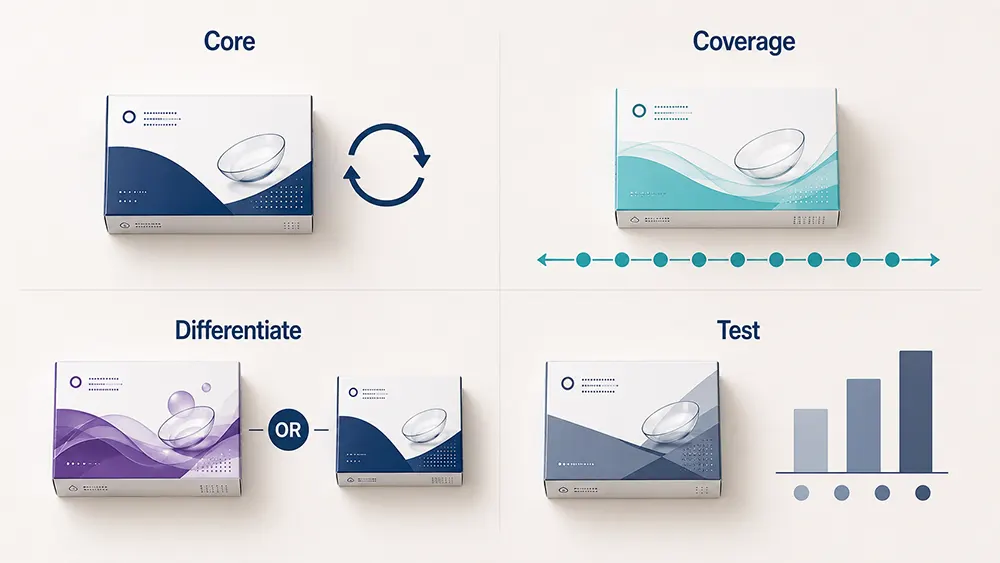
A practical internal framework is:
| Product Role | Commercial Purpose |
|---|---|
| Core | Handles recurring mainstream demand |
| Coverage | Fills an important prescription or replacement-cycle gap |
| Differentiate | Adds a meaningful alternative to the standard clear-lens range |
| Test | Allows new demand to be evaluated without premature inventory depth |
These roles do not need to appear on retail packaging. They are primarily a portfolio-management tool.
A Core product should usually be easy to understand, easy to reorder, and capable of supporting recurring demand.
A Coverage product may sell less frequently but still matter because removing it would leave a meaningful gap.
A Test product earns more inventory only after demand becomes clearer.
The Differentiate role is particularly important when clear lenses otherwise appear highly similar.
Vitamin B12 prescription clear lenses can serve as one example.
Their value in a distributor portfolio should come from their actual product characteristics and the way they differ from the core clear-lens range. They should not be presented as automatically superior to ordinary clear lenses or as a medical treatment.
That distinction matters.
A differentiated product works best when the buyer can answer:
What does this add to my existing range?
rather than simply:
Is this more expensive or cheaper?
For buyers reviewing this category specifically, Why Vitamin B12 Prescription Clear Contact Lenses Stand Out from Ordinary Clear Lenses explains the product difference, while What to Check Before Buying Vitamin B12 Clear Contact Lenses for Distribution focuses on purchasing and documentation checks.
Operational Reliability Changes How a Product Is Valued
Two clear lenses with similar specifications can create very different amounts of work downstream.
That difference often becomes visible only after the first order.
Documentation reduces friction
Suppose an optical retailer receives a new lens range and begins preparing staff materials or ecommerce listings.
The retailer needs confirmation of the replacement cycle. Then the material. Then the power range. Later, someone notices that the product page and the specification sheet show information differently.
If every question requires another email to the distributor, the product is already creating friction before it reaches the customer.
Useful documentation may include, where relevant:
-
Prescription range
-
Replacement cycle
-
Material information
-
Diameter and base curve
-
Packaging information
-
Product specifications
-
Relevant manufacturer or product documents
-
Applicable compliance documentation
The exact requirements depend on the product and destination market. One certificate or document should never be assumed to apply universally.
The commercial principle is simpler:
The easier accurate product information is to verify and use, the easier the product is to distribute professionally.
Documentation rarely gets the same attention as price during an initial quotation. Once the product moves through several downstream buyers, its value becomes much more obvious.
Availability matters after the first sale
The second operational test is replenishment.
A retailer can successfully launch a product and still lose confidence in it a few months later if important SKUs become difficult to reorder.
Repeated stock gaps may lead to:
-
Lost sales
-
Product substitution
-
Broken ecommerce listings
-
Retailer frustration
-
Fragmented inventory
-
Reduced confidence in future promotions
This is where first-order economics and long-term economics begin to separate.
A small price advantage may matter during supplier comparison. Stable replenishment matters when a retailer has already invested in selling the product.
The article How to Decide Which Contact Lens SKUs Deserve Deeper Inventory explores which SKUs justify more working capital. From a positioning perspective, the key lesson is that important products become more valuable when downstream buyers can rely on them repeatedly.
The Product Stays the Same. The Buying Question Changes by Channel
Product specifications should remain consistent across channels.
What changes is the problem the buyer needs the product to solve.
| Channel | What Matters Most |
|---|---|
| Optical Stores | Prescription coverage, clear staff explanation, specifications, repeat availability |
| Wholesale | Portfolio role, order continuity, documentation, replenishment |
| Ecommerce | Prescription clarity, listing consistency, differentiation, stock visibility |
An optical-store employee needs to explain the range without turning every customer conversation into a technical investigation.
An ecommerce customer has no employee standing beside the product page, so prescription selection and product differences need to make sense on their own.
A wholesaler has another concern: whether the product can remain commercially reliable after it has been supplied to multiple downstream accounts.
The facts have not changed.
The buying friction has.
This is why identical product presentation across every channel can weaken an otherwise useful product.
A clear lens may have a legitimate role in the range, but if its ecommerce page uses the same generic description, imagery, and claims as every competing lens, customers still have little reason to compare anything except price.
Sometimes the product is not the commodity.
The presentation makes it one.
Calling a Lens “Premium” Does Not Create Positioning
When price competition becomes uncomfortable, companies often reach for stronger adjectives.
A standard product becomes:
“premium.”
Or:
“advanced.”
The problem is that each new adjective creates another question:
Premium because of what?
If the distributor cannot answer that precisely, the language adds little commercial value.
A useful positioning statement is usually more specific.
Perhaps the product provides dependable coverage across the distributor's core prescription demand.
Perhaps it gives optical retailers a differentiated option beside a standard clear-lens range.
Perhaps the product is supported by clearer information and a more predictable repeat-order process.
Those explanations are less glamorous than the word “premium.”
They are also easier for a professional buyer to evaluate.
Positioning should clarify a decision, not decorate a product.
That principle is particularly important in professional optical channels, where exaggerated language can reduce rather than increase confidence.
Competing Beyond Price Means Giving Buyers Fewer Reasons to Hesitate
Price will always matter.
It should.
Distributors still need workable margins, and downstream buyers still need commercially sensible products.
The problem begins when price is the only part of the offer that feels concrete.
A stronger clear-lens proposition helps the buyer answer several questions quickly:
-
Why does this product belong in my range?
-
Which prescriptions can I rely on?
-
How is it different from another product I already carry?
-
Can my team obtain the information it needs?
-
What happens if the product begins selling well?
-
Will repeat ordering remain practical?
The fewer unresolved questions there are, the less pressure there is to reduce the entire decision to a single number.
This is one reason an apparently cheaper product can become expensive over time.
A few cents saved on the first order can mean very little compared with a product that is difficult to explain, regularly unavailable, or constantly creating administrative work for retailers.
The strongest clear-lens offer is often the one that creates the least uncertainty for the buyer.
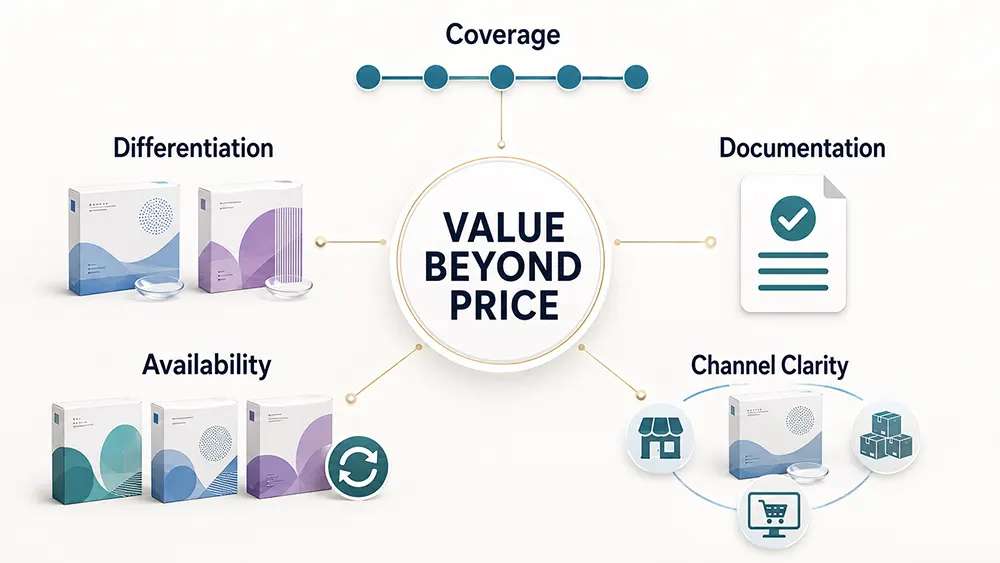
Make Clear Lenses Easier to Choose
Clear contact lenses will always face some degree of price comparison.
They look similar from a distance, and the differences that matter commercially are often less visible than they are with colored lenses.
The distributor's job is to make those differences usable.
A clear product role helps the buyer understand why the lens exists.
Practical prescription coverage reduces missed orders.
Accurate documentation makes the product easier for downstream businesses to work with.
Reliable availability supports the confidence needed to promote and reorder it.
Channel-appropriate presentation helps the relevant buyer understand the value without adding artificial claims.
Put those elements together and the commercial conversation changes.
The buyer is no longer comparing only one lens price against another.
They are comparing one operating relationship against another.
Mislens works with distributors, wholesalers, optical retailers, and professional ecommerce partners evaluating powered clear lenses and differentiated clear-lens options for their markets.
If you are reviewing an existing range or considering adding Mislens clear lenses, the most useful starting point is your actual distribution situation: market, sales channel, prescription requirements, current portfolio, and expected repeat-order pattern.
Discuss Clear Lens Distribution
Tell us the market and channel you serve, the prescription coverage you need, and how your current clear-lens portfolio is structured. We can discuss which Mislens products may fit that range and what product information is available for review.